

Picking the right food truck kitchen equipment is hands-down the most critical choice you'll make when you're starting out. This isn't just about filling space; it's about building the engine that drives your entire operation. Get it right, and your truck will be a smooth, efficient, money-making machine that can handle any lunch rush. Get it wrong, and you're in for a world of frustration. This guide is all about getting you geared up for success right here in the competitive Las Vegas market.
Building Your Las Vegas Food Truck Dream Machine
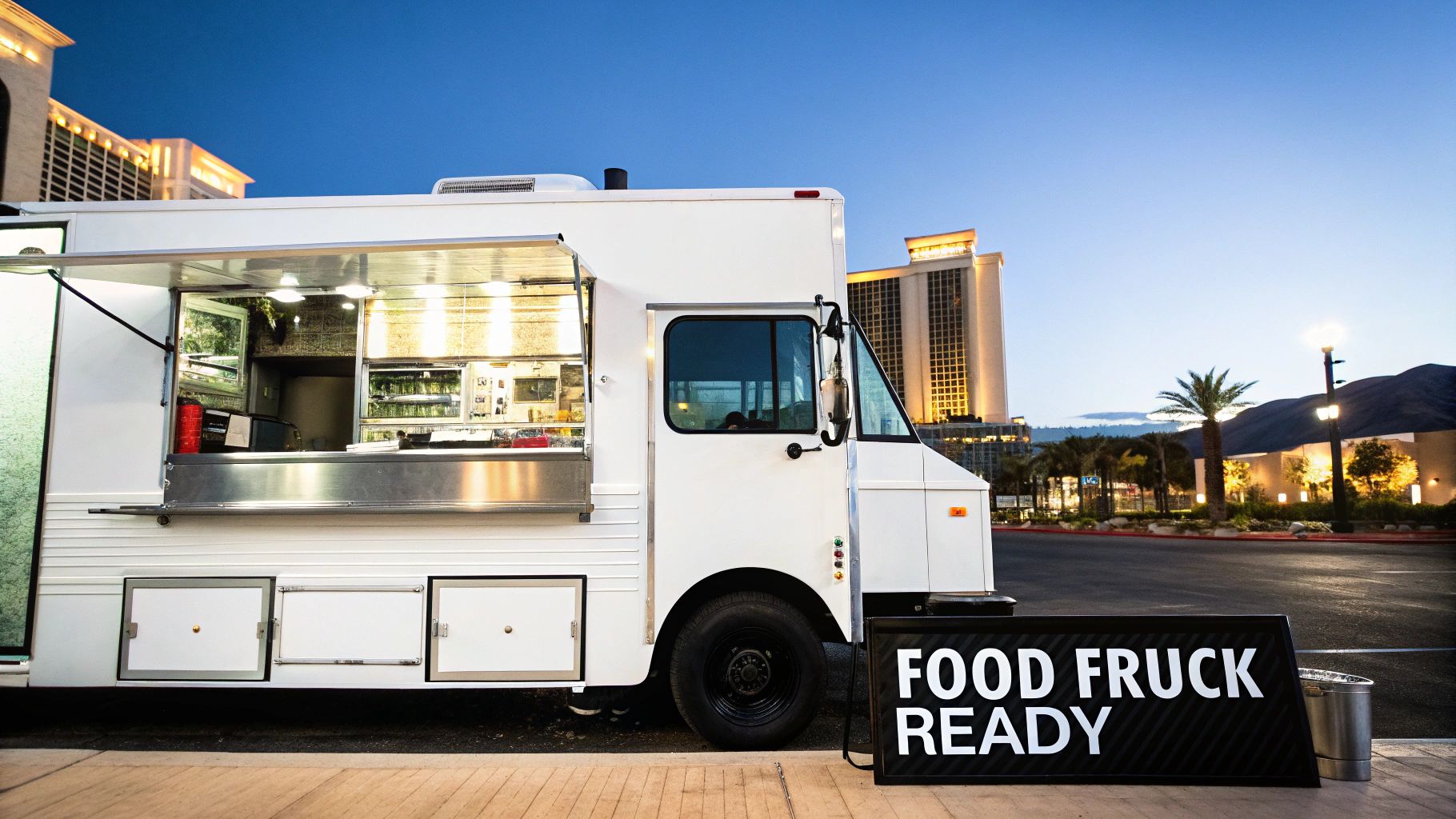
Welcome to the Las Vegas food scene. It's a wild, vibrant place where you'll find a diverse array of restaurants that cater to every palate, and food trucks are becoming just as iconic as the Strip itself. In a city that serves up everything you can imagine, there’s a massive opportunity for food truck owners to make their mark. But making it here takes more than a cool concept and a killer recipe—it requires a perfectly planned kitchen on wheels.
Putting together a food truck isn't a game of Tetris, just trying to squeeze equipment into a box. You're designing a strategic, high-octane commercial kitchen that can take our desert heat and serve massive crowds without breaking a sweat. Every single choice, from the layout to the brand of fryer, plays a part in whether you sink or swim.
Key Equipment for Vegas Success
Your journey starts with the basics, the core pieces that form the backbone of any solid food truck. The cooking line might get all the glory, but the support equipment is what really keeps you in the game, especially in a demanding place like Vegas. This is the essential restaurant equipment needed for success.
Here's what you absolutely can't skimp on:
- Commercial Refrigerators: These are the unsung heroes of your kitchen, keeping ingredients safe and fresh when it's scorching outside. Undercounter models are a lifesaver for maximizing your limited space.
- Commercial Freezers: From frozen burger patties to bags of fries, a dependable freezer means you can stock up for big events and never worry about product loss.
- Ice Machines: In the Las Vegas heat, ice isn't a bonus—it's a core part of your business and a serious profit generator. A quality ice machine is non-negotiable.
The secret to a successful food truck is reliability. Your gear has to be tough enough for the road and powerful enough to perform flawlessly when you've got a line 20 people deep. The last thing you ever want is to turn away a paying customer because your equipment failed.
From Concept to Reality
Think of this guide as your roadmap for outfitting a mobile kitchen that's built to win. We're going beyond simple checklists to dig into the why behind choosing the perfect food truck kitchen equipment. Our goal is to help you build a space that’s hyper-efficient, breezes through health inspections, and sets you up for profit from your very first service.
For a deep dive into laying out your kitchen for maximum flow, check out our comprehensive guide to food truck design. Making smart choices now is how you build a dream machine ready to take over the streets of Vegas.
Essential Refrigeration For a Desert Climate
Let's be blunt: in Las Vegas, your food truck's refrigeration isn't just a cold box—it's the heart of your entire operation. It's what stands between your inventory and the punishing desert heat, protecting every dollar you've invested in ingredients. A standard residential fridge won't just struggle; it will fail, likely on a sizzling summer afternoon right in the middle of a rush.
This is where commercial-grade, NSF-certified refrigeration becomes a non-negotiable part of your build. Think of it as a high-performance engine for your kitchen. These units are engineered to handle the constant door-swinging of a busy service and maintain safe food temperatures even when the asphalt outside is hot enough to cook on.
The numbers don't lie. The food truck industry is absolutely booming, on track to pull in an impressive $2.8 billion in revenue by 2025. With the average truck generating between $20,000 and $42,000 a month, you can't afford the catastrophic food spoilage that comes from unreliable cooling. Your bottom line depends on it.
Must-Have Refrigeration Units
Every square inch inside a food truck is prime real estate. Choosing the right food truck kitchen equipment means finding units that deliver maximum cooling power without eating up your precious workspace.
- Undercounter Refrigerators: These are the real workhorses. They slide perfectly under your prep counters, putting produce, sauces, and proteins right where you need them, without taking up an inch of your prep surface.
- Undercounter Freezers: Just as important, these give you instant access to your frozen goods—think burger patties, fries, or specialty desserts. Their compact design is a lifesaver in a tight kitchen.
- Sandwich Prep Tables: For any concept serving sandwiches, salads, or tacos, these are a total game-changer. You get a refrigerated base, a row of cold wells up top for all your toppings, and a built-in cutting board. It's an assembly line in a box that will dramatically speed up your service.
Choosing the right refrigeration isn't just about keeping things cold; it's about designing a smarter workflow. The goal is a seamless flow where your team can grab, prep, and cook without tripping over each other. That’s the secret to shorter ticket times and happy, returning customers.
To help visualize how these pieces fit together, here’s a quick comparison of the core refrigeration units you'll likely need for a Las Vegas food truck.
Food Truck Refrigeration Comparison
| Equipment Type | Primary Use Case | Key Feature for Vegas | Space Consideration |
|---|---|---|---|
| Undercounter Refrigerator | Storing fresh ingredients like produce, meats, and sauces. | High-ambient rating to handle extreme external heat. | Fits below counters, preserving valuable workspace. |
| Undercounter Freezer | Holding frozen goods like fries, proteins, or bread. | Rapid temperature recovery after door openings. | Compact footprint, essential for small layouts. |
| Sandwich/Pizza Prep Table | All-in-one station for assembling dishes quickly. | Insulated lid to protect toppings from desert sun. | Combines three functions, maximizing efficiency. |
Ultimately, this trio forms the foundation of a highly functional and heat-resistant mobile kitchen, ensuring your ingredients stay safe and your service line keeps moving.
Calculating Your Cooling Capacity
So, how much cold storage do you actually need? Your menu holds the answer. A truck slinging burgers and fries has completely different requirements than one serving gourmet salads.
Start by making a detailed list of every single refrigerated and frozen ingredient you need for a packed service. Then, estimate the volume of each. Crucially, always plan for your peak demand—that Friday night rush on Fremont Street will push your capacity to its limits. Running out of a key ingredient because you skimped on fridge space is a rookie mistake that costs you sales. It’s always smarter to have a little more cooling capacity than you think you need.
This is also the perfect time to check out our guide on energy-efficient commercial refrigeration. It’s packed with tips for picking units that can take the Vegas heat without putting too much strain on your generator.
The Importance Of a Reliable Ice Machine
In the Las Vegas food scene, an ice machine isn't just a piece of equipment; it's a profit center. When the temperature climbs, cold drinks like sodas and specialty lemonades become high-margin bestsellers. You have to be ready for that demand.
When you're shopping for an ice machine for your truck, focus on two things:
- Reliability: The constant vibration and movement of a food truck are brutal on equipment. You need a commercial-grade unit that's built like a tank and known for its durability.
- Energy and Water Efficiency: Your generator's power is finite, and water is a precious resource. A highly efficient machine will crank out the most ice possible while sipping power and water, which helps keep your operating costs in check.
A quality ice machine isn't an expense; it's an investment that pays for itself by ensuring you never miss a sale on a hot day.
Choosing Your Cooking and Preparation Powerhouses
If refrigeration is the heart of your mobile kitchen, then the cooking line is its fiery soul. This is where the magic happens—where your menu goes from an idea on paper to the delicious food that’s going to build your reputation all over Las Vegas. Picking the right food truck kitchen equipment for cooking and prep is one of the most important decisions you'll make, directly impacting how fast you can serve a crowd during a chaotic lunch rush.
Just think of your cooking equipment as a team of specialists. A taco truck is going to crush it with a big commercial griddle and a steam table. That setup would be totally wrong for a burger truck, which needs a charbroiler and a couple of deep fryers. Your menu is the blueprint; your equipment is what you build your business with.
The Great Debate: Propane vs. Electric
One of the first things you’ll have to decide is how to power that cooking line. While you might have a few smaller electric items, when it comes to the heavy-lifting, propane is almost always the undisputed champion in the food truck world.
- Propane Power: There’s a reason this is the industry standard. Propane gives you that intense, consistent heat you need for griddles, charbroilers, and fryers. It's dependable, easy to transport, and it doesn't hog all the power from your generator. That leaves precious electricity free for your refrigeration, lights, and POS system.
- Electric Power: Electric gear like induction cooktops or certain countertop ovens definitely have their place for specific jobs. They're often smaller and don't throw off as much ambient heat. But trying to run your whole main line on electric? You’d need a massive, loud, and fuel-guzzling generator, which just isn't practical for most trucks.
For any operator in Las Vegas, reliability is everything. A propane-fueled cooking line gives you raw power and freedom from the electrical grid, making it the clear winner.
Assembling Your Culinary Arsenal
Once you've settled on propane, it's time to pick the specific pieces for your production line. Every single item has to earn its spot on the truck, so you want to choose versatile, high-performance gear.
Core Cooking Equipment:
- Commercial Griddle: This might be the most flexible piece of equipment you'll ever own. A good flat-top can handle it all—pancakes and eggs for a breakfast service, burgers, cheesesteaks, and seared veggies for lunch. A 36-inch model is a popular place to start, usually running between $2,000 to $6,000.
- Commercial Charbroiler: If you want those perfect grill marks and that smoky flavor on burgers, steaks, or chicken, a charbroiler is a non-negotiable. The sight and smell of it alone is a customer magnet.
- Deep Fryers: For fries, wings, donuts, or anything that needs to be perfectly crispy, a solid countertop deep fryer is a must. Find a model with two baskets so you can double your output during a rush. These typically cost $1,500 to $4,000.
- Convection Ovens: Not every truck needs one, but a compact oven can be a game-changer for baking, roasting, or just finishing off dishes. If you need that capability but are tight on space, a countertop commercial convection oven is a smart, space-saving move.
Your cooking line is a direct reflection of your brand. A customer sees the flames from your charbroiler or hears the sizzle on your griddle, and it builds anticipation. Quality equipment not only works better but also projects a professional image that customers trust.
The Unsung Heroes of Food Prep
Let's be real: behind every great cooking line is an efficient prep station. These are the unsung heroes that make speed and consistency possible. And in a space as tight as a food truck, they’re even more important.
- Stainless Steel Work Tables: This is your command center. You need heavy-duty, NSF-certified tables. Grabbing one with an undershelf is a pro move—it gives you critical extra storage for smallwares or dry goods, letting you use your vertical space.
- Food Processors and Slicers: Trying to manually slice onions or shred cheese for a line of 100 people is a recipe for disaster. A commercial food processor or slicer can turn hours of prep work into minutes, freeing up your crew to focus on cooking and taking orders.
- Smallwares: Don't sleep on the small stuff. High-quality knives, cutting boards, food pans, and squeeze bottles are the tools your team will have in their hands all day long. Investing in durable, well-organized smallwares just makes the whole kitchen run smoother.
By taking the time to choose these cooking and prep powerhouses, you're not just buying gear—you're designing a seamless workflow. Every piece should work together, letting your team move effortlessly from prep to the cooking line to the service window, pumping out perfect orders even when the pressure is on.
Mastering Workflow In a Compact Kitchen
Let's be honest, all the best food truck kitchen equipment on the planet won't do you any good if your layout is a mess. I always tell new operators to think of their mobile kitchen like a submarine galley or an airplane cockpit. Every single inch has to have a purpose, and every move you make needs to be deliberate and efficient. A smart, ergonomic design is what separates a chaotic, slow-moving truck from a smooth, high-volume money-maker.
It all starts with creating logical zones. Your kitchen absolutely needs distinct areas for cold storage, a hot cooking line, and a separate service window. This setup keeps your team from tripping over each other, creating clear, safe paths that cut down on accidents and wasted motion. The real goal is to build a kitchen that feels totally intuitive, where everything is exactly where you expect it to be.
Designing for Speed and Efficiency
An efficient layout directly translates into faster service, and in Las Vegas, faster service means more sales. You’re aiming to shave off every possible step your team takes to get an order out the window. Those few seconds saved on each ticket really add up, easily translating to dozens of extra customers served during a hectic lunch rush.
Here are a few practical tips to build a workflow that’s lightning-fast:
- Go Vertical: Use wall-mounted shelving and racks for your ingredients, smallwares, and disposables. This keeps your precious counter space free for the actual prep and cooking.
- Keep Tools Close: Your most-used utensils, squeeze bottles, and spices should be within arm's reach of their station. There's a reason magnetic knife strips are a classic space-saver—they just work.
- Think in a Straight Line: Arrange your equipment to follow the natural flow of an order, from raw ingredient to finished product.
This visual shows the ideal linear workflow that every successful food truck should strive for.
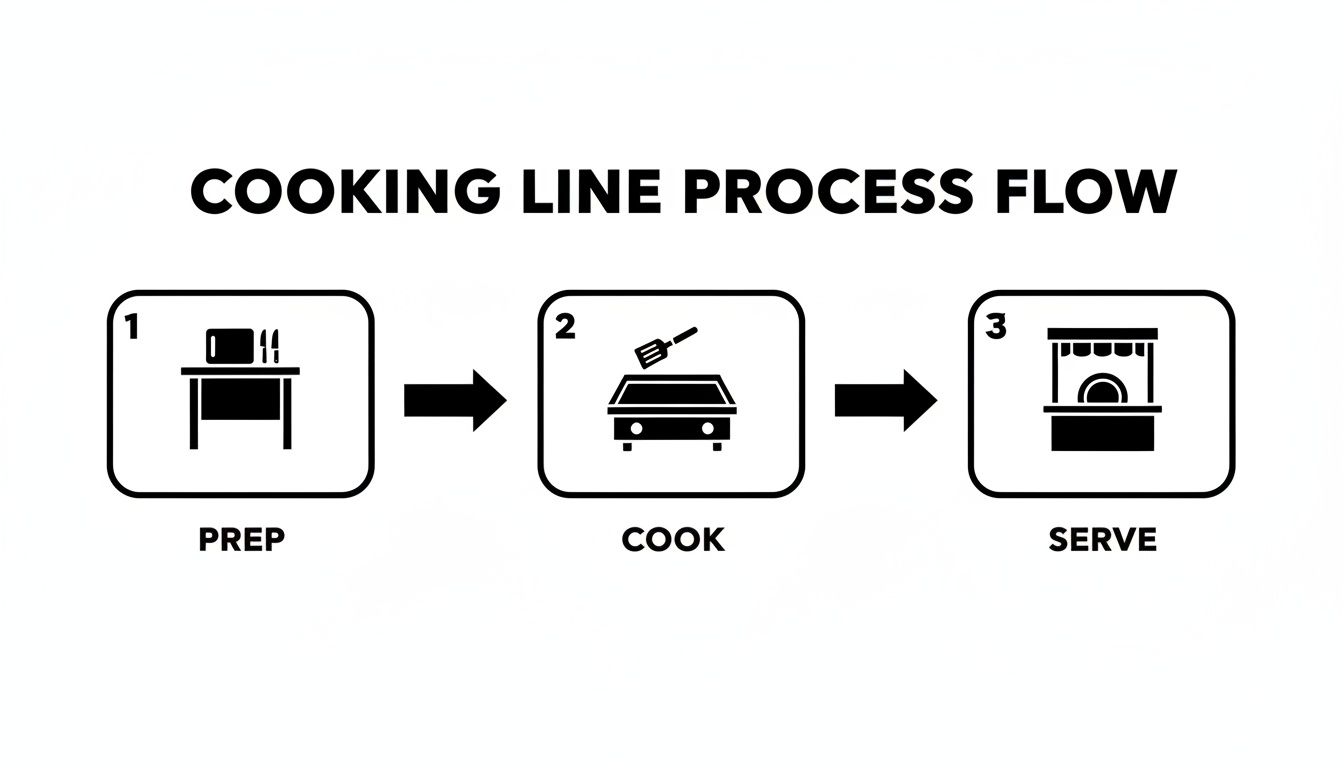
This simple Prep-Cook-Serve model keeps ingredients moving in one direction. It’s the key to preventing bottlenecks and keeping the service window clear so you can focus on your customers.
Why This Matters More Than Ever
Getting this right isn't just a local concern; it’s driven by some massive global growth. The worldwide food truck market is projected to grow by an incredible USD 2.27 billion between 2024 and 2029. All that growth means more competition, making a well-oiled kitchen more critical than ever if you want to grab your piece of the Las Vegas pie. You can get more insights on this food truck market expansion and what it means for operators.
A well-designed workflow is the invisible engine of your food truck. Customers won't see it, but they will absolutely feel it in how quickly their food is ready. It's the secret ingredient that lowers stress on your team and pushes your revenue to its full potential.
Building a kitchen that minimizes strain and maximizes output isn’t just about making things comfortable; it’s a core business strategy. When you thoughtfully plan your layout and choose the right food truck kitchen equipment to support it, you create an environment where your team can really perform. In the fast-paced world of Las Vegas street food, that efficiency is your ultimate edge.
Navigating Nevada Health Codes and Safety Compliance
Think of the Southern Nevada Health District (SNHD) as a partner in your success, not an obstacle. Their job is to ensure every food operation is safe for the public, and passing their inspection is a massive milestone for any new food truck. It all comes down to having the right food truck kitchen equipment—certified, professionally installed systems that show you’re serious about public safety right from the start.
The rulebook can feel a little intimidating, but Las Vegas inspectors are mainly focused on a few core areas that prevent foodborne illness. Getting these right isn't just about avoiding a fine; it's about building a professional operation that can stand out in a city with sky-high standards for food.
The Non-Negotiable Certifications: NSF and ETL
Before a piece of equipment even makes it onto your truck, you need to look for two little logos that mean everything: NSF (National Sanitation Foundation) and ETL (Intertek Testing Services). These are the gold standard certifications an SNHD inspector will be looking for on your gear.
- NSF Certification: This tells the inspector that your refrigerators, prep tables, and sinks are designed to be easily cleaned and sanitized. They’re made with smooth, non-porous surfaces where bacteria can’t hide.
- ETL Certification: This stamp of approval confirms that your electrical and gas equipment, like fryers and griddles, has been rigorously tested to meet safety standards and won't pose a fire or electrical hazard.
In the food truck world, these certifications are your ticket to play. Using uncertified residential gear is an automatic red flag for inspectors. It can lead to a failed inspection, frustrating delays, and the unexpected cost of replacing perfectly good (but non-compliant) equipment.
Essential Safety and Plumbing Systems
Beyond individual pieces of gear, your truck has to operate as a single, self-contained system. The SNHD has some non-negotiable requirements for fire safety and plumbing that are absolute must-haves for any mobile kitchen in Clark County.
Mandatory Systems for Compliance:
- Fire Suppression System: This is probably the single most important safety feature on your truck. A professionally installed system, like an Ansul system, is designed to automatically douse dangerous grease fires. If you have any open-flame cooking, this is not optional.
- Ventilation Hood: All that smoke, grease, and heat from your cooktop has to go somewhere. A powerful commercial vent hood pulls it all out of your kitchen, keeping the air clean for your team and dramatically reducing fire risk.
- Required Sinks: You can’t just have any sink; you need a specific setup. This means a full three-compartment sink for the classic wash, rinse, and sanitize process for dishes, plus a completely separate dedicated handwashing sink with its own hot and cold running water for staff.
Before you go for your final inspection, it's smart to run through the essentials just like an inspector would. To help you prepare, we've put together a quick checklist summarizing the key areas the SNHD will be focused on.
SNHD Food Truck Compliance Checklist
| Requirement Category | Specific Equipment/System | Purpose and SNHD Focus |
|---|---|---|
| Food Safety Certifications | NSF & ETL Marks on Equipment | Ensures all surfaces are non-porous and easy to sanitize; verifies electrical and gas safety. |
| Fire Safety | Professional Fire Suppression System & Commercial Vent Hood | Required for open-flame cooking to prevent grease fires and ensure proper air circulation. |
| Sanitation & Plumbing | Three-Compartment Sink & Dedicated Handwashing Sink | Guarantees proper dishwashing procedures and separates hand hygiene from food prep. |
| Refrigeration | Commercial-Grade Undercounter or Reach-In Units | Must hold food at safe temperatures (below 41°F for cold, above 135°F for hot). |
| Utilities | Onboard Potable Water Tank & Gray Water Tank | Your truck must be a self-contained unit with separate tanks for clean and wastewater. |
Thinking about these regulations as a checklist makes the process much more manageable. You’re not just buying equipment; you’re building a safe, professional, and compliant mobile kitchen ready for business.
Your Pre-Inspection Game Plan
The global food truck market is booming, expected to grow from $4.04 billion in 2024 to $5.77 billion by 2029. In a hot market like Las Vegas, having reliable, compliant equipment isn't just about passing an inspection—it’s about operational efficiency. For a deeper dive into making sure every "i" is dotted and "t" is crossed, consulting with experts on health & safety audits and compliance can be a game-changer.
When you understand what inspectors are looking for—certified commercial freezers, a properly installed fire suppression system, and the right sink setup—the inspection stops being a hurdle. Instead, it becomes the final confirmation that you're ready to hit the streets of Las Vegas safely and legally.
Powering and Sourcing Your Equipment
You’ve got a solid plan on paper, but now it’s time to actually bring your mobile kitchen to life. This is where the vision gets real, starting with the single most important utility on your truck: power. Without a reliable source of electricity, even the best food truck kitchen equipment is just expensive metal. Your whole operation, from the commercial refrigerators to the POS system, hinges on a steady flow of juice.
First things first, you need to calculate the total electrical load of your kitchen. Seriously, add up the power requirements for every single piece of equipment, from that beast of a commercial freezer down to the smallest food warmer. This number is your north star for picking a generator that can handle the demand without breaking a sweat, especially on a blistering Las Vegas summer afternoon when your AC and ice machines are working overtime.
Choosing the Right Power Source
Your generator is the heart of your food truck. Choosing the right one is a make-or-break decision. You need a model that’s not only powerful enough to run everything at once but also quiet enough that it won't drive away customers or violate local noise ordinances. Trust me, an overloaded or unreliable generator is one of the quickest ways to shut down service right in the middle of a profitable rush.
When it comes to fuel, you’ve got more options than just gasoline or diesel. Propane is a common go-to for cooking appliances, but it's worth understanding the bigger picture. Digging into the pros and cons of choosing between propane and CNG can help you design a more efficient and resilient setup from the ground up.
The right generator is an investment in peace of mind. A quiet, dependable unit ensures your commercial refrigerators stay cold, your lights stay on, and your service remains uninterrupted, protecting both your inventory and your reputation.
Partnering with a Local Las Vegas Supplier
Once you’ve sorted out your power plan, the final piece of the puzzle is sourcing your equipment. In a city like Las Vegas, with its massive and demanding restaurant scene, working with a local supplier who gets the market is a huge advantage. A local pro knows exactly what it takes for equipment to survive the brutal desert climate and the nonstop pace of high-traffic tourist spots.
Going with new, fully compliant equipment backed by solid warranties is always the smartest long-term move. Brands like Atosa are well-respected for their durable commercial refrigerators, freezers, and cooking lines—they're built to handle the constant vibration and stress of a mobile environment. New gear guarantees you’ll sail through health inspections with NSF and ETL certified equipment, plus you get the confidence that comes with a manufacturer's warranty. This is it—the final step in turning your research into a fully-equipped, ready-to-roll business prepared to conquer the streets of Vegas.
Food Truck Equipment FAQs
Stepping into the Las Vegas food truck world is exciting, but it definitely brings up a lot of questions. We get it. Here are some straight answers to the things we hear most often from new operators just starting out.
Can I Just Buy Used Equipment to Save Cash?
Look, I understand the temptation. Kitting out a truck isn't cheap, and finding used gear can feel like a smart shortcut to lower your startup costs. But in a city like Las Vegas, it’s a massive gamble.
Used equipment is a total wild card. It almost never comes with a warranty, and you have no idea if it meets the strict NSF or ETL certifications the health department demands. When it comes to the real workhorses like your commercial refrigerators and commercial freezers, buying new is the only way to guarantee reliability and compliance right out of the box. Skimping now could mean a failed inspection or a broken-down cooler that costs you thousands in lost product and repairs down the road.
What’s the Single Most Important Piece of Gear?
Every piece of your kitchen puzzle is important, but if I had to pick one non-negotiable for a Vegas truck, it’s your refrigeration. Hands down. Your entire food safety program lives and dies by your ability to keep things cold in the desert heat.
Think about it: if your high-performance commercial refrigerator can't handle a 110°F day, you're done. You're not just out of business for the afternoon; you're throwing out hundreds of dollars in inventory. Don’t ever cut corners here. Quality refrigeration isn't an expense—it's your business insurance.
Investing in a new, warranty-backed ice machine isn't just a cost—it's a direct investment in your profitability. In a city where cold drinks are a high-margin necessity, a reliable ice supply ensures you can meet customer demand and maximize revenue, especially during peak summer months.
How Much Power Do I Really Need?
This is the mistake we see rookies make over and over: underestimating their power needs. It’s a costly error that can shut you down mid-rush.
To get it right, you have to add up the electrical load of everything that could possibly be running at the same time—your fryer, griddle, lights, POS system, ice machine, and especially your AC unit. Once you have that total, get a generator with at least 20-25% more capacity. That buffer is critical. It keeps you from tripping breakers and ensures your whole operation runs like a well-oiled machine, even on the busiest Saturday on the Strip.
Ready to build your dream food truck with reliable, compliant, and warranty-backed equipment? Las Vegas Restaurant Equipment offers everything you need, from high-performance Atosa commercial refrigerators to powerful cooking lines, all at showroom-free pricing. Get fast, free delivery to the Las Vegas area and start your journey with gear built to win. Explore our full catalog and get a personalized quote at https://lasvegasrestaurantequipment.com.