

Running a restaurant in the vibrant city of Las Vegas means your refrigeration is in a constant battle with the desert heat. That fight shows up every month on your NV Energy bill. Investing in energy efficient commercial refrigeration is one of the smartest moves you can make to slash those costs and guarantee your food stays safe, even during the brutal summer months. It’s the first step in turning one of your biggest expenses into a source of savings and reliability.
Keeping Your Cool in the Las Vegas Heat
In the 24/7 hustle of the Las Vegas food scene, a great menu is only half the battle. This city boasts a diverse array of restaurants catering to every palate, from high-end spots on the Strip to beloved local joints in the Arts District. For any of them to succeed, their kitchen depends on a few essential workhorses: commercial refrigerators, commercial freezers, and ice machines.
These aren’t just boxes that keep things cold. They're the lifeline of your operation, safeguarding thousands of dollars in inventory.
The problem? In a city where summer days routinely climb past 100°F, standard refrigeration equipment just can't keep up. The relentless ambient heat forces compressors to work overtime, sending energy consumption through the roof and dramatically increasing the risk of a breakdown—usually when you can least afford it.
The True Cost of Inefficient Cooling
That old walk-in cooler or freezer isn't just a piece of equipment; it's an ongoing operational cost that's quietly bleeding your profits. These units are fighting a losing battle against the Mojave Desert, leading to inconsistent temperatures that threaten both food safety and quality. This is exactly why a focus on energy efficient commercial refrigeration isn't a luxury—it's essential for survival.
This isn't a small-scale problem. Nationwide, commercial refrigeration systems are massive energy hogs. They account for roughly 40% of the total energy used in supermarkets, a number that really puts their impact on a business's bottom line into perspective.
For a Las Vegas restaurant owner, that’s not just a statistic—it’s a direct reflection of your monthly utility bill. Every time a standard compressor kicks on to fight the heat seeping into your kitchen, it's chipping away at your profitability.
Why Modern Equipment is a Smarter Investment
Upgrading to a modern, energy-efficient unit is less of an expense and more of a strategic investment in your business's future. These systems are built differently. They're engineered to perform perfectly even in high-heat environments, using advanced insulation, high-efficiency compressors, and smart tech to hold precise temperatures with far less effort.
Here’s what that really means for your Las Vegas operation:
- Serious Utility Savings: You'll see a direct, measurable drop in your monthly energy bills. No guesswork involved.
- Better Food Safety: Stable temperatures protect your valuable inventory from spoilage, which means less waste and more profit.
- Greater Reliability: Modern units are far less likely to fail during the punishing summer months, saving you from the nightmare of emergency repairs and operational downtime.
By choosing the right equipment, you can turn a major energy drain into a source of real savings. A great place to start is by exploring a range of modern, efficient commercial coolers designed for demanding environments like ours. This guide will walk you through everything you need to know.
Choosing the Right Refrigeration for Your Vegas Venue
In the 24/7 hustle of Las Vegas hospitality, your equipment choices can either drain your profits or drive your success. Picking the right commercial refrigerators and freezers isn't just about finding a box that keeps things cold—it's your first, most critical step toward an efficient and profitable kitchen. You're looking for that sweet spot between the initial price tag, long-term energy savings, and the raw power needed to handle a Vegas-level rush.
Get this choice wrong, and you'll feel it. An undersized unit will burn itself out trying to keep up, putting your inventory at risk and stressing every component. Go too big, and you’re just paying to cool empty space, watching your utility bills climb from day one.
Matching Your Equipment to Your Menu
Your menu and your customer volume should be the foundation of this decision. Las Vegas is a culinary capital with a diverse array of restaurants, and each has unique needs. A bustling steakhouse on the Strip has completely different requirements than a craft cocktail bar on Fremont Street. The steakhouse needs massive walk-in space for aging prime cuts, while the bar needs slick, efficient undercounter and back-bar coolers for fast service.
Before you even start looking at models, get a feel for your kitchen's flow and how much product you actually need on hand.
- Capacity: How much produce, protein, and dairy do you really need to get through a peak service? Figure out the cubic footage you need, then tack on a 20% buffer. You'll thank yourself during a busy holiday weekend.
- Footprint: Where is this thing actually going to live? Measure your space, but don't forget to account for the clearance space needed around the unit for air to circulate. In our desert heat, proper ventilation isn't a suggestion; it's a requirement.
- Access: Is this a reach-in for the line cooks who need to grab ingredients instantly, or a walk-in for bulk storage? Think about the doors, too. Glass doors are great for a quick inventory check but can lose cold air faster every time they're opened. Solid doors are better insulators.
This simple chart can help you map out the decision-making process when you're thinking about an upgrade.
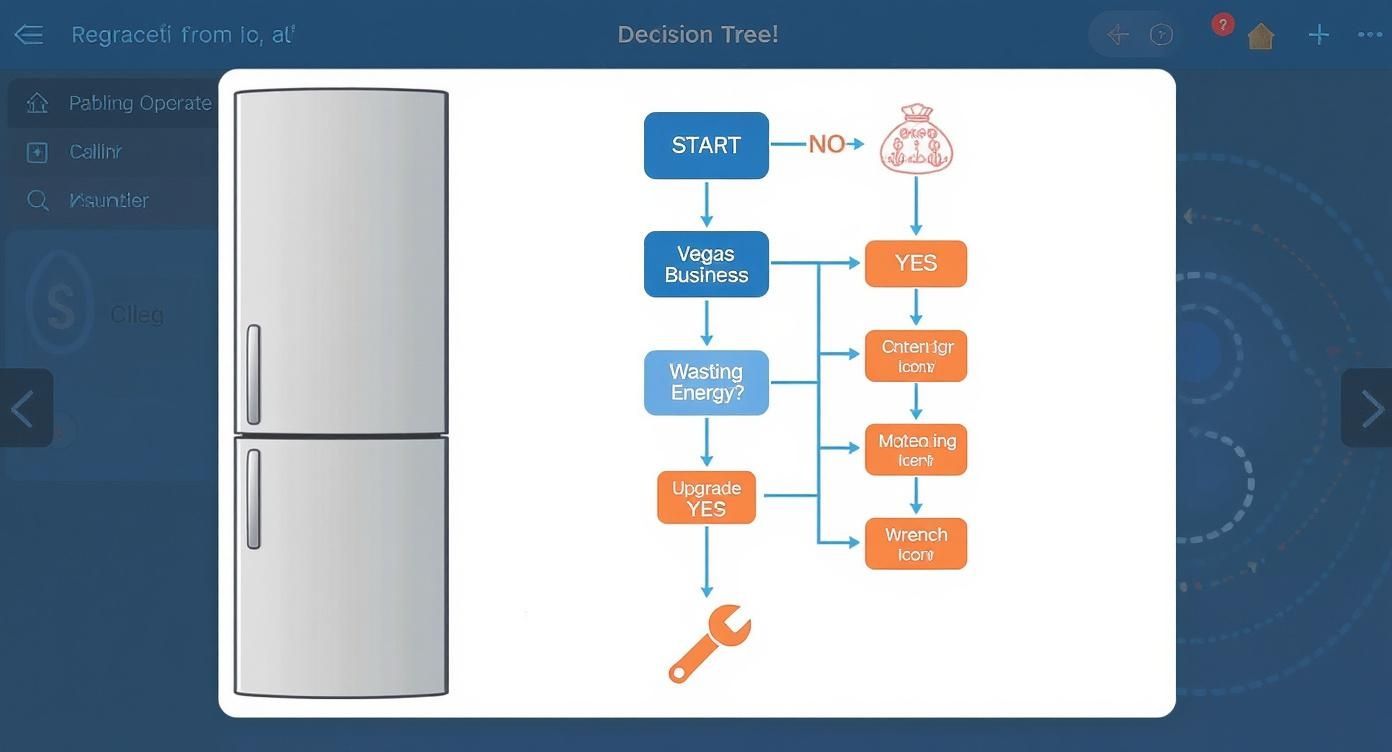
The main takeaway here is pretty clear: for any business in Vegas, the first question to ask is, "Where am I losing money on energy?" That answer tells you whether it's time to upgrade or stick with what you've got.
Decoding Efficiency Labels for the Desert
When you're comparing units, there are two labels you absolutely cannot ignore here in Las Vegas: ENERGY STAR and the climate class rating. These are your best friends for predicting how a unit will perform and what it will cost you over its lifetime.
The ENERGY STAR label means the equipment meets strict efficiency standards from the EPA. On average, certified commercial refrigerators are about 10% more efficient than their standard counterparts. That’s a direct saving on your NV Energy bill, month after month.
Don't just look at the ENERGY STAR sticker as a "nice-to-have." In a high-cost energy market like ours, it's a must-have for any new equipment. It's the most straightforward sign that a unit is built to save you cash.
Just as critical is the climate class rating. This tells you the hottest room temperature the unit can handle while still working properly. For the Mojave Desert, you should only be looking at units with a "T" (Tropical) rating.
A "T-Class" rating guarantees your cooler can hold its temperature even when your kitchen feels like an oven, up to 109°F (43°C). Buying a unit with a lower rating to save a few bucks upfront is a recipe for disaster. It will struggle, fail, and end up costing you a fortune in spoiled food and service calls.
To help you sort through the options, we've put together a quick guide to the features that matter most in our climate.
Feature Comparison for Energy-Efficient Refrigeration
Here's a quick-reference table breaking down the essential features and why they're so important for a Las Vegas kitchen.
| Feature | What It Is | Why It Matters in Las Vegas | Energy Savings Potential |
|---|---|---|---|
| ENERGY STAR Certification | Meets strict EPA guidelines for energy efficiency. | Lower monthly utility bills in a high-cost energy market. A non-negotiable for profitability. | High |
| "T-Class" Climate Rating | Designed to operate effectively in ambient temperatures up to 109°F. | Ensures your unit won't fail during brutal summer heatwaves, protecting thousands in inventory. | High |
| ECM Fan Motors | Electronically commutated motors that are more efficient than standard motors. | Uses up to 70% less energy than older motor types and produces less waste heat in the kitchen. | High |
| LED Lighting | Light-emitting diodes instead of incandescent or fluorescent bulbs. | Lasts longer, uses significantly less energy, and adds less heat inside the cooler. | Medium |
| Self-Closing Doors | Doors with mechanisms that automatically pull them shut. | Prevents cold air loss from doors being accidentally left ajar during a chaotic service. | Medium |
| High-Density Insulation | Thicker, higher-quality polyurethane foam inside the unit's walls. | Better insulation means the compressor runs less often to maintain temperature, especially in a hot kitchen. | Medium |
Ultimately, choosing a unit with the right combination of these features is the key to long-term savings and reliability. For a selection of equipment built to handle our demanding environment, check out our range of commercial refrigerators designed for Las Vegas kitchens.
Real-World Scenarios in Las Vegas
Let's look at how these choices play out for two very different Las Vegas operations.
Scenario 1: The High-Volume Strip Buffet
A buffet at one of the major resorts is an absolute machine, serving thousands of people a day. They need a massive arsenal of essential restaurant equipment: multiple large walk-in commercial coolers and commercial freezers for bulk inventory, plus a ton of reach-in units, refrigerated prep tables, and high-capacity ice machines right on the line. For them, every single piece of equipment has to be ENERGY STAR certified and T-Class rated. The ROI is almost immediate because of the sheer scale of their operation and the constant beating the equipment takes.
Scenario 2: The Arts District Food Truck
A food truck faces the exact opposite problem: tight space and a limited power supply from a generator. The owner needs compact, super-efficient undercounter units. Here, an energy efficient commercial refrigeration model isn't just a nice-to-have, it's critical. It draws less power, which means less strain on the generator. The T-Class rating is also a lifesaver, as the inside of that truck can get dangerously hot on a July afternoon. Making the right choice keeps the food safe and the generator from tripping mid-service.
Installation and Setup for Peak Desert Performance
You’ve just invested in a top-tier piece of energy-efficient commercial refrigeration, but the real savings don't kick in until it's installed and set up the right way. Here in Las Vegas, where the summer heat can make a kitchen feel like a sauna, a shoddy installation is a fast track to sky-high energy bills and a fried compressor.
Proper setup isn't just a suggestion—it's everything. It's the foundation for your unit's entire lifespan and performance.
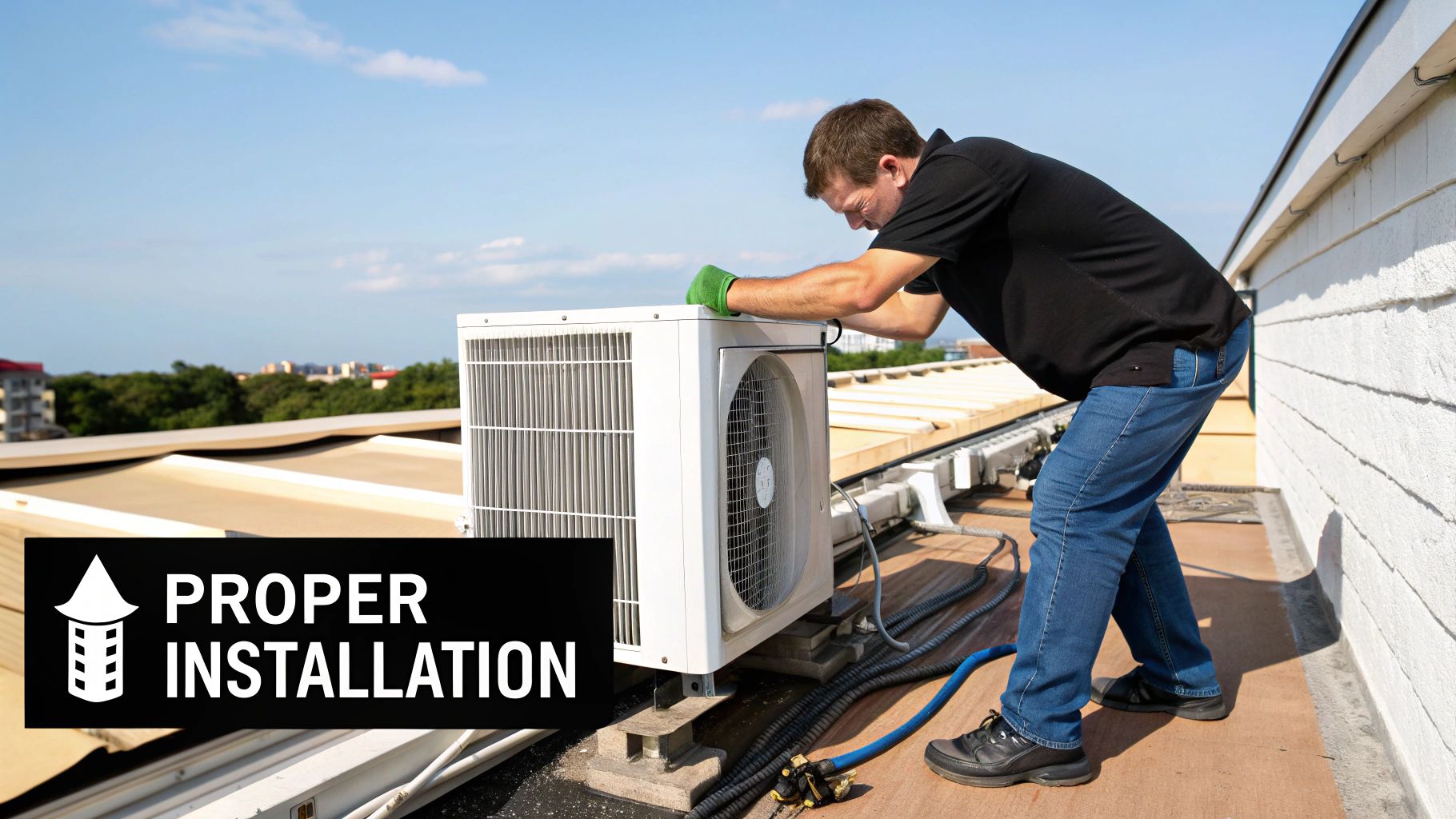
Think of your new refrigerator or freezer like a star athlete. Even the best of the best need the right conditions to perform. For your equipment, that means smart placement and professional handling from the moment it arrives.
Location Is Everything in a Vegas Kitchen
Where you put your unit will make or break its energy consumption. Your kitchen is a war zone of heat, and putting your refrigeration on the front lines next to the grill is a battle it’s guaranteed to lose. The compressor will be forced to run nonstop, wiping out all the efficiency you paid a premium for.
You'll want to steer clear of these all-too-common placement mistakes:
- Direct Sunlight: A unit getting blasted by the afternoon sun through a window is a huge no-go.
- Next to the Hot Line: Keep your refrigeration far away from heat-producing monsters like ovens, fryers, and ranges. That radiant heat forces the cooling system into constant overdrive.
- In Tight Corners: Shoving a unit into a cramped, unventilated space is like putting a plastic bag over its head. The hot air gets trapped, and the condenser can't do its job.
Every single degree the air gets hotter around your unit, your refrigeration has to work harder. Proper placement is the easiest win you can get. Just moving a unit a few feet can make a real difference on your monthly NV Energy bill.
Give Your Equipment Room to Breathe
One of the most critical parts of a successful install, especially in our desert climate, is proper ventilation. The condenser coils are how the unit gets rid of all the heat it pulls from inside. If air can't flow around them, that heat has nowhere to go, and the whole system starts to choke.
This is true whether you're running a massive casino kitchen or a tiny food truck on Fremont Street. The principle is the same: give it space.
Make sure there's at least three to six inches of clearance around the sides, back, and top of the unit. This isn't optional. That buffer zone lets cool air get pulled in and hot air escape, allowing the condenser to work like it's supposed to.
Why You Should Never DIY the Installation
I get it, trying to save a few bucks with a DIY setup is tempting. But trust me, it’s a gamble that almost never pays off. A professional installer does a lot more than just plug the thing in. They have the expertise to calibrate every component for our brutal environment.
Here's what a pro handles that you might miss:
- Correct Refrigerant Levels: If a unit is undercharged or overcharged, it runs poorly and can cause serious mechanical damage. A pro has the gauges and knowledge to get this spot-on.
- Leveling and Sealing: They'll make sure the unit is perfectly level so the doors seal tight. A good seal prevents cold air from leaking out, which is just money escaping into your kitchen.
- Initial Thermostat Calibration: They will set the thermostat correctly from the start, ensuring your food is held at a safe temperature without wasting energy by overcooling.
An improper installation can even void your warranty, leaving you holding the bag for some very expensive repairs. Investing in a professional ensures your energy-efficient commercial refrigeration actually lives up to its name from day one.
Daily Maintenance That Lowers Your Energy Bills
You've made the investment in a top-tier, energy-efficient commercial refrigeration unit. That's the first step. But the real, month-after-month savings come from simple, consistent upkeep. For a busy Las Vegas kitchen, maintenance can't be some complicated, multi-hour ordeal. It has to be a series of quick, effective habits your staff can actually stick with.
These small daily actions add up, turning into significant cuts on your monthly energy bills.
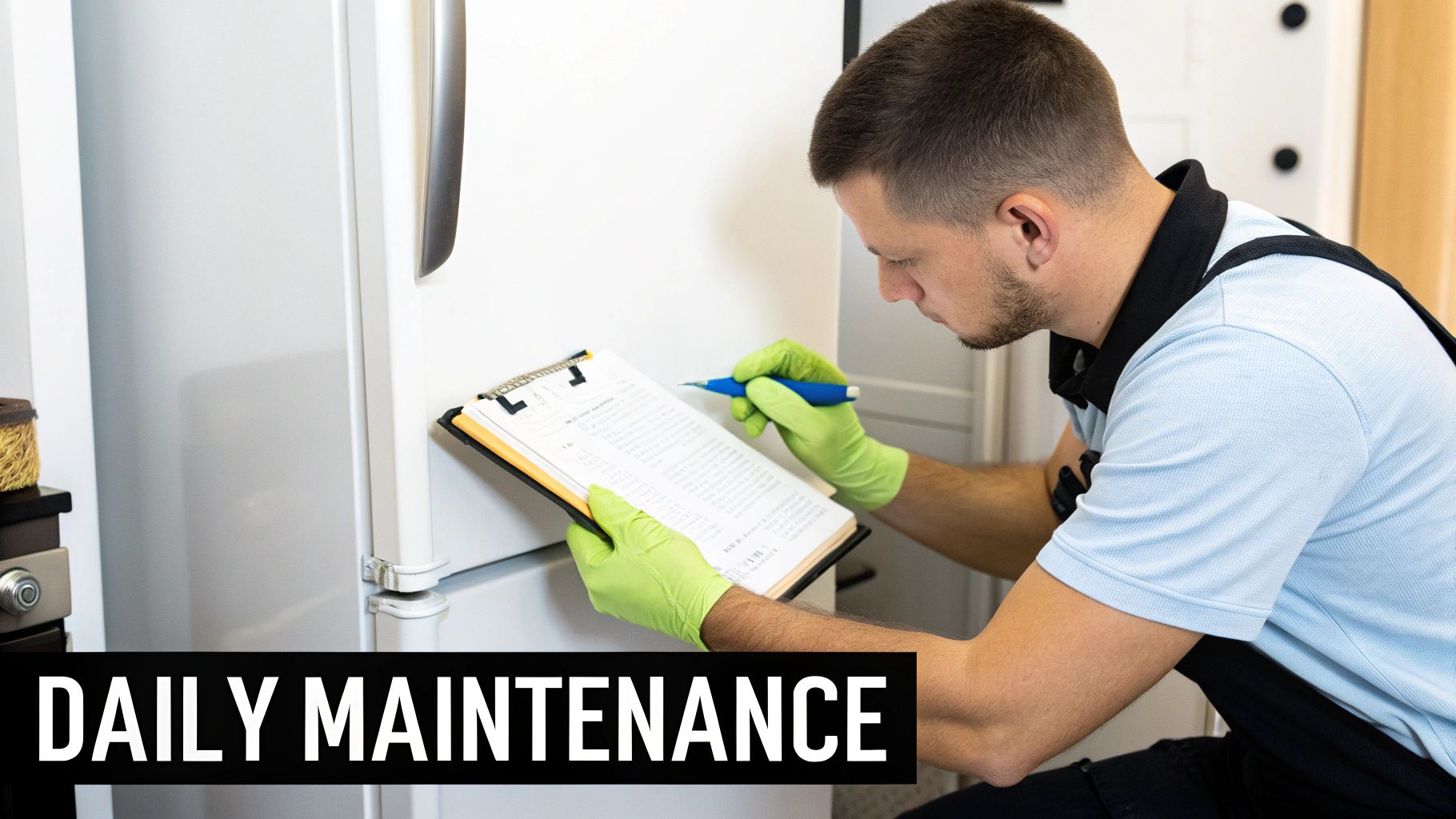
Think of it like preventative medicine for your most critical kitchen equipment. These aren't just chores; they're proven strategies to extend the life of your coolers and freezers, keeping them at peak performance even when the July heat is brutal.
The Power of Cleanliness and Airflow
One of the sneakiest energy vampires in any commercial kitchen is a dirty condenser coil. You’ll usually find these coils at the top or bottom of your unit, and their job is to release the heat pulled from inside. When they get caked with the grease, dust, and grime you find in any working kitchen, they just can't breathe.
The result? The compressor works overtime, running longer and harder to keep things cool, which sends your energy use through the roof. A clean coil is the cornerstone of an efficient operation, hands down.
What's going on inside the unit is just as crucial. Smart organization isn't just about grabbing ingredients faster during a dinner rush; it’s about basic physics.
- Don't Overcrowd the Shelves: When you pack items too tightly, you block the flow of cold air. Always leave some space between products and along the walls. This allows air to circulate properly and maintain a consistent temperature from top to bottom.
- Cool Hot Foods First: Never, ever put a steaming-hot hotel pan straight into the cooler. Let it cool to room temperature first. This simple step dramatically reduces the thermal load on your compressor.
- Keep Those Doors Shut: Sounds obvious, right? But in the chaos of service, doors get left ajar. Train your team to minimize how long doors are open and to double-check that they seal completely every single time.
A simple rule of thumb I tell every crew: If you can't see the back wall of the cooler, it's too full. Proper airflow is just as critical as the refrigeration cycle itself.
Your Essential Maintenance Checklist
The key to all of this is a simple, repeatable maintenance schedule. It doesn't have to be complicated. A few quick checks each day, plus a more thorough look once a week, can prevent 90% of common efficiency problems.
I've seen this simple schedule save operators thousands. It’s the difference between a minor fix and a major, inventory-spoiling breakdown.
Preventive Maintenance Schedule
| Task | Frequency | Impact on Efficiency |
|---|---|---|
| Clean Condenser Coils | Weekly | High - Prevents compressor overwork and significantly reduces energy use. |
| Check & Wipe Door Gaskets | Daily/Weekly | High - A tight seal stops cold air from escaping, preventing constant running. |
| Verify Thermometer Reading | Daily | Medium - Catches temperature fluctuations before they become a major issue. |
| Wipe Down Fan Blades | Weekly | Medium - Clean fans move air more effectively with less energy. |
| Clear Floor Vents | Daily | Low - Ensures proper air intake for the system to run cool. |
Making these tasks a non-negotiable part of your routine is the best insurance policy you can have for your equipment.
This proactive approach is only getting more important. The industry is seeing a major shift toward smart, connected refrigeration systems. IoT-enabled monitoring lets managers track energy use in real-time, pinpoint inefficiencies, and optimize performance from a phone or tablet. In some cases, this leads to energy savings of up to 20%. You can discover more insights about the commercial refrigeration market and see just how much this tech is changing the game.
By implementing a basic maintenance routine, you’re not just cleaning. You’re gathering intel that helps you spot a problem before it becomes a disaster. That daily temperature check or weekly coil cleaning could be the thing that alerts you to a developing issue, long before you lose thousands in spoiled inventory and emergency repair bills.
Making the Numbers Work: ROI and Local Rebates
Putting new equipment on your line is a big investment, so let's talk dollars and cents. Thinking about the return on investment (ROI) for energy-efficient commercial refrigeration isn't just about spending money; it's a smart financial move. This is especially true here in Las Vegas, where our energy bills can be brutal.
Figuring out what you'll save isn't some complicated mystery. It really just comes down to comparing what your old, energy-guzzling unit costs to run against what a new, efficient model will cost you. Once you see that difference, you'll know exactly how fast that new cooler or freezer will start paying you back.
A Quick Way to Estimate Your Savings
To get started, you just need a couple of numbers: the annual energy use (in kWh, or kilowatt-hours) for your old unit and for the new one you're eyeing. You can usually find this right on the spec sheet or the ENERGY STAR sticker.
Then, grab your latest NV Energy bill to find your commercial electricity rate. Let's walk through a quick example.
- Old Unit's Annual Use: 3,500 kWh
- New Unit's Annual Use: 2,100 kWh
- Your NV Energy Rate: $0.15 per kWh (but definitely check your bill for your exact rate)
Here’s the simple math:
- Energy Saved Annually: 3,500 kWh - 2,100 kWh = 1,400 kWh
- Annual Dollar Savings: 1,400 kWh x $0.15/kWh = $210
That $210 is your baseline savings each year. To see the payback, just divide the price of the new fridge by that number. If the new unit costs $2,500, you're looking at a payback of just under 12 years ($2,500 / $210). But hold on—that's before we factor in the incentives that can seriously speed things up.
Tapping into Local and Federal Incentives
This is where the deal gets a lot sweeter. There are several programs out there specifically designed to help Nevada businesses like yours afford energy-efficient upgrades. Getting these on your side can slash that initial cost and make your ROI look a whole lot better.
Think of rebates and tax credits as an instant discount on your investment. They're designed to reward smart business decisions that also help our community's energy grid. It’s a true win-win.
Here’s where to start looking:
- NV Energy Rebates: Our local utility is your first stop. They often have solid rebate programs for businesses that install ENERGY STAR certified equipment. Check their site for the latest on commercial refrigerators, freezers, and ice machines because these offers can take a serious chunk out of the final price.
- Federal Tax Credits: The federal government also steps up with tax credits for buying high-efficiency gear. This isn't just a deduction; it’s a dollar-for-dollar reduction of what you owe in taxes. You'll want to chat with your accountant to see exactly which credits your restaurant can claim.
These programs make a huge difference. But if the upfront cost still feels like a stretch, financing can close the gap. You can learn more about our restaurant equipment financing options to see how a flexible plan can get you the equipment you need now. By pairing financing with rebates, you can start saving on your power bill right away, turning a big purchase into a manageable monthly expense.
Got Questions About Commercial Refrigeration in Vegas? We’ve Got Answers.
Jumping into an energy-efficient commercial refrigeration upgrade is one of the best moves you can make for your Las Vegas business. Still, it’s a big decision. Whether you're running a high-volume spot on the Strip or a neighborhood joint in Summerlin, you probably have a few questions before you pull the trigger.
Let's cut right to the chase. Here are the most common questions we get from local restaurant, bar, and hotel owners, along with some straight-up, practical answers to help you feel confident about your next move.
What’s the Biggest Mistake Restaurants Make with Their Coolers?
Hands down, the single biggest mistake is buying based on the sticker price alone and completely forgetting about what it costs to run the thing. That cheaper fridge might save you a few hundred bucks at checkout, but it can bleed you dry with high NV Energy bills over its lifetime, especially here in the Vegas heat.
Another huge miss is not getting equipment with a "T-Class" (Tropical) climate rating. This is non-negotiable for us. It means the unit is built to handle the brutal reality of a kitchen hitting 109°F. Without that rating, your cooler will be fighting for its life all summer, setting you up for an early breakdown and risking thousands in spoiled product when a heatwave hits.
Realistically, How Much Can I Save on My Power Bill?
The exact amount depends on how ancient your current gear is, but the savings are often pretty dramatic. Just switching to an ENERGY STAR certified commercial refrigerator can make it about 10% more efficient than a standard model. If you get one with modern tech like ECM fan motors, you could use up to 70% less energy than those old power-guzzling motors.
In a busy Las Vegas restaurant, refrigeration can easily be 40% to 60% of your entire energy bill. Shaving even a small percentage off that number adds up fast and goes directly to your bottom line.
Think about it this way—every dollar not spent on electricity is a dollar of pure profit. Over a few years, those savings almost always blow past the initial price difference of buying a better unit.
Do Ice Machines Get Energy Efficiency Ratings Too?
You bet they do. Ice machines are another massive energy hog in any kitchen, so picking an efficient one is just as important. Like your coolers and freezers, commercial ice machines can earn the ENERGY STAR label if they meet tough requirements for both electricity and water usage.
An ENERGY STAR certified ice machine can be up to 15% more energy-efficient and 20% more water-efficient than a standard one. For any Vegas business—from a casino bar slinging drinks all night to a small cafe—cutting back on both your power and water bills is a huge win. Don't overlook your ice machine in your energy-saving game plan.
Is Professional Installation Really Worth It for a Basic Cooler?
Even if it looks like you can just plug it in and go, getting a professional installation is always the right call in a commercial kitchen. A pro does more than just slide it into place. They make sure the unit is perfectly level, which is critical for getting a tight door seal and stopping expensive cold air leaks.
More importantly, they'll check that the refrigerant levels are correct and that the unit has enough breathing room for proper ventilation—a must-have in our climate. A bad install can void your warranty, kill performance, and wipe out any energy savings you were supposed to get. It’s a small price to pay to protect a much bigger investment.
How Do I Know When to Repair vs. Replace My Old Unit?
Ah, the classic question. It really boils down to the unit's age and how much the repair is going to cost you.
A solid guideline is the 50% rule: if the repair bill is 50% or more of what it would cost to buy a new, comparable unit, it's time to replace it.
You also have to look at its age. If your commercial freezer or fridge is pushing past the 10-15 year mark, it's an energy dinosaur compared to what's available today. Even if it's technically still running, the extra money you’re paying on your energy bill every single month could be paying for a brand-new, reliable, and efficient machine that will save you money in the long run.
Ready to slash your energy bills and get your Las Vegas kitchen equipped to win? At Las Vegas Restaurant Equipment, we live and breathe high-quality, energy-efficient commercial refrigerators, freezers, and ice machines built tough enough for the desert. Check out our full collection and find the perfect gear for your spot.