

A commercial ice cream machine is a heavy-duty workhorse designed for one thing: producing large volumes of ice cream, gelato, or soft serve, day in and day out. These aren't your average home countertop models. They're built for the grind of a professional kitchen, emphasizing speed, durability, and most importantly, consistency. In the vibrant city of Las Vegas, where you'll find a diverse array of restaurants catering to every palate, adding one of these is a strategic move to tap into a highly profitable menu category.
Choosing the Right Machine for the Las Vegas Market
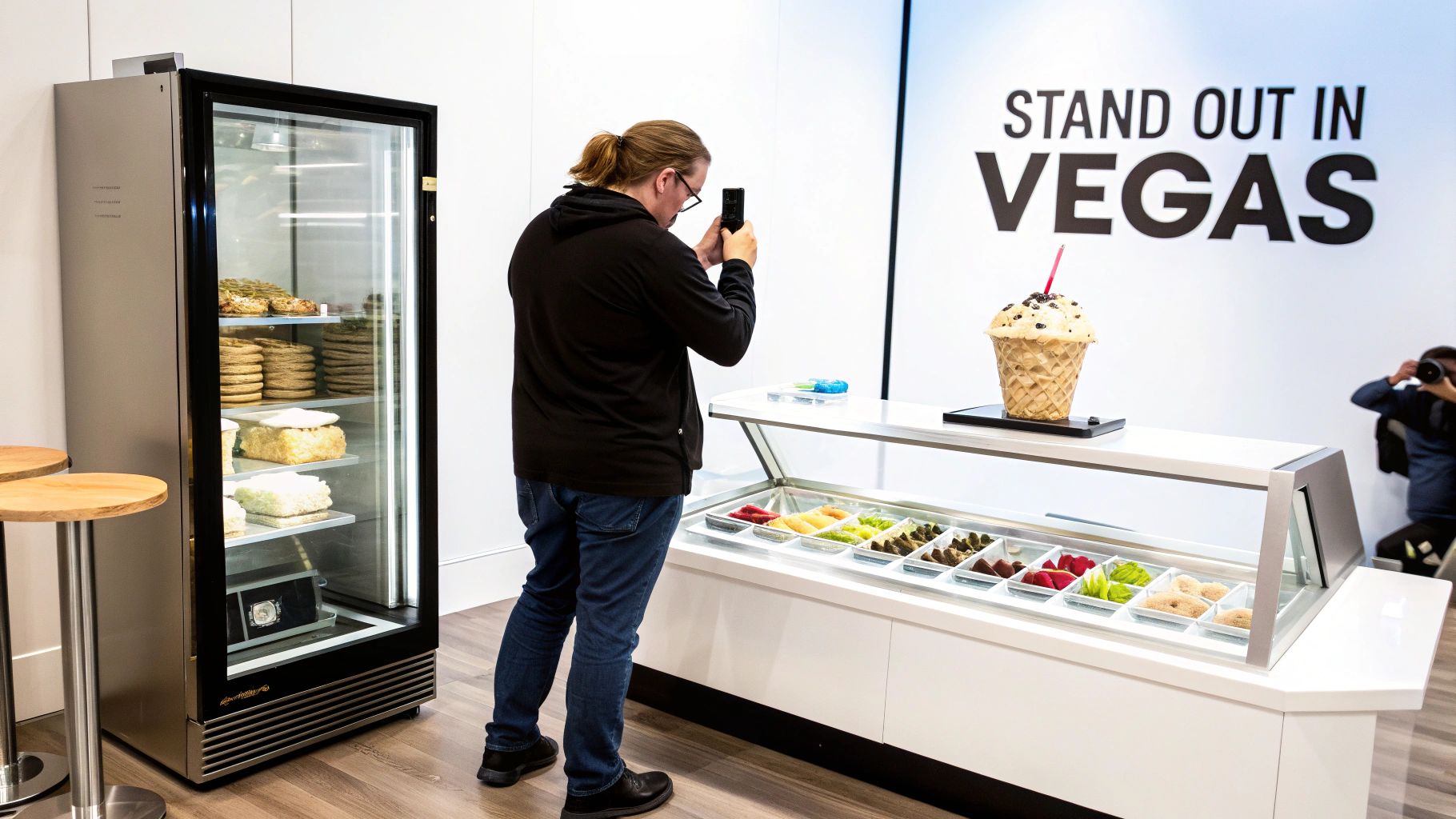
In a city as competitive and dynamic as Las Vegas, you’ve got to create an experience. From the mega-resorts on the Strip to the cool, independent cafes downtown and the family spots out in Henderson, a unique menu is what gets people talking. A commercial ice cream machine isn't just a piece of equipment; it's your ticket to creating signature frozen desserts that make your brand stand out.
But a great machine doesn't work in a vacuum. To really nail your dessert program, you need a full support system. Success requires an ecosystem of essential restaurant equipment working together to produce and serve top-notch frozen treats. This includes:
- Commercial Refrigerators: You need a reliable spot to keep your liquid ice cream mix perfectly chilled and safe before it ever hits the freezer.
- Commercial Freezers: This is critical for "hardening off" and storing finished batches of hard ice cream or gelato, locking in that perfect texture.
- Ice Machines: While not for the ice cream itself, you can't run a successful beverage service—the perfect partner to any dessert—without a solid ice machine.
Matching Machines to a Diverse City
People's love for high-quality frozen desserts is only getting stronger. The global market for commercial ice cream machines is set to climb from USD 2 billion in 2025 to a massive USD 3.5 billion by 2035. That's a steady 5.6% annual growth rate, fueled by customers who want fresh, artisanal treats when they dine out. You can discover more insights about this growing market and see just how big the opportunity is for restaurants like yours.
To simplify your decision, this chart breaks down which machine type is the best fit for common Las Vegas business models.
The takeaway is pretty clear: high-volume resorts need the speed of soft serve machines, artisan cafes can create magic with gelato makers, and classic ice cream parlors are built around traditional batch freezers.
Choosing the right machine from the get-go aligns your dessert program with your kitchen's reality and your customers' expectations. It's the first step to building a successful frozen dessert menu in the bustling Las Vegas market.
Matching Ice Cream Machines to Las Vegas Venues
To make things even simpler, here’s a quick-reference table to help you match the right machine to your specific Las Vegas business.
| Machine Type | Best For | Ideal Las Vegas Venue |
|---|---|---|
| Batch Freezer | High-quality, dense, traditional ice cream. | A dedicated ice cream parlor on Fremont Street or a family restaurant in Henderson. |
| Soft Serve | High-volume, quick-serve cones, and sundaes. | A busy casino food court, a poolside cafe at a Strip resort, or a quick-service spot. |
| Gelato Machine | Rich, dense, and artisanal frozen desserts. | A trendy Arts District coffee shop, a high-end Italian restaurant, or a boutique hotel cafe. |
| Frozen Yogurt | Healthier, customizable self-serve options. | A self-serve yogurt shop in Summerlin or a health-focused cafe near a fitness center. |
Ultimately, whether you're serving scoops to tourists or swirls to locals, the right machine is the foundation of a profitable and popular dessert offering.
Understanding Soft Serve, Batch Freezers, and Gelato Makers
Picking the right commercial ice cream machine isn't just about buying equipment; it’s about deciding on the personality of your dessert menu. Every machine type creates a totally different product—each with its own texture, temperature, and customer appeal. Getting a handle on these key differences is the first step to making sure your investment fits your unique Las Vegas business concept.
Think of a batch freezer like it’s the heart of a local craft brewery. Its whole purpose is to produce distinct, high-quality batches of traditional hard ice cream. This is the machine that lets a chef in a Henderson fine-dining spot create a signature bourbon-pecan ice cream that perfectly matches their menu. The focus here is all about quality and uniqueness, not just pumping out volume. It’s the perfect choice for any business that wants to serve a premium, scoopable product.
On the flip side, a soft serve machine is more like a high-volume espresso maker in a slammed coffee shop. It’s all about speed, consistency, and on-demand service. Just picture a poolside bar at a Strip resort on a blistering summer day. A good soft serve machine can crank out hundreds of perfectly swirled cones an hour, keeping the crowds happy without all the hassle of scooping, portioning, or storing tubs in a separate commercial freezer.
Differentiating Machine Outputs
You have to know what comes out of the machine. Sure, all frozen desserts are delicious, but their structural differences change everything from how customers see them to how your kitchen operates. Each machine is a specialized tool built for a specific job.
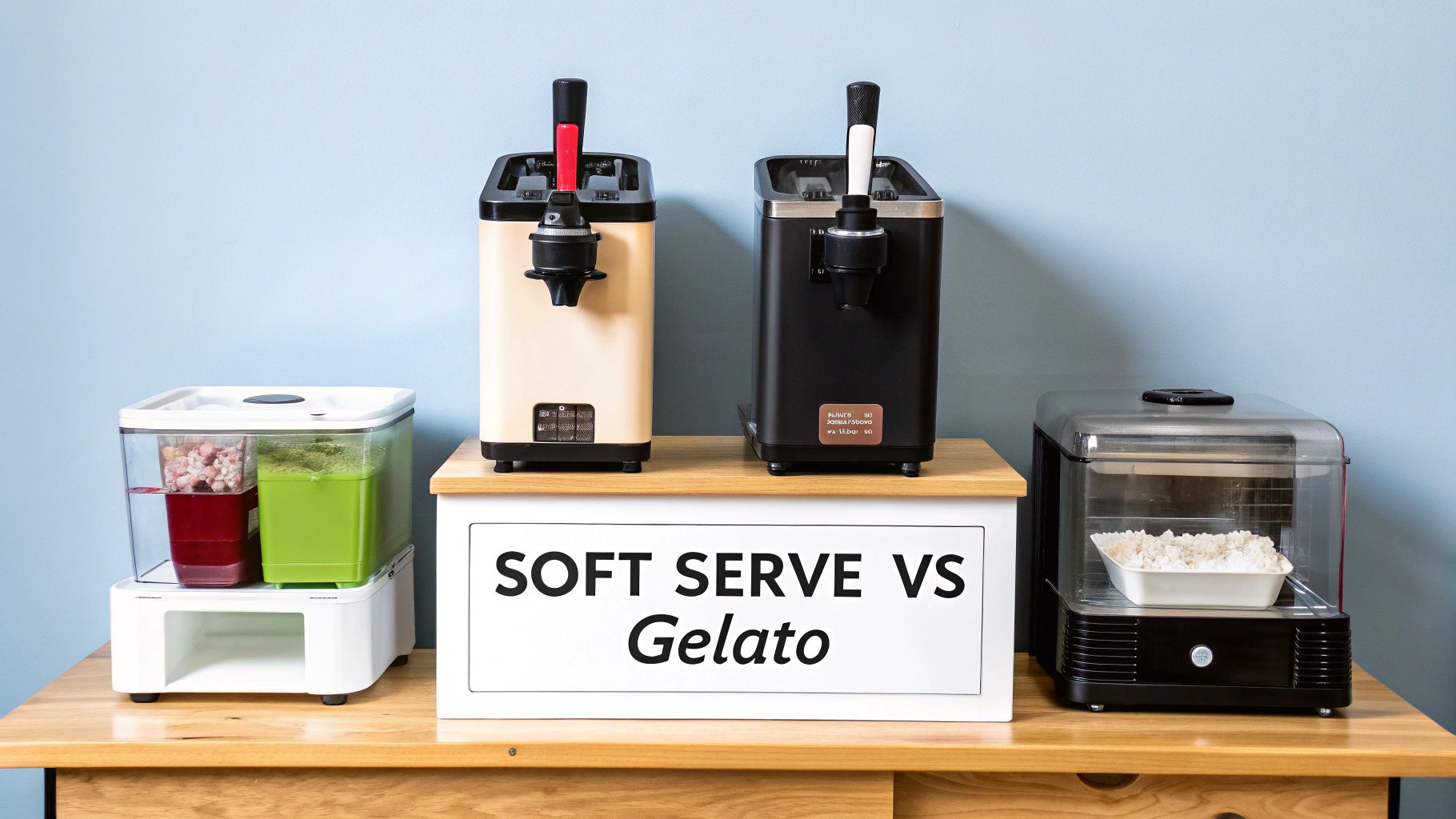
- Soft Serve Machines: These units make a product that's warmer and has more air (what we call overrun) than hard ice cream. This gives it that light, creamy texture that gets dispensed right into a cone for immediate enjoyment. They are the engine behind classic cones, sundaes, and milkshakes.
- Batch Freezers (Hard Ice Cream): These produce a much denser, colder product with way less air. The ice cream comes out in a semi-solid state and then has to be "hardened" in a commercial freezer to get to the right serving temperature. This is your go-to for creating classic, scoopable ice cream.
- Gelato Makers: A gelato machine runs a bit warmer than a batch freezer and whips in a lot less air. The result is an incredibly flavorful, dense, and silky product that is the hallmark of authentic Italian gelato—perfect for an upscale cafe in the Arts District.
- Frozen Yogurt Machines: These are functionally a lot like soft serve machines, but they're calibrated specifically for yogurt mixes, which have a different fat and sugar content. They are the backbone of the self-serve froyo shops you see all over neighborhoods like Summerlin.
Tying Technology to Las Vegas Scenarios
Let's bring this all back to the real world here in the vibrant Las Vegas restaurant scene. The city’s wild mix of spots, from high-end dining to quick-service tourist traps, gives us perfect examples for each machine.
A classic Italian restaurant on the Strip that wants to be truly authentic would absolutely invest in a gelato maker. That choice shows a real commitment to tradition and quality, giving diners a genuine taste of Italy. That rich, dense dessert is the perfect end to a sophisticated meal and justifies a premium price. For that culinary identity, it’s an essential piece of restaurant equipment.
Meanwhile, a chaotic casino food court needs to serve thousands of people every single day. Here, high-capacity, twin-twist soft serve machines are a must-have. They let you serve lightning-fast, offering two different flavors plus a swirl, which gives customers more choice and keeps the line moving. In a high-pressure spot like that, the machine's speed is its greatest asset.
The market for these machines is huge, which tells you how important they are in the food service world. Soft serve machines, a commercial staple, are holding strong in the U.S. with a projected value of USD 72.21 million in 2025, and that’s expected to climb to USD 95.36 million by 2034. Globally, manufacturers are building commercial models with bigger capacities to keep up with demand. To really see the opportunity, you can read the full research about these market trends.
Key Takeaway: The machine you pick directly shapes your menu's identity. A batch freezer is for artisanal, creative flavors, while a soft serve machine is for high-volume sales. The foundation of a successful dessert program is matching the right technology to what your Las Vegas venue actually needs.
In the end, it doesn't matter if you're making small, unique batches for a boutique eatery or serving endless swirls to tourists. The right commercial ice cream machine will work seamlessly with your other essential kitchen gear, like commercial refrigerators for your mix and commercial freezers for hardening, to deliver a fantastic product every single time.
How to Size Your Machine for Peak Las Vegas Demand
Choosing the right size for your commercial ice cream machine in Vegas isn’t just a guess—it's a strategy. In a city that truly never sleeps, demand can go from zero to one hundred in an instant. Picture a post-show crowd flooding out of a Strip theater or the relentless line at a weekend brunch buffet; being unprepared is simply not an option. Getting the sizing right is the difference between capturing every possible sale and watching frustrated customers walk away.
The two big metrics you need to get your head around are capacity (quarts per hour) and recovery time. Capacity is easy—it’s how much finished product the machine can churn out in an hour. Recovery time, though, is how quickly it can freeze a new batch of mix after the current one is gone.
If your machine is too small, it'll have a slow recovery time, leaving you high and dry during a rush. That means long lines and lost money.
On the flip side, going too big might seem like a safe bet, but it creates its own set of headaches. Those larger units drink more energy, eat up precious kitchen real estate, and can lead to a ton of product waste if you aren't consistently selling at high volumes. The real goal is to find that sweet spot where your machine works as hard as you do, but not a bit harder than it needs to.
Translating Specs into Real-World Performance
Let's ditch the technical jargon and think about this in real Las Vegas terms. A high-volume food court at a casino needs a beast of a machine that can serve hundreds of people an hour. For that, a floor model soft serve machine with a massive quarts-per-hour rating and lightning-fast recovery is the only way to go. It’s built for constant, relentless demand.
Now, think about a cozy, independent coffee shop in the Arts District. The needs are completely different. A compact countertop model is probably the perfect fit. It makes smaller batches of artisanal gelato or ice cream, which is ideal for a business where demand is steady but not overwhelming. That smaller footprint also frees up critical counter space for other gear.
To dial in your ideal machine size, use this simple framework:
- Estimate Your Peak Demand: During your busiest hour, how many servings do you realistically expect to sell? A good rule of thumb is to assume 15-25% of your customers might order a frozen dessert.
- Calculate Required Output: Multiply your peak-hour customers by your average serving size (say, 5 ounces). This gives you the total ounces you'll need per hour.
- Convert to Quarts: There are 32 ounces in a quart. Just divide your total hourly ounce requirement by 32 to figure out the quarts per hour your machine needs to handle.
Countertop vs. Floor Models: The Space Equation
The physical size of your machine is just as crucial as its output. Las Vegas kitchens, whether they're on the Strip or in a suburban Henderson plaza, are almost always tight on space. This is where the countertop versus floor model debate really heats up.
A common mistake I see is operators choosing a machine based on output alone, without ever thinking about its physical footprint. You have to plan how it will fit into your kitchen's workflow, right alongside your commercial freezers and refrigerators.
Countertop models are the compact workhorses designed for businesses with low to moderate volume. They’re perfect for adding a profitable dessert option without a major kitchen overhaul. A bar could easily use one for signature boozy milkshakes, or a cafe could add a single soft serve flavor to its menu.
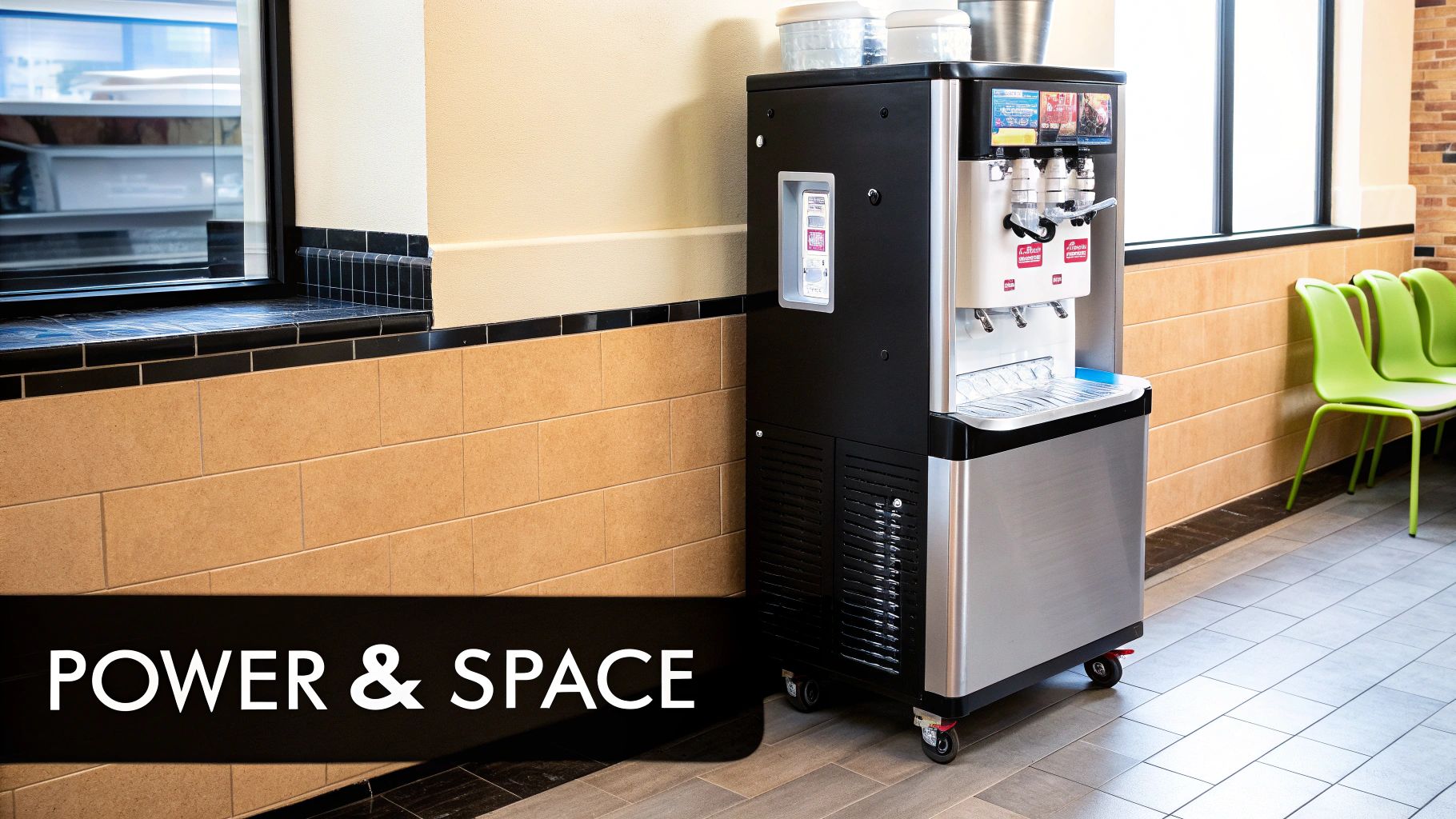
Floor models are the heavy-duty powerhouses of the ice cream world. They are built for high-volume spots where demand is constant and fierce. These machines need dedicated floor space and often have specific power and plumbing requirements. They're the standard for any serious ice cream parlor, busy buffet, or QSR that depends on speed.
A huge part of the commercial market is driven by industrial-grade machines like continuous freezers, which are projected to hit a 29.4% revenue share in 2025. These high-capacity units are essential for mass production. When you're planning your layout, just remember that your ice cream machine needs to play nice with other big equipment. For a deeper dive into managing large-scale cold storage, check out our guide on commercial walk-in refrigerators.
Navigating Power, Cooling, and Kitchen Space
You’ve figured out the capacity you need for the Vegas crowds, but now for the real-world stuff. A commercial ice cream machine is a serious piece of equipment, and it comes with specific demands that can make or break your kitchen’s entire workflow.
Ignoring its power, cooling, and space needs is like building a gorgeous new resort on the Strip but completely forgetting to plan for parking. It’s a guaranteed recipe for operational chaos.
Before you even think about adding a machine to your cart, your absolute first step is to get familiar with your building's electrical setup. These machines aren't simple plug-and-play appliances. They need specific voltage and phasing to run safely and efficiently, and guessing is not an option.
Understanding Your Electrical Needs
Most heavy-duty restaurant equipment, including almost all floor-model ice cream machines, requires a 208/230-volt outlet. This is far more powerful than your standard wall socket. Beyond that, you need to know if your machine requires single-phase or three-phase power.
Think of it this way: single-phase is like a standard, steady stream of electricity good for smaller equipment. Three-phase power is like a supercharged, continuous power supply built for industrial-strength motors.
A high-volume casino food court or a large production kitchen in Henderson will almost certainly have three-phase power ready to go. On the other hand, a smaller cafe in the Arts District might only be wired for single-phase. Getting a licensed electrician to confirm what you have is a non-negotiable step before you buy.
The Air-Cooled vs. Water-Cooled Debate in the Desert
In the middle of a blistering Las Vegas summer, how your machine cools itself is one of the most critical decisions you'll make. This choice directly impacts its efficiency, its lifespan, and your monthly power bill. You really have two options: air-cooled and water-cooled.
An air-cooled machine works a lot like a car's radiator. It uses a fan to pull in the surrounding air and blow it over condenser coils to get rid of heat. This is usually the simpler and more affordable choice upfront.
- Pros: Lower initial cost and much easier installation since there's no plumbing involved.
- Cons: It pumps hot air right back into your already-hot kitchen, forcing your AC to work overtime. And most importantly, it needs room to breathe.
For an air-cooled unit to have a fighting chance in the Las Vegas heat, it needs at least 6-8 inches of clearance on all sides for proper airflow. Shoving it into a tight, unventilated corner is a surefire way to cause overheating, poor performance, and eventually, a total breakdown.
A water-cooled machine, however, connects directly to your plumbing. It circulates water through the system to absorb heat from the condenser and then sends the heated water down the drain.
In a hot, cramped kitchen where every inch of real estate is gold, a water-cooled machine can be a total lifesaver. It doesn't add extra heat to the room, which makes things much more comfortable for your staff and puts less strain on your HVAC system.
Of course, that efficiency comes with a price. It needs a professional plumber to install it, and it will increase your water bill—a very real consideration in a water-conscious city like Las Vegas. Still, for many high-volume spots, the better performance and cooler kitchen make it a worthwhile investment. Thinking about overall kitchen efficiency is key, and you can learn more by exploring our insights on energy-efficient commercial refrigeration to see how cooling systems impact your bottom line.
Planning Your Physical Footprint
Finally, you have to map out the machine’s actual physical footprint. Don't just look at the dimensions on the spec sheet and call it a day. You have to plan for the "operational halo" around it—that's the space your team needs for daily use, cleaning, and maintenance.
Think through the whole workflow. Where will your staff stand to run the machine? Is there enough room to pop open the service panels when it needs a tune-up?
Most importantly, how does it fit in with your other equipment? Your commercial ice cream machine should sit in a spot that creates a smooth path between your commercial refrigerator (where the mix is kept) and the commercial freezer or dipping cabinet where the final product is hardened and served. A poorly placed machine creates bottlenecks, slows down service, and costs you money during a Vegas rush.
Your Smart Buyer Checklist for Las Vegas Businesses
Alright, you've waded through all the technical specs. Now comes the hard part—making the final call on a commercial ice cream machine. This is where the rubber meets the road, and you have to think about the practical realities of owning and operating this equipment right here in the Las Vegas market.
This isn't just about output and capacity anymore. It's about compliance, day-to-day costs, and finding a partner who will have your back. Let's walk through the final checkpoints to make sure your investment is a smart one that will pay off for years to come.
Compliance and Certifications
In the Las Vegas food scene, compliance isn't just a suggestion; it's the law. The Southern Nevada Health District (SNHD) doesn't mess around when it comes to public safety, and your equipment is the first thing they’ll look at. For any commercial ice cream machine, there are two certifications you absolutely cannot ignore.
- NSF (National Sanitation Foundation): This little seal of approval is your guarantee that the machine is built for food safety. It means the materials are non-toxic, the surfaces are smooth and easy to clean, and there aren't any tiny cracks or crevices where bacteria can throw a party.
- ETL (Intertek Testing Services): This one is all about electrical safety. An ETL mark confirms the machine meets North American standards, ensuring it won't be a fire or shock hazard in your kitchen. It’s peace of mind in a plug.
Choosing a machine without both NSF and ETL certifications is asking for trouble. An SNHD inspector can shut you down on the spot or refuse to let you open if your equipment isn't up to code. It's a risk that's just not worth taking.
Think of these certifications as a sign of quality, too. A machine built to meet these tough standards is designed to handle the abuse of a commercial kitchen, making it a much more reliable investment for your Las Vegas restaurant.
Labor-Saving Cleaning Features
Let's be honest, labor is one of your biggest line items. Every minute your staff spends scrubbing a machine is a minute they aren't serving your customers. Modern ice cream machines have some brilliant features designed to cut down on that cleaning grind—a lifesaver in a 24/7 town like ours.
Keep an eye out for models with automated cleaning cycles. These systems circulate sanitizer through the machine with just the push of a button, minimizing hands-on time. Another game-changer is a standby or sleep mode, which keeps the mix safely chilled in the hopper and freezing cylinder overnight. This feature means you don't have to break down and clean the entire machine every single day, which saves an incredible amount of labor and cuts down on wasted product.
Reliability and Energy Efficiency
When it's 110 degrees outside in July, the last thing you need is your ice cream machine giving up the ghost during a dinner rush. Reliability is king. Stick with brands that have a proven track record for durability and ask other local business owners what they use, especially those who’ve survived a Vegas summer or two.
Energy efficiency is right up there in importance. A commercial ice cream machine is a power-hungry beast that runs for hours on end. With Nevada's energy costs, an inefficient model will quickly eat into your profits. Look for machines with high-efficiency compressors and top-notch insulation. They might cost a little more upfront, but the savings on your monthly power bill will make it a far better investment in the long run.
Cost Breakdowns and Financing
The price tag on a commercial ice cream machine can be all over the map, depending on what you need it to do. Here’s a rough guide to help you set a budget:
- Entry-Level/Countertop Models: You can find these for $2,000 to $6,000. They're perfect for businesses just dipping their toes in, maybe adding a single flavor or serving a lower volume of customers.
- Mid-Range Floor Models: These are the workhorses, typically running from $7,000 to $15,000. They offer more capacity and features, making them a great fit for most restaurants and standalone dessert shops.
- High-Capacity/Premium Models: For the big players—casinos, massive buffets, and high-traffic tourist spots—these machines can cost $16,000 or more. They're built for maximum output and come with all the bells and whistles.
Don't let the sticker shock scare you. Many restaurant owners, especially when they're starting out, use financing to get the equipment they need without draining their bank account. Options like equipment loans or leases let you get the machine running and generating revenue while you pay it off over time. It's a smart way to manage your cash flow while also investing in other key pieces, like commercial refrigerators, commercial freezers, and ice machines.
We've covered a lot of ground, but having a clear checklist can make all the difference. The table below breaks down the key questions and local considerations to keep in mind as you get ready to buy.
Commercial Ice Cream Machine Buyer Checklist
| Key Consideration | Questions to Ask Your Supplier | Local Las Vegas Notes |
|---|---|---|
| Capacity & Output | What's the hourly output? How many quarts does the hopper hold? What's the recovery time? | Factor in tourist surges and weekend rushes. Don't just plan for an average Tuesday. |
| Machine Type | Is this a batch freezer, soft-serve, or gelato machine? Is it air-cooled or water-cooled? | Air-cooled is common, but ensure you have enough clearance. Water-cooled needs plumbing and can be an issue in a drought-conscious area. |
| Power & Utilities | What are the voltage and phase requirements? Does it need a dedicated circuit? | Double-check your building's electrical capacity. A surprise visit from an electrician is a budget-killer. |
| Footprint & Space | What are the exact dimensions? How much clearance is needed for airflow and cleaning? | Measure your space twice. Remember to account for door frames and hallways for delivery. |
| Compliance | Is this machine NSF and ETL certified? Can you provide the documentation? | Non-negotiable for the Southern Nevada Health District (SNHD). No certs, no service. |
| Cleaning & Labor | Does it have a standby mode? Is there an automated cleaning cycle? | These features are huge labor-savers and reduce product waste, which is critical for profitability. |
| Warranty & Support | What does the warranty cover (parts, labor)? Do you have local technicians for service? | You need a reliable local service team. When a machine goes down on a hot day, you can't wait for a tech to fly in. |
| Delivery & Install | Is delivery and installation included? What are the logistics for a Las Vegas/Henderson delivery? | Ask about tailgate delivery vs. inside delivery. Getting it off the truck is only half the battle. |
Use this checklist when you talk to suppliers. It’ll help you cut through the sales pitch and focus on what truly matters for your business, ensuring you get a machine that’s a perfect fit for the unique demands of the Las Vegas market.
Common Questions About Commercial Ice Cream Machines
Jumping into the world of commercial ice cream machines can feel like a lot, especially in a market as demanding as Las Vegas. The desert heat and the unique rhythm of our city bring up real-world questions that need solid answers if you want to run a smooth, profitable dessert program. This section cuts through the noise and tackles the most common questions we hear from restaurant owners.
Whether you're slinging scoops on the Strip or running a quiet café in Henderson, you need to know the day-to-day realities of your equipment. Let's get into the details that really matter.
How Do I Choose Between Air-Cooled and Water-Cooled in Las Vegas?
Here in Vegas, this decision really comes down to two things: your kitchen's airflow and your water budget. An air-cooled machine is the go-to choice for most. It’s simpler to install, but it absolutely must have room to breathe to survive our summers.
Think of it like this: the machine has to exhale all the heat it pulls from the ice cream. You need to give it at least 6-8 inches of clearance around the vents. If you cram it into a tight corner, it's going to overheat, struggle to keep up, and eventually burn out.
On the other hand, a water-cooled unit can be a lifesaver in a blazing hot or cramped kitchen. It doesn't pump more heat back into the room, which your staff and your HVAC system will thank you for. The trade-off? It needs a plumbing hookup and will definitely add to your water bill—a major consideration in our Southern Nevada climate.
Local Insight: For most Las Vegas kitchens with decent ventilation, an air-cooled model is the practical, cost-effective way to go. But if you’re working in a tight, high-heat kitchen where every degree counts, a water-cooled machine is a worthwhile investment for consistent performance.
What Is a Realistic Maintenance Schedule for These Machines?
A solid maintenance routine isn't just a suggestion; it's what will keep your commercial ice cream machine humming through the busiest tourist seasons. If you neglect it, you're just setting yourself up for expensive downtime. That's especially true in our dusty desert environment, where condenser coils get clogged fast.
Here’s a simple schedule that works:
- Daily: Wipe down the outside and make sure all drip trays are emptied and cleaned. It’s all about keeping things looking professional.
- Weekly: Time for a deep clean. You need to fully clean and sanitize every single part that comes into contact with your mix—the hopper, the freezing cylinder, and the dasher (the mixing arm).
- Monthly: Get those condenser coils cleaned. Dust and grease are the enemy, and they love to build up in Vegas kitchens. While you're at it, check all the seals and O-rings for wear and tear, and lubricate any moving parts your manual tells you to.
We also highly recommend getting a professional service check once a year to catch problems before they turn into emergencies. This kind of proactive care is just like what's needed for other vital equipment. For more on that, check out our guide on commercial ice maker maintenance.
Where Do I Store My Ice Cream Mix and Other Supplies?
Great ice cream starts with great storage. It’s a critical link in the chain that begins long before the mix ever touches your machine, and it relies on your other key pieces of restaurant equipment working together.
Remember, all liquid ice cream and soft serve mixes are dairy. They have to be stored in a commercial refrigerator at or below 40°F (4°C) to keep nasty bacteria from growing. As soon as you open a container, you have to follow the manufacturer's use-by date to the letter.
Once you’ve made a batch, the finished product needs its own home in a dedicated commercial freezer. Whether it’s hard-pack ice cream that needs to harden or gelato waiting for service, it has to be kept in a dipping cabinet or storage freezer at 0°F (-18°C) or colder. This is what keeps it smooth and creamy and prevents those awful ice crystals from forming. When it comes to your dessert program, your refrigeration is just as important as the machine that makes the magic.
At Las Vegas Restaurant Equipment, we get the unique challenges of setting up a kitchen in this city. We're here to provide the reliable, compliant, and efficient equipment you need to win.