

In the fast-paced, high-stakes world of a commercial kitchen, a Class B fire extinguisher is your absolute first line of defense against one of the most common dangers: flammable liquid fires. These specialized units are engineered to knock down flames fueled by cooking oils, grease, and even certain cleaning solvents—all of which are ever-present in a busy food service operation.
Protecting Your Las Vegas Kitchen From Flammable Liquid Fires
Here in the vibrant city of Las Vegas, where a diverse array of restaurants caters to every palate, kitchens operate under a level of pressure that's hard to find anywhere else. With the constant sizzle from commercial griddles and the non-stop bubbling of deep fryers, the risk of a flammable liquid fire is always simmering just below the surface. A simple grease spill or an overheated pan can erupt into a serious blaze in a heartbeat.
This is where the unique danger of a Class B fire really shows itself. Unlike a fire involving paper or wood, you cannot use water on a grease fire. Hitting it with water will cause a violent, explosive reaction that sends flaming liquid flying, making a bad situation infinitely worse. That’s why having the right tools isn't just about compliance—it’s about survival.
The Amplified Risks in a Commercial Setting
Your essential restaurant equipment, from high-capacity commercial refrigerators and commercial freezers to constantly running ice machines, adds complex electrical components into this high-heat environment. A simple malfunction near a flammable liquid can be catastrophic.
In high-stakes kitchens powering the diverse array of Las Vegas restaurants, bars, and casinos, Class B fire extinguishers are genuine lifesavers. These extinguishers, usually filled with dry chemical agents or carbon dioxide, are built to smother a flammable liquid fire without spreading the flames or conducting electricity. This makes them absolutely indispensable for success.
For Las Vegas restaurateurs, a Class B fire extinguisher is more than just a red can on the wall. It’s a critical asset protecting your staff, your customers, and the business you’ve poured your life into building.
Of course, solid fire prevention starts with good habits. Proper maintenance of your cooking equipment is a foundational step. For example, knowing how to clean your commercial deep fryer correctly doesn't just improve your food quality; it dramatically cuts down on the buildup of flammable grease that fuels these fires.
Beyond Passing Inspection
At the end of the day, this is about more than just passing your next fire inspection. It’s about building a culture of safety. The relentless pace of a successful Vegas restaurant magnifies every single risk, which is why proactive fire safety has to be a top priority.
To really lock down your kitchen's safety, you should explore more effective workplace fire prevention tips. But it all starts here: having the correct Class B fire extinguishers ready to go, and making sure every single person on your team knows how to use them, is the cornerstone of protecting your operation.
Decoding Fire Classes for Restaurant Safety
If you want to protect your Las Vegas restaurant, you first have to understand what you're up against. Think of fire safety as a simple alphabet—A, B, C, and K—where each letter stands for a different type of fuel. Getting a handle on these categories is the first step to choosing the right fire extinguisher and making sure your crew knows what to do when things get hot.
Not all fires are created equal, and grabbing the wrong extinguisher can turn a small problem into a catastrophe. Picture this: someone tries to douse a grease fire (Class B) with a water extinguisher (meant for Class A). The result? A violent, explosive reaction that sends flaming grease flying across your kitchen. That same water extinguisher on an electrical fire from a commercial freezer (Class C) creates a deadly electrocution hazard.
This is exactly why we classify fires. It's a universal language that helps everyone identify the hazard and grab the right tool to shut it down safely and quickly.
To help you get a quick visual, here’s a simple breakdown of the fire types you’re likely to encounter in a busy Las Vegas kitchen. This little cheat sheet makes it easy to spot the risks and match them to the right solution.
Quick Guide to Fire Classes in a Commercial Kitchen
| Fire Class | Fuel Source | Common Kitchen Examples | Best Extinguisher Type |
|---|---|---|---|
| Class A | Ordinary Combustibles | Wood, paper (menus, boxes), cloth (aprons, towels), plastic | Water, ABC Dry Chemical |
| Class B | Flammable Liquids & Gases | Cooking grease, oil spills, cleaning solvents, propane | ABC Dry Chemical, CO2 |
| Class C | Energized Electrical Gear | Ovens, mixers, commercial freezers, ice machines, faulty wiring | ABC Dry Chemical, CO2 |
| Class K | High-Temp Cooking Oils | Commercial deep fryers, griddles, woks | Wet Chemical (Class K) |
As you can see, your kitchen has a little bit of everything. That's why having a mix of extinguishers isn't just a good idea—it's essential for comprehensive protection.
The Alphabet of Fire Risks in Your Kitchen
Each letter corresponds to a fuel source you probably see every single day. Learning these distinctions is like seeing your kitchen through the eyes of a fire marshal, helping you spot dangers before they become disasters.
Here’s a closer look at what each class means for you:
- Class A Fires: These are your most basic fires, fueled by anything that leaves an ash. Think wood from a pizza oven, stacks of paper takeout boxes, cloth aprons, or plastic food containers.
- Class B Fires: This is the realm of flammable liquids and gases. In a kitchen, that’s cooking oil, grease, gasoline, certain cleaning solvents, and propane. This is the main target for a Class B fire extinguisher.
- Class C Fires: This class covers any fire involving live electrical equipment. From your commercial refrigerators and commercial freezers to the ice machines and blenders on the line, if it’s plugged in, it’s a potential Class C hazard.
- Class K Fires: This one is a kitchen special. It was created specifically for fires involving the extremely hot cooking oils and grease found in commercial deep fryers and high-efficiency griddles.
A fire's "class" is just a fancy way of saying what's burning. Matching the extinguisher to the fuel is the single most important part of safely putting out a small fire before it becomes a big one.
Class B vs. Class K: The Critical Kitchen Distinction
For any Las Vegas restaurateur, the most important lesson here is the difference between Class B and Class K. They both involve cooking liquids, but they are absolutely not the same. Mistaking one for the other is a common and incredibly dangerous mistake.
The key difference is temperature.
Modern, high-efficiency commercial fryers heat cooking oil to much, much higher temperatures than older equipment. At those extreme temps, a standard Class B extinguisher just doesn't have the cooling power. It might knock down the flames, but the oil can stay hot enough to spontaneously re-ignite moments later.
That's precisely why Class K extinguishers were invented. They use a wet chemical agent that sprays a fine mist, which reacts with the hot oil to create a thick, soapy foam. This foam blanket does two things: it smothers the flames by cutting off oxygen, and, just as importantly, it cools the oil down, preventing a dangerous flare-up.
So, your Las Vegas kitchen needs a smart, layered defense. You absolutely need a Class K extinguisher right by your deep fryers and griddles. At the same time, Class B fire extinguishers are essential for protecting other areas from different flammable liquid threats—like a grease spill on the floor away from the cook line or a fire involving flammable cleaning chemicals in a storage closet.
Choosing the Right Agent for a Class B Fire Extinguisher
When you're picking out a Class B fire extinguisher, it's not about grabbing the shiniest red canister. The real decision lies with what’s inside—the extinguishing agent that does the heavy lifting. Different agents work in completely different ways, and for a busy Las Vegas restaurant, making the right choice can be the difference between a small flare-up and a full-blown disaster.
Think about it: the fire risks near your fryers and cookline are a world away from what you’d find in a storage area with your commercial freezers. Understanding what makes each agent tick is the key to building a fire safety plan that actually works when you need it most.
This chart gives you a quick visual breakdown of the fire classes, so you can see exactly where Class B fits in the grand scheme of things.
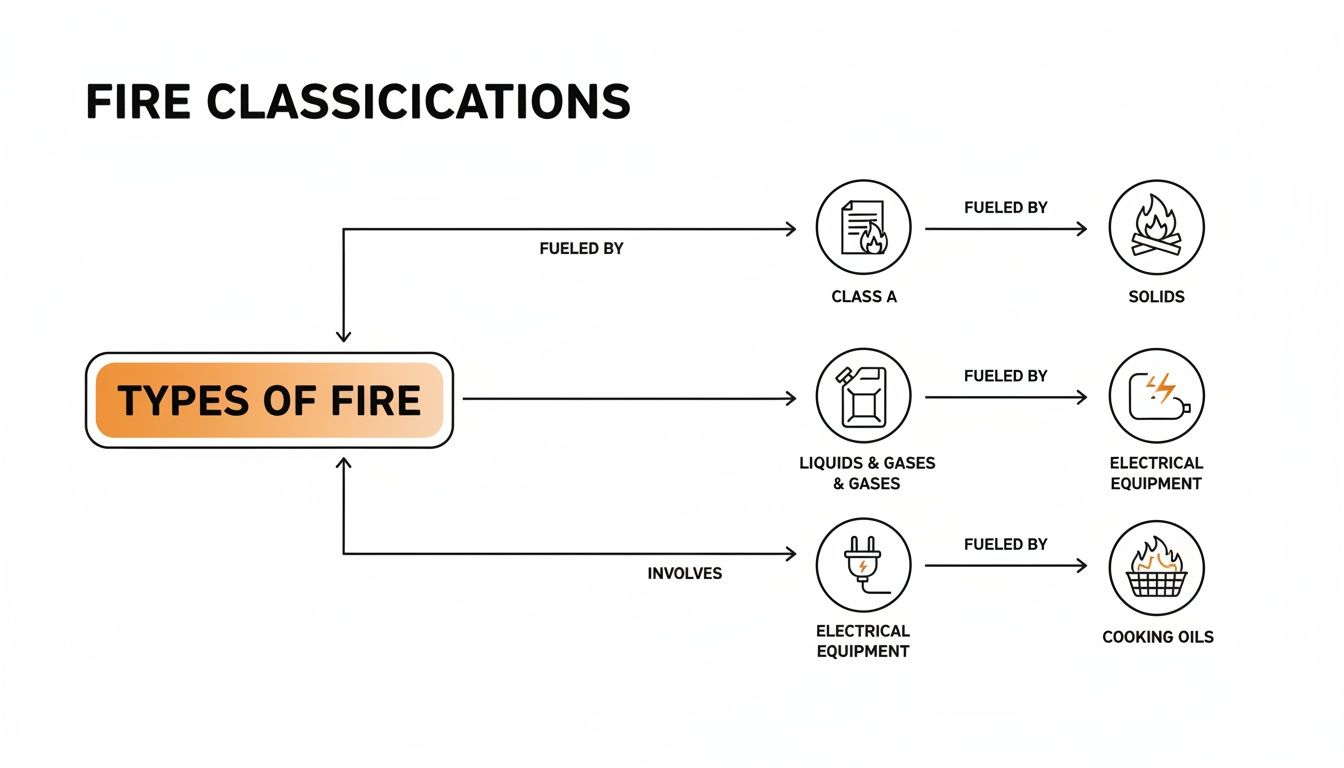
As you can see, Class B fires are all about flammable liquids—a whole different beast compared to Class A (wood, paper) or Class C (electrical) fires.
ABC Dry Chemical: The All-Purpose Workhorse
Walk into almost any business, and you’ll likely spot an ABC Dry Chemical extinguisher. It’s the versatile, jack-of-all-trades option because it can handle Class A, B, and C fires. The agent inside is a super-fine powder, usually monoammonium phosphate, that works by smothering the fire and breaking up the chemical reaction of the flames.
For a bustling restaurant on the Strip, that versatility is a massive plus. It’ll knock down a grease spill (Class B) just as well as it’ll handle an electrical fire from a dodgy commercial refrigerator compressor (Class C).
But here's the trade-off: the cleanup is a nightmare. That fine powder gets everywhere, and it’s not just messy—it's corrosive. It can wreck the sensitive electronics inside your modern ovens, POS systems, and other expensive gear.
Carbon Dioxide (CO2): The Clean Operator
If the ABC extinguisher is a sledgehammer, the Carbon Dioxide (CO2) model is a scalpel. Instead of powder, it blasts out a cloud of intensely cold CO2 gas. This does two things at once: it displaces the oxygen to suffocate the fire and simultaneously chills the fuel source.
The biggest win for CO2? It leaves absolutely no residue. Zero. This makes it the go-to choice for areas with delicate electronics like server rooms or around your main electrical panels, where food contamination is also a big worry.
The downside is that CO2 isn't great in open, drafty spaces. A strong blast from the HVAC or an open kitchen door can scatter the gas, making it less effective. You also have to get closer to the fire, as its range is shorter than a dry chemical model.
Choosing the right agent is a strategic decision. You're balancing firefighting power against potential collateral damage and cleanup costs. A messy dry chemical agent might save your building, but a clean CO2 agent might save your expensive equipment.
Foam Extinguishers: The Liquid Shield
Foam extinguishers are another solid choice for Class B fires, though you don’t see them as often in general-purpose kitchens. They shoot out a foam that spreads across the surface of a flammable liquid, creating a barrier that separates the fuel from the air. This blanket not only smothers the flames but also cools everything down to stop it from reigniting.
While foam is fantastic on liquid spills, its fatal flaw is that it's water-based. That means it cannot be used on electrical (Class C) fires. Using one on an electrical fire creates a serious electrocution hazard, which makes it a risky choice for the mixed-hazard environment of a commercial kitchen.
Picture this: a midnight rush in a Las Vegas casino kitchen where a fryer malfunction sparks a grease blaze—Class B fire extinguishers step in to prevent catastrophe, targeting flammable liquids that plague commercial cooking. Unlike water-based options that could explode the fire, Class B models use agents like ABC dry chemical powders, which coat fuels and interrupt the chemical reaction, ideal for the oils and solvents common in Atosa fryers or pizza prep tables. A striking 85% of building fires could be controlled with portables per recent studies, emphasizing their frontline role. Discover more insights about these fire extinguisher facts on rainbowrestores.com.
Where to Put Your Extinguishers (And How Big They Need to Be)
Buying the right Class B fire extinguishers is a great first step, but knowing exactly where to put them is just as important. In the fast-paced, sometimes chaotic world of a Las Vegas restaurant, smart placement means your team can grab an extinguisher and act in seconds. This isn't about guesswork; it's a strategic plan guided by codes designed to save lives and protect your business.
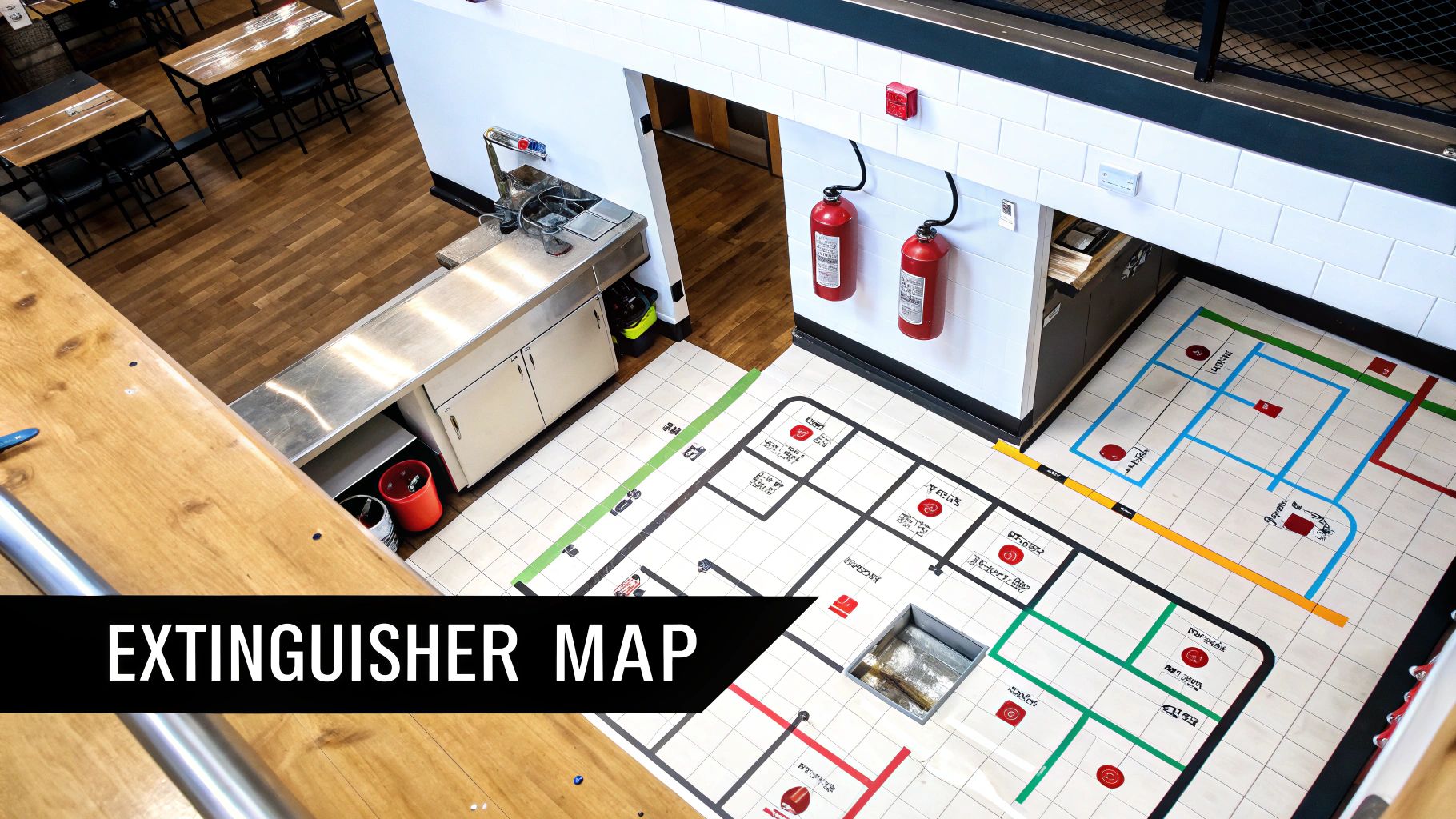
The National Fire Protection Association (NFPA) standard 10 is the official rulebook here, and it's what Las Vegas fire marshals live by during inspections. The key concept they'll be looking for is "travel distance"—that's the absolute farthest anyone should have to walk to get their hands on an extinguisher.
For Class B hazards—your flammable liquids—that distance is a lot shorter than for other fire types. The exact requirement depends on how risky the area is and how powerful your extinguisher is.
Understanding Ratings and Firefighting Power
Ever look at the label on an extinguisher and see something like 10-B or 40-B? That’s its Underwriters Laboratories (UL) rating, and it’s a direct measure of its firefighting muscle. It has nothing to do with how much the unit weighs; it's all about performance.
Think of it this way: the number in a Class B rating tells you the approximate square footage of a flammable liquid fire that an average person can put out.
- A 10-B extinguisher can handle a 10-square-foot fire.
- A 40-B extinguisher gives you the power to tackle a 40-square-foot fire.
Going with a higher-rated extinguisher not only gives you more security but can sometimes increase the allowable travel distance, giving you a bit more flexibility in your layout.
Mapping Out Your Las Vegas Kitchen
Let's bring this down to the floor of a typical Las Vegas restaurant. Your kitchen is ground zero for Class B risks, from cooking grease and fryers to flammable cleaning chemicals.
The general rule for Class B hazards is a maximum travel distance of 30 to 50 feet.
NFPA 10 Guideline: An extinguisher must be placed so that the travel distance to the nearest unit does not exceed 50 feet for lower-risk areas or 30 feet for higher-risk areas.
Basically, from any spot where a grease spill or other Class B fire could ignite, an employee should never be more than a few quick steps from an extinguisher.
Key spots to mount your extinguishers include:
- Near Exits and Walkways: Place extinguishers along the normal paths people walk, especially near exits. This makes them easy to grab on the way out if needed.
- Close to the Action: Put units right near where flammable liquids are used or stored, like by the cook line or inside chemical storage closets.
- Visible and Unblocked: They absolutely must be in a conspicuous spot where they can be seen easily. Never let them get blocked by ice machines, commercial freezers, or other restaurant equipment. The top of the extinguisher shouldn't be more than five feet off the ground.
A smart kitchen layout is your first line of defense. When you're designing a restaurant kitchen, mapping out fire extinguisher locations from the very beginning ensures you’re building a safe, compliant, and efficient workspace.
Passing Your Fire Marshal Inspection
For any restaurant operator in Las Vegas or Henderson, getting this right is your ticket to a smooth fire inspection. The fire marshal will walk your floor looking specifically at travel distances, signage, and whether the extinguishers are easily accessible.
When you follow the 30/50-foot rule and have the correctly rated Class B fire extinguishers in place, you’re showing the inspector that you're serious about safety. It proves your equipment isn't just there to check a box—it's ready for a real emergency.
Creating Your Fire Extinguisher Inspection Checklist
Owning the right Class B fire extinguishers is only half the battle. Making sure they actually work when you need them to is the other, and frankly, it’s the one that really counts. A fire extinguisher is just a red paperweight if it’s depressurized, damaged, or out of date.
For any restaurant in Las Vegas, a strict inspection schedule isn’t just a good idea—it's a legal must-have. We're talking requirements from OSHA and the NFPA, not to mention the Clark County Fire Department, who won't hesitate to write a fine.
The good news is that staying compliant and safe doesn't have to be a nightmare. It really boils down to three simple things: quick checks your team can do, an annual visit from a certified pro, and keeping good records of it all.
This kind of proactive approach keeps your equipment ready for the unique chaos of a commercial kitchen. Kitchens in the vibrant city of Las Vegas and across Nevada are ground zero for Class B fire threats, with all that grease bubbling away in fryers, on griddles, and over ranges. This is exactly where Class B fire extinguishers shine, using CO2 or dry chemicals to snuff out flames by cutting off oxygen.
Think they don't make a difference? In 2,600 monitored incidents, portable extinguishers like these put out 81.5% of fires completely and effectively controlled another 74.6%. The NFPA's 2023 data shows industrial fires make up 25% of all structural blazes in the U.S., a stat that hits close to home when you consider the 38,000 kitchen fires a year that cause over 270 injuries and $1.2 billion in damage. You can dig into these fire incident statistics from the U.S. Fire Administration for more detail.
Monthly Visual Inspections Your Staff Can Perform
Every single month, one of your trusted team members should do a quick visual once-over on every extinguisher in the building. It only takes a few minutes for each one, but it’s your best first defense against equipment failure.
Here’s the rundown of what to look for:
- Location and Accessibility: Is the extinguisher where it's supposed to be? Can you see it clearly, and is there anything blocking it—like boxes, commercial refrigerators, or trash cans?
- Pressure Gauge: For the common dry chemical models, check the needle. It needs to be in the green zone. If it’s pointing to the red (either overcharged or undercharged), it needs professional service right away.
- Physical Condition: Give it a good look. Do you see any big dents, rust, corrosion, or signs of leaking? Make sure the nozzle is clear of any gunk.
- Pin and Tamper Seal: Is the locking pin in place? Is the plastic tamper seal still intact? If that seal is broken, it’s a red flag that someone might have used or messed with it.
The Annual Professional Maintenance Visit
Your monthly checks are non-negotiable, but they don’t take the place of the annual inspection by a certified fire protection technician. This professional visit is mandatory to stay compliant and involves a much deeper dive into the extinguisher's health.
The technician will go through every part of your extinguisher's functionality, checking everything from its internal guts to the labels on the outside. When they're done, they'll attach a new, dated service tag. That tag is the very first thing a fire marshal looks for during an inspection.
This annual service is your official proof that you're doing things by the book. It's also when the technician will handle required internal maintenance (done every six years for dry chemical units) or let you know when it's time for longer-term hydrostatic testing.
Hydrostatic Testing and Keeping Detailed Logs
So, what's hydrostatic testing? It's a process where the extinguisher's cylinder is pressure-tested to make sure there are no hidden leaks or metal fatigue. This is required every five years for CO2 extinguishers and every 12 years for dry chemical models. Your certified tech will take care of this off-site.
Finally, write everything down. Keep a dedicated logbook or a simple digital file for every inspection, both the monthly walk-throughs and the annual pro service. Note the date, who did the inspection, and any problems you found or fixed. This log is critical evidence for fire code officials that you’re on top of your safety game.
Keeping these records straight is just as important as managing any other compliance paperwork, like the logs related to your grease trap sizing and maintenance.
Training Your Staff for a Fire Emergency
You can have the best class B fire extinguishers in all of Las Vegas, perfectly placed and ready to go, but they're useless if your team doesn't know how to use them. An extinguisher is just a tool, and in a real emergency, a tool without a trained hand is just a red can on the wall. The final, most critical piece of your fire safety plan is empowering your team with the confidence and knowledge to act decisively.
The goal here is simple: turn panic into action. When things get heated—literally—your staff needs a simple, memorable technique that they can fall back on without thinking. This is where the P.A.S.S. method comes in. It's the gold standard for a reason.
The P.A.S.S. Technique Made Simple
This four-step process is the universal method for using a fire extinguisher. It should be drilled into every single employee from day one.
- Pull: Pull the pin. It's that little metal ring at the top. This breaks the tamper seal and gets the extinguisher ready for action.
- Aim: Aim the nozzle right at the base of the fire. You're not trying to fight the flames in the air; you have to smother the fuel source on the ground.
- Squeeze: Squeeze the lever slowly and evenly. This will release the extinguishing agent.
- Sweep: Sweep the nozzle from side to side, making sure to cover the entire base of the fire until it's completely out.
This simple technique builds muscle memory. In a high-stress situation, your team will act on instinct instead of freezing up.
Knowing When to Fight and When to Flee
Just as important as knowing how to fight a fire is knowing when. You have to teach your team to make that split-second judgment call: Can I handle this, or do we need to get out now? A small, contained blaze—like a little grease spill that just caught fire on the floor—is exactly what these portable extinguishers are designed for.
Your team’s personal safety is always, without question, the number one priority. If a fire is spreading fast, if smoke is filling the room, or if it’s blocking their way out, their only job is to evacuate, close the door behind them, and call 911.
Beyond just the extinguishers, it’s smart to implement essential employee safety training programs that cover all the bases. This builds a real culture of safety where being prepared is just second nature to everyone on your crew.
Your safety briefing for your Las Vegas or Henderson team doesn't need to be some complicated, drawn-out affair. Just cover the key points:
- Emergency Exits: Make sure everyone knows every single way out of the building, not just the front door.
- Muster Point: Pick a safe spot outside, away from the restaurant, where everyone will meet after an evacuation.
- Communication Plan: Who calls 911? Who is in charge of getting customers out safely?
- Extinguisher Locations: Your staff should be able to point to the nearest Class B, K, and ABC extinguishers with their eyes closed.
Regular, short safety huddles can transform your crew from scared bystanders into a capable first line of defense, ready to protect themselves, your customers, and the business you've worked so hard to build.
Common Questions About Kitchen Fire Extinguishers
When you're running a restaurant in the vibrant city of Las Vegas, fire safety compliance can feel like a maze. It’s a high-stakes environment, and knowing the ins and outs of your fire extinguishers is absolutely crucial for protecting everything from your bustling dining room to the hard-working kitchen filled with essential restaurant equipment. Here are some quick answers to the questions we hear most often from restaurant owners.
Do I Need Both Class K and Class B Extinguishers?
Yes, almost every commercial kitchen needs both, and for good reason. Think of them as specialists on the same team.
A Class K extinguisher is your go-to for the incredibly hot fires that can erupt in modern commercial deep fryers and griddles. Its wet chemical agent is the only thing that can reliably cool that scalding oil and stop it from reigniting.
But you still need a Class B fire extinguisher. It handles other flammable liquid threats, like a grease spill on the floor away from the cook line or a fire involving cleaning solvents in a storage closet. Each one has a specific, critical job to do.
How Often Must Fire Extinguishers Be Replaced?
It really depends on the type of extinguisher you have. The disposable ones that can't be recharged have a clear expiration date—they must be replaced entirely 12 years from the date they were manufactured.
Rechargeable extinguishers work on a different schedule. They need:
- Internal Maintenance: A certified pro has to perform an internal check-up every six years for dry chemical models.
- Hydrostatic Testing: This is a pressure test to make sure the cylinder is still sound. It’s required every five years for CO2 units and every 12 years for dry chemical extinguishers.
And, of course, if an extinguisher has been used—even for a second—or shows any sign of damage, it needs to be professionally serviced or replaced immediately.
Can I Use a Class B Extinguisher on an Electrical Fire?
This is a great question, and the answer comes down to what’s inside. Many Class B fire extinguishers, like the Dry Chemical or Carbon Dioxide (CO2) types, are also rated for Class C (electrical) fires. That makes them perfect for tackling a fire in a commercial freezer or from some faulty wiring.
Always check the label on the extinguisher itself. If you see a "C" rating next to the "B," you're good to go on an electrical fire. But be careful—foam-based extinguishers are a definite no-go for Class C, as the water in the foam conducts electricity and could create a serious shock hazard.
What Are Common Fire Code Violations in Restaurants?
Fire marshals in Las Vegas and Henderson see the same mistakes over and over. The most frequent slip-ups include blocked or hard-to-reach fire extinguishers, expired inspection tags, and missing or incorrect signage.
The big one, though, is having the wrong type of extinguisher for the job. A classic example is not having a dedicated Class K unit within 30 feet of a deep fryer. That's an easy mistake to make, but it's one that can lead to a failed inspection and a hefty fine.
For all the essential restaurant equipment your Las Vegas kitchen needs for success, from commercial refrigerators and commercial freezers to ice machines and the right safety gear, trust the experts. Las Vegas Restaurant Equipment offers reliable, warranty-backed products with fast, free shipping to ensure your operation is safe, compliant, and ready for business. Check out our selection at https://lasvegasrestaurantequipment.com.