

Once the last slice of prosciutto or roast beef hits the tray, your job isn't done. The very next steps you take are arguably the most important of the day for that piece of equipment. This isn't just about cleanup; it’s about a non-negotiable safety protocol that protects your team, your customers, and your investment.
Your Immediate Post-Use Meat Slicer Safety Plan
In the vibrant city of Las Vegas, where you'll find a diverse array of restaurants that cater to every palate, from a packed buffet on the Strip to a beloved Henderson deli, what you do the moment that blade stops spinning matters. We're talking about the bedrock of kitchen safety and hygiene, the kind of stuff that keeps the Southern Nevada Health District happy and your operation running smoothly.
Consistency is king. Success in this competitive landscape requires the essential restaurant equipment needed for success, including commercial refrigerators, commercial freezers, and ice machines. A solid shutdown routine for this equipment, especially your slicer, is what separates the pros from the amateurs. Let’s walk through the immediate, must-do actions before you even think about grabbing a scrub brush.
The seconds after you finish slicing are crucial. This isn't the time for deep cleaning yet; it's about making the machine safe to approach. Here's a quick-reference table for the immediate actions every operator should take, without fail.
Immediate Actions After Using Your Slicer
| Action | Why It's Critical in a Las Vegas Kitchen | Timeframe |
|---|---|---|
| Power Down & Unplug | Eliminates any chance of accidental startup. This is a huge liability and a common source of horrific injuries. | Immediately |
| Set Blade to Zero | Guards the razor-sharp edge, protecting hands from accidental cuts and the blade from being nicked or damaged. | Immediately |
| Initial Wipe-Down | Removes large debris and grease, making the full sanitation process faster and more effective. Prevents food from drying and hardening on the machine. | Within 1 Minute |
Think of these three steps as the "safe out" procedure for your slicer. They create a secure environment, signaling to everyone in the kitchen that the machine is offline and ready for its full cleaning and sanitation cycle.
First Actions After Slicing
Okay, let's break down those initial steps. The goal here is simple: neutralize any immediate danger so you can move on to the real cleaning.
First, kill the power. Hit the switch to turn it off, then physically unplug the slicer from the wall. This isn't optional. Having two layers of protection ensures there's absolutely zero chance of that blade firing up while someone's hands are nearby.
Next, dial that thickness knob all the way back to the "zero" setting. This tucks the blade's edge safely behind the guard plate. It’s a small move that protects both your staff from nasty cuts and the blade itself from getting dinged.
Finally, do a quick pre-clean. With the slicer confirmed off and unplugged, grab a cloth or paper towel and carefully wipe away any big chunks of food, grease, or residue. Getting the gunk off now makes the real sanitation process a whole lot easier and more effective.
That blade is unforgiving, even when it’s not moving. Never, ever attempt to clean or handle the blade without wearing proper, high-quality cut-resistant gloves. It's a simple piece of PPE that prevents a trip to the ER.
A strict, repeatable safety routine is just as vital as having the right fire safety gear. Speaking of which, grease-heavy equipment always carries a fire risk, which is why understanding your extinguishers is so important. You can get a full rundown on Class B fire extinguishers in our detailed guide. Ultimately, these careful post-use procedures are a cornerstone to prevent foodborne illness and keep your kitchen safe.
A Practical Guide to Disassembling and Cleaning Your Slicer
Look, a quick wipe-down just doesn't cut it. For any busy kitchen in Las Vegas—from a Fremont Street spot to a massive Strip resort buffet—after using a meat slicer you should have a non-negotiable disassembly protocol. It’s the only way you’re going to get into every single groove and crevice where nasty bacteria love to hide and multiply.
Proper cleaning is a system, a routine. It’s what keeps your customers safe from foodborne illness and ensures your essential equipment runs like a champ for years to come. So let’s walk through how to actually break down and clean this thing.
Before you even think about taking parts off, the first three steps are always the same.
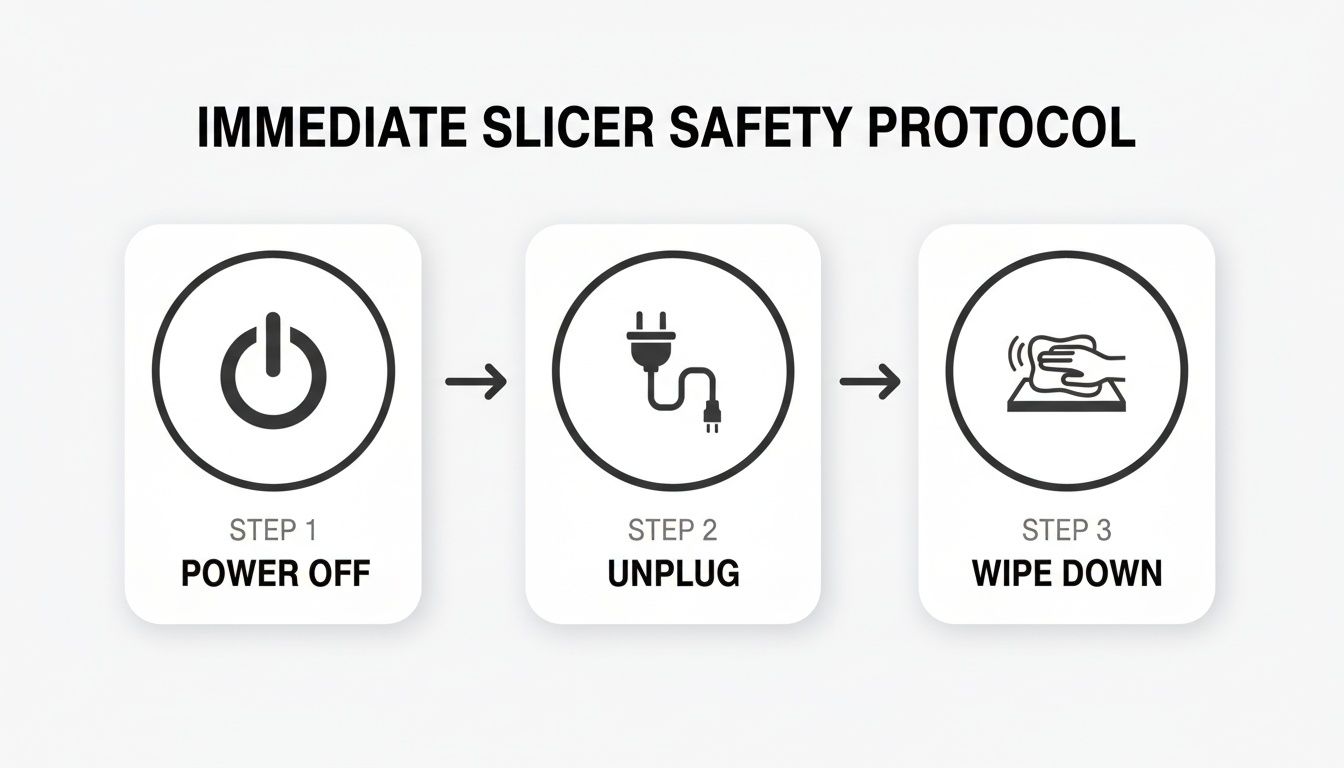
Getting this three-step safety check done—power off, unplug, wipe down—puts the slicer in a secure state. Only then is it actually safe to handle for a deep clean.
Preparing for a Deep Clean
Before you loosen a single screw, the very first move is gearing up. Get yourself a pair of quality, cut-resistant gloves. That blade is ridiculously sharp even when it’s not moving, and this is a piece of PPE you never, ever skip.
Next, get your cleaning station ready. The gold standard here is a three-compartment sink, which is absolutely vital for the wash, rinse, and sanitize method. You’ll want to fill the first sink with hot, soapy water, the second with clean rinse water, and the third with a food-safe sanitizing solution, diluted to the proper concentration.
Step-by-Step Slicer Disassembly
Alright, the slicer is unplugged and you’ve got your gloves on. Time to start taking it apart. Most models are built similarly, even if the exact mechanisms differ.
- Take Off the Product Tray: This is almost always the first piece to go. It might just slide right off, or you may have to release a simple lock or lever to get it free.
- Remove the Blade Cover: The guard that sits over the blade is made to be removed easily. Just look for a knob or latch that releases it. Getting this out of the way is key to exposing the entire blade for cleaning.
- Carefully Remove the Blade: This is where you need to pay the most attention. Most commercial slicers come with a specific blade removal tool or have a sequence you need to follow. Always check your manufacturer's manual, handle that blade like it's made of glass, and never rush this step.
Once you have all the parts off, you can start the cleaning process for each piece.
Get all those removable parts—the product tray, blade cover, and the blade itself—submerged in that first sink of soapy water. Use a dedicated brush to scrub every surface, and really focus on the seams and edges where food bits love to get stuck.
After a good scrub, move each part over to the second sink for a solid rinse with clean water to get all the soap off. Finally, they go into the sanitizing solution for the required contact time—check the sanitizer's instructions. This is the step that actually kills off any lingering bacteria.
While those parts are soaking, turn your attention back to the slicer's body. Grab a clean, sanitized cloth and meticulously wipe down every single surface. You need to get into the tracks where the carriage slides and clean all around the motor housing and control knobs. If you’ve got some stubborn grime, a non-abrasive scrub pad will do the trick. It's a process that's just as important as cleaning your other stainless steel gear; for more tips on that, check out our guide on how to clean stainless steel grill grates.
Getting Sanitization Right: It’s More Than Just Wiping It Down
Let’s be clear: cleaning a slicer and sanitizing it are two completely different things. Getting that distinction right is what separates a safe Las Vegas kitchen from a disaster waiting to happen.
Cleaning gets rid of the visible grease and food scraps. But sanitizing? That’s the mission-critical step where you actually kill the pathogens—like Listeria—that you can't see. In the non-stop rush of a casino buffet or a busy Summerlin deli, this isn’t just a good idea; it’s a public health requirement.
Think about your other essential gear, like your commercial refrigerators and freezers. You count on them to keep food out of the temperature danger zone. Sanitizing your slicer is the same kind of active safety measure. It's your last line of defense against cross-contamination before that blade touches food again.
The Four-Hour Rule Isn't a Suggestion
The FDA Food Code doesn't mince words: after using a meat slicer you should break it down for a full clean and sanitization at least every four hours if it's in continuous use. This "four-hour rule" is specifically designed to stop dangerous bacteria in their tracks. In the temperature danger zone (41°F to 135°F), four hours is all it takes for a small problem to become a full-blown hazard.
In a fast-paced Vegas kitchen, four hours can disappear in a flash. That’s where things get tricky. A 2016 CDC study really pulled back the curtain on this, showing that while 63.0% of kitchen staff said they cleaned their slicers every four hours, inspectors found that only 45.8% of delis were actually compliant. The gap between knowing and doing is huge.
The four-hour rule is what we call a critical control point. It’s non-negotiable. Set timers on your phone, put a specific person in charge of it each shift, and build it into your opening, mid-shift, and closing duties until it’s automatic.
Choosing Your Sanitizer Wisely
Not just any chemical will do. You need a food-safe sanitizer approved for food-contact surfaces. In most kitchens I've worked in around Vegas, we stick to one of these three:
- Quaternary Ammonium (Quats): A great go-to. It’s effective, not too harsh on your equipment, but you have to get the dilution just right.
- Chlorine (Bleach): It’s cheap, it's powerful, and everyone has it. The downside is that if you mix it too strong, it can be corrosive to metal parts over time.
- Iodine: You don’t see it as often, but it works well. Just be aware that it can sometimes stain plastic components.
Mixing it right is everything. Too weak, and you're just spreading germs around. Too strong, and you could leave behind a chemical residue. Always—and I mean always—use test strips to check that your solution has the correct parts per million (PPM) listed on the manufacturer's label.
Why Contact Time is the Secret Ingredient
So, you've sprayed the sanitizer. You’re not done yet. This is the part everyone messes up.
Contact time is the minimum amount of time the sanitizer needs to stay wet on the surface to actually kill anything. If you just spray and wipe, you’ve accomplished nothing.
For most quat or chlorine-based sanitizers, we’re talking 30 to 60 seconds. The surface of the slicer and all its parts need to stay visibly wet for that full time. Let it sit, then you can let it air-dry or wipe it down with a fresh, single-use towel. Respecting the contact time means you actually finished the job. Knowing these details is a huge part of being prepared for a surprise visit and will help you ace every item on your restaurant health inspection checklist.
Looking Over Your Blade and Slicer for Peak Performance
So, you've got the slicer sparkling clean, but the job isn't quite done yet. In the high-stakes, fast-paced restaurant world of Las Vegas, "good enough" never cuts it. A clean slicer is about food safety, for sure. But a meticulously inspected one? That's about protecting your bottom line, your equipment investment, and the quality that makes guests choose you over the place next door.
This quick post-cleaning once-over is your best defense against unexpected breakdowns.
Think of it as a daily health check for one of the hardest-working machines in your kitchen. Taking just a minute to look it over after every clean can be the difference between serving perfect, paper-thin prosciutto and having a machine that chews up product, literally costing you money with every pass.
Your Daily Inspection Checklist
A systematic check is the only way to make sure nothing gets missed. After the deep clean is done, take a beat to really examine the slicer's most important parts. It's not just about the blade—the whole machine is a system, and one small worn-out part can throw the entire operation off kilter.
- Seals and Gaskets: Get a good look at all the rubber and silicone seals. Are they cracking, dry, or torn? Here in Nevada's dry climate, these components can degrade way faster than you'd think, creating tiny hiding spots for bacteria.
- Guards and Handles: Run your eyes and hands over the blade guard, product tray, and all the handles. Any cracks or chips? A damaged guard isn't just a health code violation; it's a major laceration risk waiting to happen.
- Feet and Stability: Give the slicer a little nudge. Are the feet secure? Does it sit perfectly level without a hint of a wobble? An unstable slicer is a dangerous slicer, period.
This is the kind of routine that gets skipped when the dinner rush is looming, but it's critically important. A 2018 study of delis found that only 37.9% of the 685 slicers they observed were completely undamaged. Many had risky cracks in guards and gaskets that operators had overlooked.
Even more telling, the same study noted that a mere 26.9% of workers actually disassembled and inspected their slicers after every full cleaning cycle. That's a huge gap in procedure. You can see the full findings for yourself over on the National Center for Biotechnology Information's website.
Blade Sharpening and Slicer Lubrication
Let's get one thing straight: a sharp blade is a safe blade. A dull one just tears at the meat, creates a ton of product waste, and puts a ton of unnecessary strain on the slicer's motor. Most modern commercial slicers have a built-in sharpener, which makes this a pretty simple task.
How often you do it really comes down to your volume. A high-traffic casino buffet carving prime rib for hours on end should be sharpening that blade daily. A smaller neighborhood bar just slicing lemons and limes for garnish might only need to do it once a week. Your product will tell you when it's time—if you start seeing ragged, shredded cuts, sharpen that blade immediately.
A sharp blade cuts, a dull blade rips. Ripped product looks unappealing and hurts your bottom line. Regular sharpening is a two-minute task that saves you hundreds of dollars in wasted inventory over time.
Finally, don't forget the lube. Key moving parts, especially the carriage slide rod, need a regular application of a food-grade lubricant to keep things running smoothly. This simple step prevents friction and wear, which is how you extend the life of your essential restaurant equipment. From your commercial refrigerators to your slicer, proper maintenance is what allows them to handle the relentless pace of a Las Vegas kitchen.
Putting It All Back Together: Proper Reassembly and Storage
Alright, you’ve done the hard part. The slicer is clean, sanitized, and all the parts are bone-dry. Now for the final phase. In any fast-paced Las Vegas kitchen, whether you're slinging sandwiches on the Strip or running a local deli, getting this last step right is non-negotiable. Putting your slicer back together correctly means it’s safe and ready to rock for the next shift.
Don't rush this. Taking an extra minute to reassemble everything properly is what separates the pros from the rookies. It prevents operational hiccups and potential injuries. A kitchen that's always ready is an efficient one, and that starts with your core equipment—the slicer, your commercial freezers, and even the ice machines.
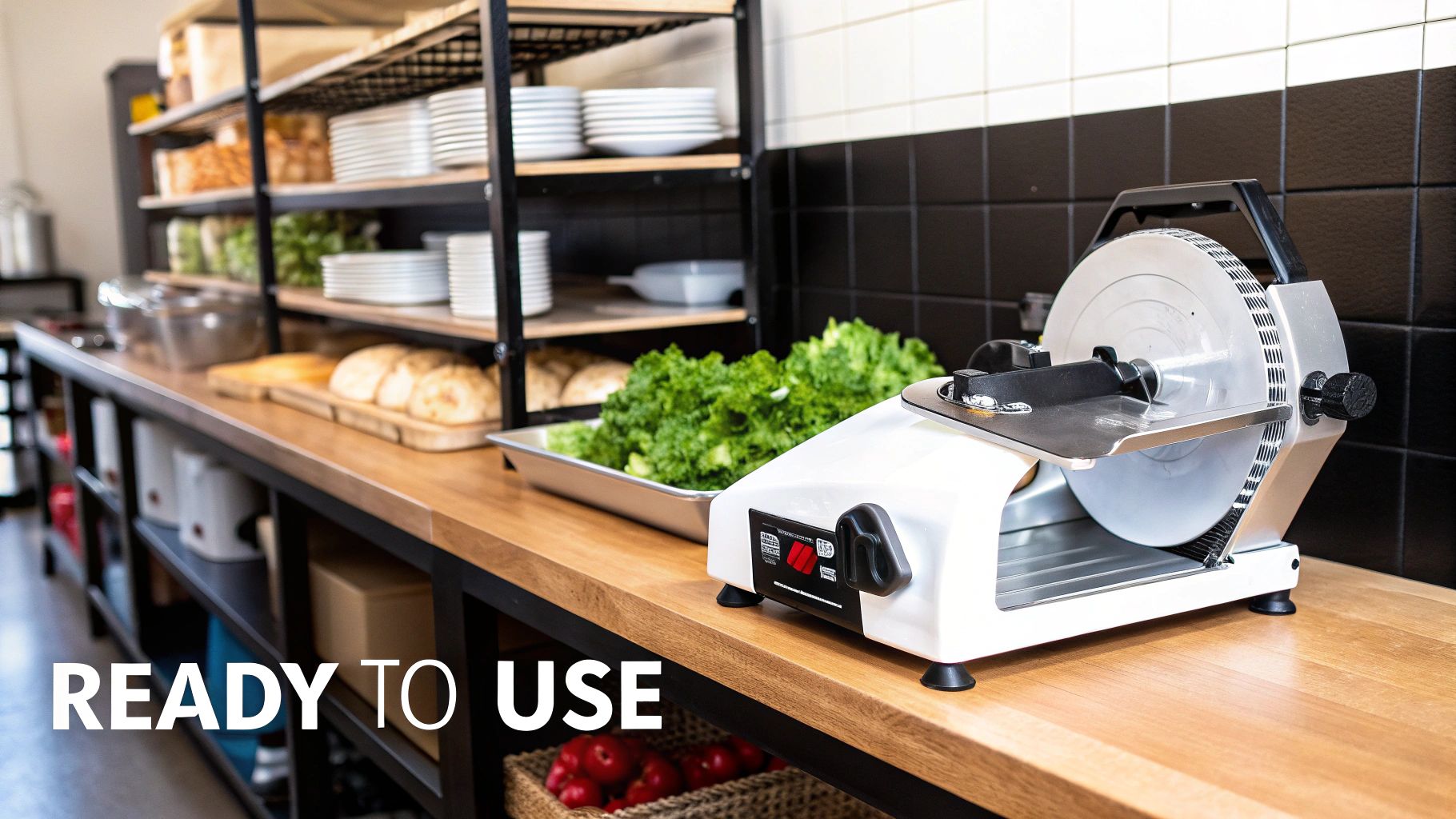
A Guide to Safe Reassembly
With all your clean, sanitized, and dry parts laid out, it's time to put the puzzle back together. Always, and I mean always, have the manufacturer's guide handy, especially if you’re new to the specific model. The little details matter.
Generally, you’re just working in reverse of how you took it apart. Start with the blade. Carefully reattach it, using the blade removal tool if your model came with one. Make sure it’s seated perfectly and securely tightened. Next up is the blade cover; you should hear a solid click or feel a latch engage to know it’s locked in place. Last, slide the product tray back onto its tracks. It should glide smoothly with zero resistance.
Pro Tip: Before you walk away, do one last safety check. Give the blade guard and the product tray a firm but gentle tug. Do they feel solid? No wobble? This five-second check can prevent a serious accident when the morning rush hits.
Look, whether you’re slicing pastrami for a Summerlin pizza joint or roast beef for an Enterprise liquor store deli, this deep clean is your best defense against cross-contamination. The FDA isn’t shy about pointing out how poorly sanitized slicers become major food safety risks. It's a big deal, and it's why the market for quality gear is booming—the global commercial food slicers market hit $1.17 billion in 2025 and is projected to reach $2.20 billion by 2033. That growth is driven by everyone from food trucks to massive casino operations in Nevada needing equipment they can count on. You can read more about the FDA’s concerns on deli slicer sanitation right from the source.
Smart Storage Practices for a Ready Kitchen
Once the slicer is fully reassembled, the last thing on your checklist is storing it correctly. This protects your hard work and the machine itself from the controlled chaos of a busy kitchen.
- Zero Out the Blade: This is the most important step. Turn the thickness dial all the way back to the 'zero' setting. This retracts the blade completely behind the guard, making it impossible for someone to accidentally cut themselves on it.
- Cover It Up: Use a clean, dedicated cover and drape it over the entire unit. This is your shield against overnight dust, grease splatter from other stations, and whatever else is floating around in the air.
- Find a Safe Home: Don't just leave it anywhere. Designate a specific spot for the slicer that’s out of the main foot-traffic paths. This prevents it from getting bumped, knocked, or damaged, protecting your investment and keeping it ready for action.
Common Questions We Get About Meat Slicer Care
Even with a rock-solid routine, questions always pop up in the heat of service. Whether you're running a high-volume deli on the Strip or a neighborhood spot in Henderson, getting the right answers keeps your crew safe and your slicer humming.
We hear these questions all the time from restaurateurs, so let's clear them up. Getting this stuff right turns good habits into muscle memory for your whole team.
How Often Should I Really Sharpen My Slicer Blade?
Honestly, it all comes down to how much you use it. If you're that busy casino deli pushing out meat for hours straight, sharpening should be a daily ritual. No question. For a smaller restaurant with more moderate slicing needs, you can probably get away with doing it weekly.
The best way to tell? Let the product do the talking. The moment you see meat shredding or tearing instead of falling away in perfect, clean slices, it’s time. Taking a few minutes to sharpen doesn't just prevent food waste—it also takes a huge strain off the slicer’s motor, which will save you a lot of money and headaches down the road.
What Are The Biggest Safety Mistakes You See When Cleaning a Slicer?
I've seen it all, but the same three major mistakes always top the list.
- Forgetting to unplug the machine first: This is the big one. It's the single most dangerous mistake you can make, and it’s how serious accidents happen. Always, always unplug it before a single drop of water touches it.
- Not wearing cut-resistant gloves: That blade is dangerously sharp, even when it’s not moving. A good pair of protective gloves isn't optional; it's essential safety gear.
- Rushing the process: Trying to get it done too fast is a recipe for disaster. You'll miss spots where bacteria can multiply, and you might even damage the machine by trying to scrub it with something like steel wool. Slow and steady wins the race here.
Can I Just Throw Slicer Parts in a Commercial Dishwasher?
That's a hard "no" from me. I know some manufacturer manuals might say certain small parts are dishwasher-safe, but it's a really bad habit to get into. The extreme heat and aggressive detergents in a commercial dishwasher will absolutely destroy protective coatings, warp metal components, and dull that expensive blade faster than you can believe.
There's a reason the three-sink method (wash, rinse, sanitize) is the industry standard. It's the only way to guarantee every single part is spotless and gives you a chance to inspect everything for wear and tear.
Do I Really Need to Clean the Slicer Between Different Meats?
Yes, 100%. This is non-negotiable for preventing cross-contamination. At a minimum, you need to wipe down the blade, product tray, and guard with a fresh, sanitized cloth to avoid mixing flavors or, even worse, allergens.
But if you're switching from a raw product to a cooked one, or from meat to cheese, a simple wipe-down isn't enough. You need to do a more thorough cleaning. This is a fundamental food safety step that protects your customers and is just as critical as making sure your commercial refrigerators and commercial freezers are holding at the right temp. It's just part of running a professional Las Vegas kitchen.
Equipping your kitchen with reliable, high-performance gear is the first step toward success. At Las Vegas Restaurant Equipment, we provide the warranty-backed commercial refrigerators, freezers, ice machines, and slicers you need to operate safely and efficiently. Explore our full catalog and get free, fast shipping to your door at https://lasvegasrestaurantequipment.com.