

When your Manitowoc ice machine suddenly gives up on you, the culprit is almost always one of three things: a dirty condenser, a clogged water filter, or a simple power supply hiccup. Before you start thinking the worst, start your Manitowoc ice machine troubleshooting with these high-impact areas. More often than not, it’s a quick fix, even in the most demanding kitchens.
Why Ice Machine Uptime Is Critical In Las Vegas
In the vibrant city of Las Vegas, where you'll find a diverse array of restaurants that cater to every palate, a working ice machine isn't just a convenience—it's the heartbeat of your service. Whether you’re running a high-end cocktail bar on the Strip or a busy cafe in Summerlin, a steady supply of clean, quality ice is non-negotiable. When that machine goes down, you're not just dealing with an inconvenience; you're looking at a direct hit to your bottom line.
A dead Manitowoc during a dinner rush spells disaster. You’re facing lost drink sales, potential food safety issues, and that frantic, expensive run to the store for bags of ice. In a city that truly never sleeps and operates under intense desert heat, the strain on our commercial kitchen equipment is on another level. This environment creates a unique set of challenges that can push even the toughest machines to their breaking point.
The Unique Challenges In The Desert
Running any kind of commercial refrigeration in Nevada comes with its own set of hurdles. Your Manitowoc, a finely tuned piece of equipment, is especially susceptible to our local climate and water conditions. I’ve seen the same issues pop up time and time again across the valley.
- Extreme Ambient Temperatures: Las Vegas kitchens can easily soar past 100°F in the summer. This forces your machine’s compressor and condenser to work overtime just to cool down, leading to increased wear and a serious drop in ice production.
- Hard Water Scale Buildup: Southern Nevada's water is notoriously hard. It’s packed with minerals that leave behind limescale, which is the arch-nemesis of an ice machine. This gunk clogs water lines, coats critical sensors, and insulates the evaporator plate, resulting in those small, mushy, or misshapen cubes right before a total system failure.
- Airborne Dust and Debris: It's the desert—dust and grease are just part of the atmosphere. Your machine’s air filter and condenser coils are constantly pulling this stuff in. A clogged condenser is one of the top reasons for overheating and a complete shutdown.
I've seen it firsthand in the field. Industry studies show that commercial ice makers are responsible for a hefty 8-10% of all refrigeration service calls, but here in Vegas, it feels much higher. I’d bet that well over 60% of the calls we get stem from totally preventable issues like a dirty condenser or scale buildup from our hard water. It’s why regular maintenance is so vital for all your restaurant equipment.
Recognizing these local challenges is the first real step in smart Manitowoc troubleshooting. It’s about shifting your mindset from just fixing a broken machine to proactively keeping it from breaking in the first place. Success requires essential restaurant equipment, and keeping everything from your commercial refrigerators and commercial freezers to your ice machines running smoothly is key. It all starts with understanding the environment. And while you're at it, check out our guide on how choosing energy-efficient commercial refrigeration can help you battle the operational costs and strain of our Las Vegas climate.
To make things even easier, I've put together a quick-reference table. When you're in the middle of a rush and the ice bin is looking empty, this is the first place you should look.
Common Manitowoc Issues And Their Likely Causes In Las Vegas
| Symptom | Common Cause in Las Vegas | First Troubleshooting Step |
|---|---|---|
| No Ice Production | Dirty/clogged condenser coils from desert dust. | Clean the condenser coils and air filter immediately. |
| Small or Hollow Ice | Limescale buildup on the evaporator plate from hard water. | Run a cleaning and descaling cycle on the machine. |
| Machine Shuts Down | High head pressure from extreme kitchen heat. | Ensure adequate ventilation and check for condenser blockage. |
| Leaking Water | Clogged drain line or mineral buildup on water components. | Inspect and clear the drain tube and water trough. |
This table covers the most frequent problems we see out here. By starting with these common local culprits, you can often get your machine back up and running without needing a service call.
Your First-Response Troubleshooting Checklist
When your Manitowoc ice machine dies in the middle of a dinner rush, panic is usually the first thing on the menu. But before you start picturing a service call bill, take a deep breath. I can tell you from experience that more than half the time, the fix is something simple that any of your staff can handle.
These first few checks don't require any tools or technical know-how. They just target the common, simple oversights that happen in the controlled chaos of a busy Las Vegas kitchen or bar. Think of this as your essential Manitowoc ice machine troubleshooting starting point.
This flowchart lays it all out, walking you through the first questions to ask. It always starts with the two biggest culprits: power and water.
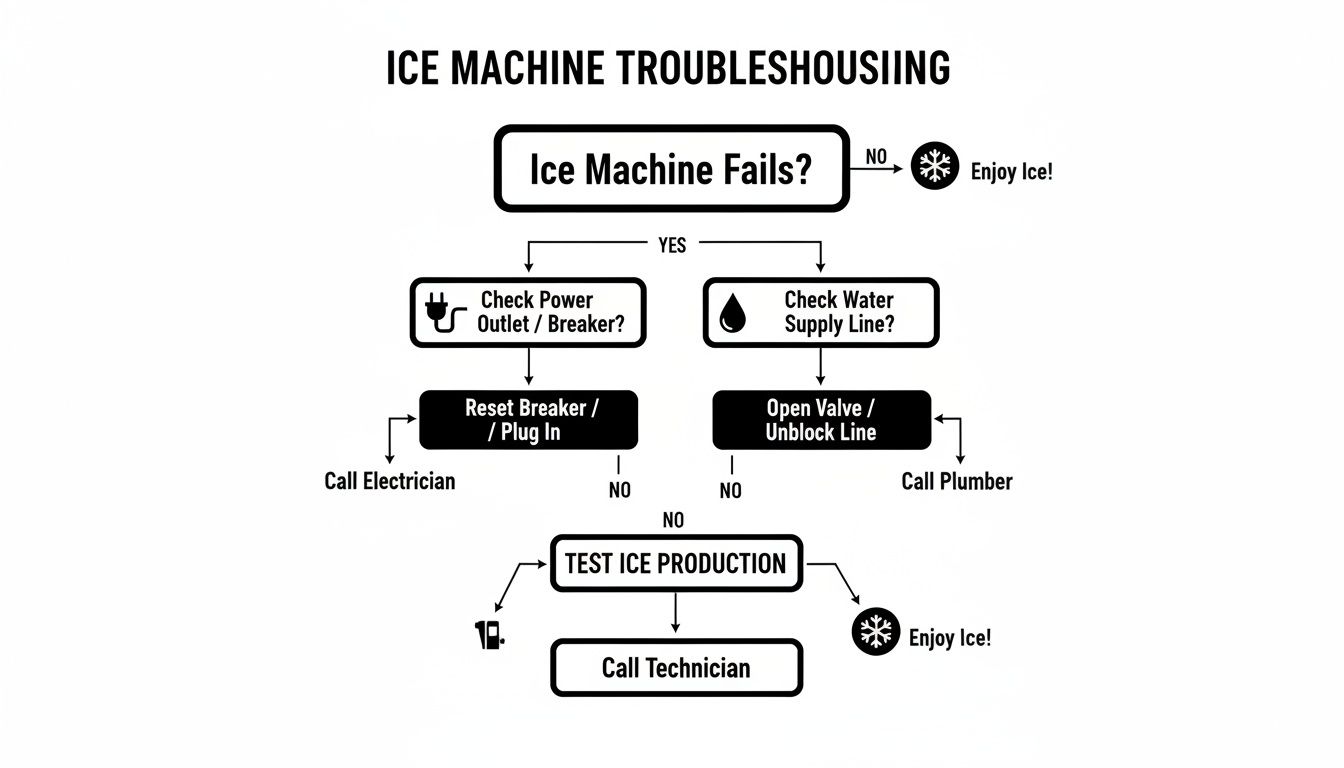
Before you ever think about taking a panel off, just confirming the basics is the fastest way to get your machine making ice again.
Verify The Basics: Power and Settings
Always, always start with the power. It sounds too simple, but you wouldn't believe how often a cleaning crew unplugs a machine by accident or a quick power flicker trips a breaker.
- Check the Plug: Get behind the machine and make sure that cord is pushed all the way into the outlet.
- Inspect the Breaker: Find your electrical panel. Is the breaker for the ice machine flipped? Sometimes a breaker can look like it's on but has actually tripped. Flip it hard to the "OFF" position, then firmly back to "ON" just to be certain.
- Confirm the Mode: Take a look at the control panel. Someone could have easily bumped the switch to "OFF" or "CLEAN" during their shift. Make sure it’s set to "ICE" or "ON."
These three checks take less than 60 seconds and solve an incredible number of "my machine is broken" calls.
Inspect The Water Supply
It’s a simple equation: no water, no ice. A choked-off water supply is the next major offender, and it's often the reason for those thin, hollow, or misshapen cubes that just won't fly in a high-end cocktail.
First, find the water line running into the back of your ice machine and follow it to the shut-off valve. Make sure that valve is turned all the way open. It's common for them to get partially closed, which starves the machine of the water it needs to make full, solid cubes.
If you’re dealing with slow production and small ice, it’s worth looking into what causes low water pressure in your building. While that article is focused on L.A., the plumbing principles are the same here in Nevada. Low water pressure means your machine can't fill and freeze efficiently.
A crucial part everyone forgets is the water curtain or damper switch. It’s a simple plastic piece that hangs inside. If it gets knocked out of place or is stuck open, the machine thinks the bin is full and won’t start a new batch of ice. Make sure it's hanging freely.
Finally, give the drain line a quick check. If it's clogged, water can back up, trigger an error, and shut everything down. Just like with your walk-in coolers and freezers, a clear drain is non-negotiable. Of course, the bin itself needs to be in good shape, too. For more on that, check out our guide on choosing the right ice bin for your ice machine.
Decoding Common Error Codes And Production Issues
When your Manitowor ice machine starts flashing an error code, it’s not just beeping—it’s trying to talk to you. These codes are a direct line to the machine's brain, telling you exactly where to start your Manitowoc ice machine troubleshooting. Instead of just guessing, you get a clear starting point, turning a potential crisis into a manageable task.
In the fast-paced world of Las Vegas restaurants and bars, understanding these signals is everything. An error code isn't a sign of failure; it's your chance to act before a small hiccup becomes a full-blown shutdown. Learning to interpret these codes is like learning your equipment's language, letting you respond quickly and keep the ice flowing.
Translating The Most Common Error Codes
Sure, your user manual lists every possible code under the sun, but in a demanding commercial kitchen, you'll see a few pop up far more often than others. Let’s break down the frequent flyers you'll see on your Manitowoc display and what they actually mean in a real-world Las Vegas kitchen.
- E01 Long Freeze Cycle: This is the classic "it's taking forever to make ice" warning. In a sweltering Las Vegas back-of-house, the number one cause is a dirty, dust-choked condenser that can't get rid of heat. Your first move should always be to clean the condenser coils and air filter.
- E19 Water Probe Fault: This one points straight to a problem with the water level sensor. Thanks to Southern Nevada's notoriously hard water, this probe often gets caked in mineral scale, which stops it from sensing the water level correctly. A good cleaning and descaling cycle usually knocks this right out.
- E20 Long Harvest Cycle: Here, the ice is made, but it's not releasing from the evaporator plate like it should. It could be scale buildup making the surface sticky or an issue with the harvest assist mechanism. Just like the E19 error, a cleaning cycle is your best first step.
Remember, these codes are diagnostic tools, not death sentences for your machine. They are designed to guide your maintenance. Clearing an E01 code by cleaning the condenser doesn't just fix the error; it boosts efficiency and takes a ton of strain off the compressor, extending the life of your whole unit.
When There Is No Error Code
Sometimes, the most maddening problems don't trigger an error code at all. Your machine might be running, but the ice quality is terrible, or production has slowed to a crawl. These "silent" issues are just as critical to jump on.
These are the common production headaches that call for a different approach to your Manitowoc ice machine troubleshooting.
Cloudy, Mushy, Or Small Ice
If your once-perfect cubes now look cloudy, feel soft, or are noticeably smaller, the problem almost always traces back to one thing: water. Here in Las Vegas, that's a constant battle.
- Limescale Buildup: Hard water minerals build up on the evaporator plate, the component that freezes the water. This layer of scale acts like insulation, preventing a clean, hard freeze. The result? Mushy, incomplete cubes.
- Clogged Water Filter: A dirty or expired water filter can't remove impurities. These dissolved solids get trapped in the ice as it freezes, which is what gives it that cloudy look.
- Low Water Flow: A valve that's not fully open or a clog in the water line can restrict how much water gets into the machine. This leads to thin, small, or even hollow ice.
The fix for these issues is almost always a full cleaning and descaling cycle, immediately followed by swapping in a new water filter. Regular maintenance is the only way to fight the effects of our local water supply. Many smart restaurant operators also invest in dedicated water filtration systems for their commercial refrigerators and ice makers to protect their equipment from the start.
Manitowoc Error Code Quick Guide
When your machine starts flashing a code, use this table as your first reference. It cuts through the manual's jargon and points you toward the most likely fix.
| Error Code | What It Means | Your First Action |
|---|---|---|
| E01 | The machine is taking too long to freeze a batch of ice. | Clean the air filter and condenser coils thoroughly. |
| E19 | The water level probe is not sensing water correctly. | Run a full cleaning and descaling cycle on the machine. |
| E20 | The harvest cycle is taking too long to release the ice. | Check for scale on the evaporator; run a descaling cycle. |
| E23 | The ice thickness probe is not sensing ice correctly. | Clean the ice thickness probe of any mineral buildup. |
By getting familiar with these codes and symptoms, you empower your team to handle common issues on the fly. This keeps your ice bin full, your drinks cold, and your customers happy—even when the desert heat is doing its worst.
Essential Cleaning Routines To Prevent Downtime
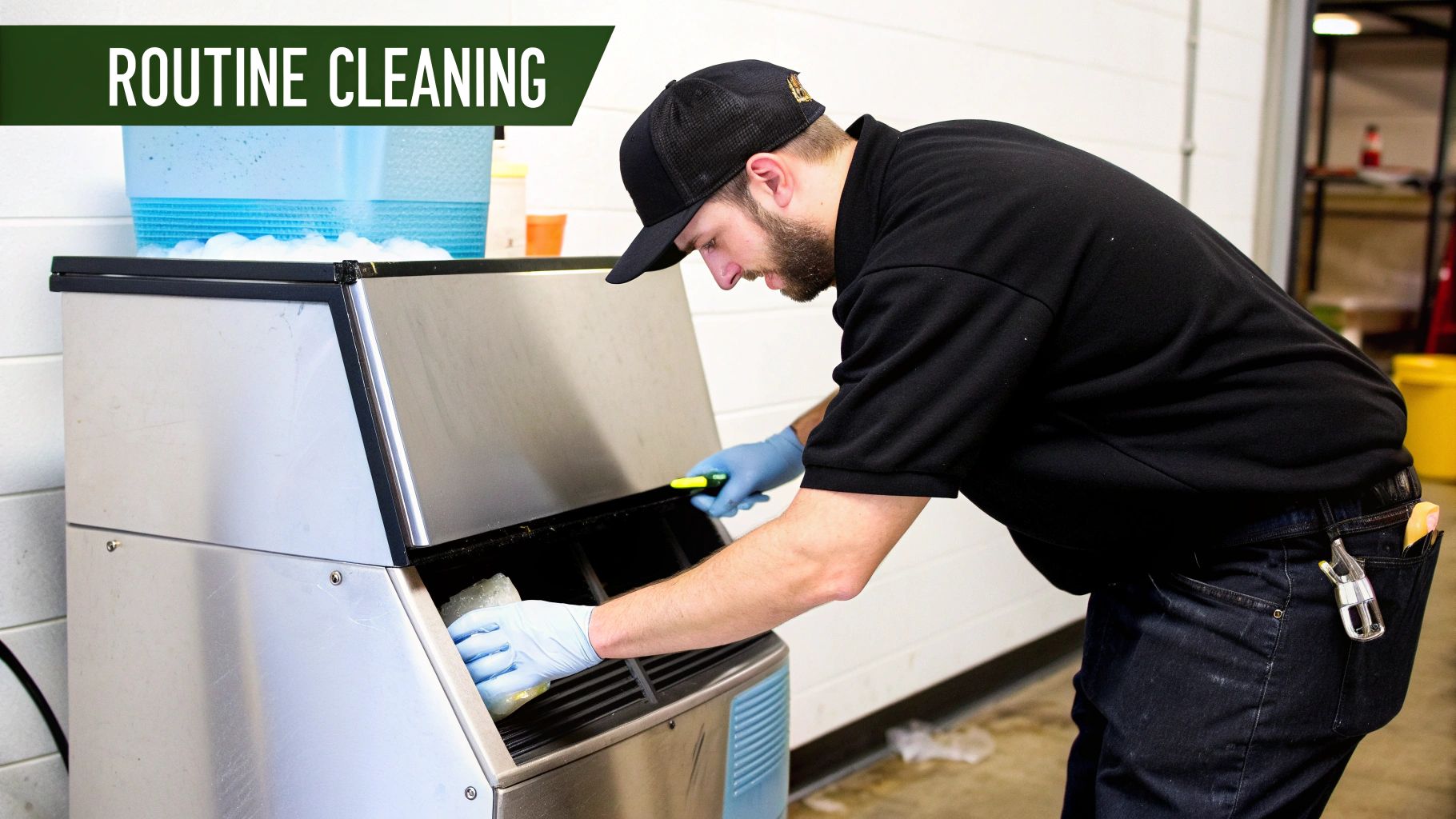
In the non-stop rush of a Las Vegas restaurant, being proactive is your best weapon against the chaos of equipment failure. When it comes to your Manitowoc ice machine, a consistent cleaning schedule isn't just maintenance—it's the most effective form of Manitowoc ice machine troubleshooting you can do. It stops the most common problems dead in their tracks before they ever have a chance to shut you down.
For any business here in Clark County, this means fighting a two-front war. You’re up against our notoriously hard water on the inside and the ever-present desert dust on the outside. These conditions are tough on all commercial refrigeration, but they're especially brutal on the complex parts of an ice machine. If you want to avoid downtime, ignoring them just isn't an option.
Battling Hard Water With Descaling And Sanitizing
The water flowing through our pipes in Southern Nevada is packed with minerals like calcium and magnesium. While it’s fine to drink, these minerals leave behind limescale on every surface inside your ice machine. This scale is the number one reason for slow ice production, weirdly shaped cubes, and component failures.
Think of scale as a thick blanket on your evaporator plate. It insulates the surface, forcing the machine to work way harder and longer just to freeze water. It also coats critical parts like the water and ice thickness probes. When those probes are caked in minerals, they can't get an accurate reading, which often leads to frustrating error codes like the E19 Water Probe Fault.
To win this fight, you need a full cleaning and sanitizing cycle.
- Descaling: This part of the process uses a special, nickel-safe cleaning solution. It’s designed to dissolve all the mineral scale that has built up on the evaporator and other parts of the water system.
- Sanitizing: After the scale is gone, a sanitizing solution is run through the machine. This step kills any lingering bacteria, slime, or mold to make sure your ice is perfectly clean and safe.
You absolutely must use a nickel-safe solution. Manitowoc evaporators have a special nickel plating over their copper core. Using a harsh, unapproved cleaner can easily strip this protective layer, causing permanent damage to the most expensive part of your machine.
Most Manitowoc models make this easy with an automated cleaning cycle. All you have to do is add the right solution and hit the "Clean" button. For a busy Las Vegas restaurant, doing this once every three months is the bare minimum to keep that scale under control.
The Non-Negotiable Condenser And Filter Cleaning
While hard water attacks your machine from the inside, the desert air is attacking it from the outside. The condenser coils are basically your ice machine’s radiator—they get rid of all the heat pulled out of the water. In a hot, dusty Las Vegas kitchen, these coils are a magnet for grease, dust, and whatever else is floating in the air.
Once the condenser gets clogged, heat can’t escape. This makes the compressor run hotter and longer, which kills your efficiency and slashes your ice production. A completely clogged condenser will eventually cause the machine to overheat and shut down, often triggering a "High Head Pressure" alert or an E01 error code.
Cleaning it is straightforward, but you have to do it regularly.
- Power Down: First thing's first—always unplug the machine before you start cleaning.
- Access the Condenser: Find and remove the front or side panel to get to the condenser coils and air filter.
- Clean the Air Filter: Your first line of defense is the air filter. Pull it out and wash it with warm, soapy water. Let it dry completely before you put it back. You should be doing this simple step every two weeks.
- Clean the Condenser Coils: Grab a soft-bristled brush and gently wipe away the loose dust from the condenser fins. If you've got greasy buildup, a dedicated coil cleaner spray will do the trick. Just follow the directions on the can.
This simple task, when done monthly, prevents the single most common cause of ice machine failure in the entire Las Vegas valley. It takes less than 15 minutes but can save you from an expensive emergency service call during a Saturday night rush. Beyond these cleanings, setting up a solid preventive maintenance schedule is key to keeping your machine running and making it last.
Establishing A Simple Maintenance Rhythm
Consistency is everything. You don't need some complicated system, just a simple, repeatable schedule that your staff can actually follow.
Here’s a practical schedule that works for any Las Vegas food and beverage spot:
| Task | Frequency | Who Is Responsible | Why It Matters |
|---|---|---|---|
| Clean Air Filter | Every Two Weeks | Kitchen Staff/Barback | Prevents the first layer of dust from clogging the condenser. |
| Wipe Down Exterior | Weekly | Cleaning Crew | Keeps the machine looking professional and sanitary. |
| Clean Condenser Coils | Monthly | Shift Manager | Stops the machine from overheating and keeps it efficient. |
| Descale & Sanitize | Quarterly (Every 3 Months) | Kitchen Manager | Removes mineral scale to stop component failure. |
By getting into this rhythm, you turn maintenance from a reactive headache into a proactive strategy. You’ll get better performance, higher quality ice, and a much longer life out of your equipment. This small investment of time is the best way to protect your revenue and a business's success depends on having the right tools, including commercial refrigerators, commercial freezers, and ice machines.
Knowing When To Call For Professional Service
Look, I get the DIY spirit. As a restaurant owner or manager, you want to be able to handle things in-house whenever possible. But when it comes to Manitowoc ice machine troubleshooting, you have to know where to draw the line. Recognizing your limits isn't just about safety—it's about protecting a piece of equipment that's absolutely vital to your Las Vegas business, and an expensive one at that.
I've seen it happen too many times: a simple issue turns into a catastrophic failure because someone tried a complex repair without the right training. The result? Way more downtime and a repair bill that stings.
Here in the Las Vegas food scene, that kind of downtime is killer. Whether you're running a fine dining spot on the Strip or a packed local bar, your equipment has to be on its A-game. That goes for your commercial refrigerators, freezers, and especially your ice machine. Knowing when to put down the wrench and pick up the phone is what keeps you serving customers instead of closing your doors.
Red Flags That Demand A Certified Technician
While you can definitely handle cleaning filters and running a descaling cycle, some symptoms are a dead giveaway that you've got a bigger problem on your hands. If you see any of these red flags, it’s time to stop and call in a pro. These issues almost always involve specialized tools, certified know-how, and some serious safety risks.
- Suspected Refrigerant Leaks: Hear a hissing sound? Notice an oily film around the refrigeration lines? Is your machine suddenly struggling to cool? You could be looking at a refrigerant leak. This is absolutely not a DIY job. Refrigerant is hazardous, and you need an EPA-certified technician to handle it and recharge the system safely and legally.
- Compressor Failures: The compressor is the heart of your ice machine. If it's making a racket, vibrating like crazy, or you hear it clicking as it tries (and fails) to start, you're in trouble. Replacing a compressor is one of the most involved and expensive repairs out there, and it requires a skilled professional.
- Complex Electrical Problems: So, you've checked the breaker and the outlet has power, but the machine is still dead. The problem is likely internal. Messing with control boards, wiring harnesses, or high-voltage parts like capacitors is a dangerous game without proper electrical training. A fried control board, for instance, can set off a chain reaction of other failures.
A common mistake I see is a restaurant manager trying to bypass a safety sensor or "hotwire" a component to get through a busy night. This not only voids your warranty but also creates a massive fire and safety hazard for your staff and kitchen.
Protecting Your Warranty And Your Investment
That Manitowoc ice machine was a big investment, and the warranty is your safety net against factory defects. But that warranty has rules. Attempting your own major repairs or using aftermarket parts can void your coverage in a heartbeat. A certified technician will use factory-approved parts and follow the right procedures, keeping that warranty valid.
For any restaurant in Las Vegas, getting the right parts and service quickly is crucial. When a technician tells you a water pump or an inlet valve has failed, you can't afford to wait. This is where having a good relationship with a local supplier like Las Vegas Restaurant Equipment really pays off; they can get you the correct OEM parts fast, so you're not down for long.
Ultimately, smart Manitowoc ice machine troubleshooting is about knowing the difference between routine maintenance and a serious repair. When your critical equipment starts showing major signs of trouble, calling in an expert is the best business decision you can make. If you're dealing with tricky issues on any of your cooling units, learning more about professional commercial refrigeration repair in Las Vegas can give you a better idea of what to expect when you make that service call.
Got Questions About Your Manitowoc Ice Machine? We've Got Answers.
Running a commercial kitchen, especially in Vegas, means you can't afford guesswork. Your Manitowoc ice machine is one of the hardest-working pieces of equipment you own, and when questions come up, you need answers fast. Here are some of the most common things we hear from restaurant and bar owners across the valley.
How Often Should I Really Clean My Manitowoc Here in Las Vegas?
This is the big one. Our unique desert environment—with its ridiculously hard water and constant dust—is brutal on ice machines. An aggressive cleaning schedule isn't just a good idea; it's a matter of survival for your equipment.
First off, that air filter. Clean it every two weeks, minimum. It takes about a minute and stops dust from choking your condenser, which is a leading cause of failure in a hot kitchen.
Beyond that, you absolutely must run a full cleaning and sanitizing cycle with a nickel-safe descaler at least every three months. If you're a high-volume spot, like a packed bar on the Strip or a 24-hour diner, you should be doing this every two months. We see it all the time: skipping this step is the number one reason for scale buildup, which tanks your ice production and guarantees a service call down the line.
Why Did My Ice Machine Suddenly Stop Making Enough Ice?
When your machine can't keep up, it's almost always an issue with maintenance or the environment. Before you panic, your Manitowoc ice machine troubleshooting should start with these three usual suspects—they account for the vast majority of cases we see.
The most common culprits are:
- A Dirty Condenser Coil: That mix of desert dust and kitchen grease creates a literal blanket on the condenser, trapping heat and preventing the machine from cooling effectively.
- A Clogged Water Filter: If your water filter is old or blocked, it's starving the machine. Restricted water flow means small, incomplete, or no cubes.
- High Kitchen Temperatures: Is your kitchen pushing 90°F? An air-cooled machine just can't breathe in that kind of heat. Its production is going to drop, plain and simple.
Start by giving the condenser and air filter a thorough cleaning. If that doesn't fix it, check for scale buildup in the water system. More often than not, this basic maintenance gets things back to normal right away.
Should I Repair My Old Manitowoc Or Just Buy a New One?
Every operator faces this decision eventually. It really boils down to a simple cost-benefit analysis. Our rule of thumb? If your machine is over 7-10 years old and you're looking at a major, wallet-busting repair like a new compressor or evaporator, it’s probably time to start shopping for a replacement.
The cost of replacing a major component can easily be more than half the price of a brand-new unit. Putting that money toward a new, more energy-efficient model with a fresh warranty almost always makes more financial sense. You’re not just buying a machine; you’re buying reliability and lower utility bills.
Think of it this way: a new ice machine, like a new commercial freezer, is an investment in avoiding downtime. And for a busy Las Vegas business, that peace of mind is priceless.
For a Las Vegas Business, Is Air-Cooled or Water-Cooled Better?
This is a critical choice in Las Vegas because our climate is so unforgiving. Air-cooled machines are, by far, the most popular and energy-efficient choice. They use fans to pull ambient air across the condenser coils. The catch? They hate high temperatures. In a sweltering Vegas kitchen, their performance and ice output can take a serious nosedive.
Water-cooled units, on the other hand, couldn't care less about how hot your kitchen gets. They use a steady stream of water to cool the condenser. The big downside is the staggering amount of water they consume, which is a major—and rising—operating expense here in Southern Nevada. For most local businesses, a well-maintained air-cooled machine with proper ventilation is the smarter, more cost-effective way to go.
When it’s time to upgrade your ice machine, commercial freezer, or any other critical kitchen equipment, Las Vegas Restaurant Equipment has the dependable, warranty-backed gear you need to keep up with the city’s demands. Explore our full range of commercial ice machines and refrigeration online.