

So, you're thinking about starting a food truck. The first thing you need is a solid food truck equipment list, which goes way beyond just a good griddle. We're talking about everything from the fryers that’ll make your signature fries to the refrigeration that keeps everything safe, right down to the three-compartment sink you absolutely need. Your menu is going to be your guide, but every single mobile kitchen starts with the same core foundation to keep things running smoothly and legally.
Building Your Mobile Kitchen in Las Vegas
Let's be real: launching a food truck in Las Vegas is jumping into the big leagues. This vibrant city is a culinary battleground, packed with a diverse array of restaurants that cater to every palate imaginable. If you want to stand out, you need more than just a killer concept. You need a mobile kitchen that's built like a tank—ready for the desert heat, the long lines, and the non-stop hustle.
Your equipment is the engine of your business. It’s not just a line item on a budget; it's a strategic investment that dictates how fast you can serve, how good your food tastes, and whether you can handle a sudden rush without breaking a sweat. Before you even think about buying a single piece of steel, you have to get familiar with the local food truck permit requirements. Trust me, these rules will shape your entire setup.
Core Equipment Categories for Success
Think of your truck as a tiny, hyper-efficient version of a full-scale restaurant kitchen. Every square inch counts, so every piece of equipment has to pull its weight. This is especially true here in Vegas, where reliability is everything.
You can break down your essential gear into a few key categories that form the backbone of any serious food truck:
- Cooking Equipment: This is where the magic happens and it's all about your menu. Are you slinging burgers? You need a commercial griddle. Frying up wings? A high-capacity deep fryer is a must. Maybe you need a charbroiler or a convection oven. This is your star player.
- Refrigeration: In the Nevada sun, this isn't optional—it's critical. We’re talking high-performance commercial refrigerators, commercial freezers, and ice machines to keep your ingredients fresh and, more importantly, safe.
- Support Systems: These are the unsung heroes. Stainless steel prep tables for your workflow, food warmers to hold product during a rush, and, of course, the sinks mandated by the health department.
Your equipment list isn’t just a shopping list—it’s your business plan made real. Every item should directly support your menu, make your workflow seamless, and check every box for the Las Vegas health and safety codes.
Getting these foundational categories right is the first big step. The same logic from designing a restaurant kitchen applies here, just on a smaller scale. It's all about creating an efficient layout in a tight space. When you get this right, you'll be ready to handle the pressure, serve consistently great food, and build a name for yourself on the buzzing streets of Vegas.
The Heart of Your Operation: Cooking and Refrigeration
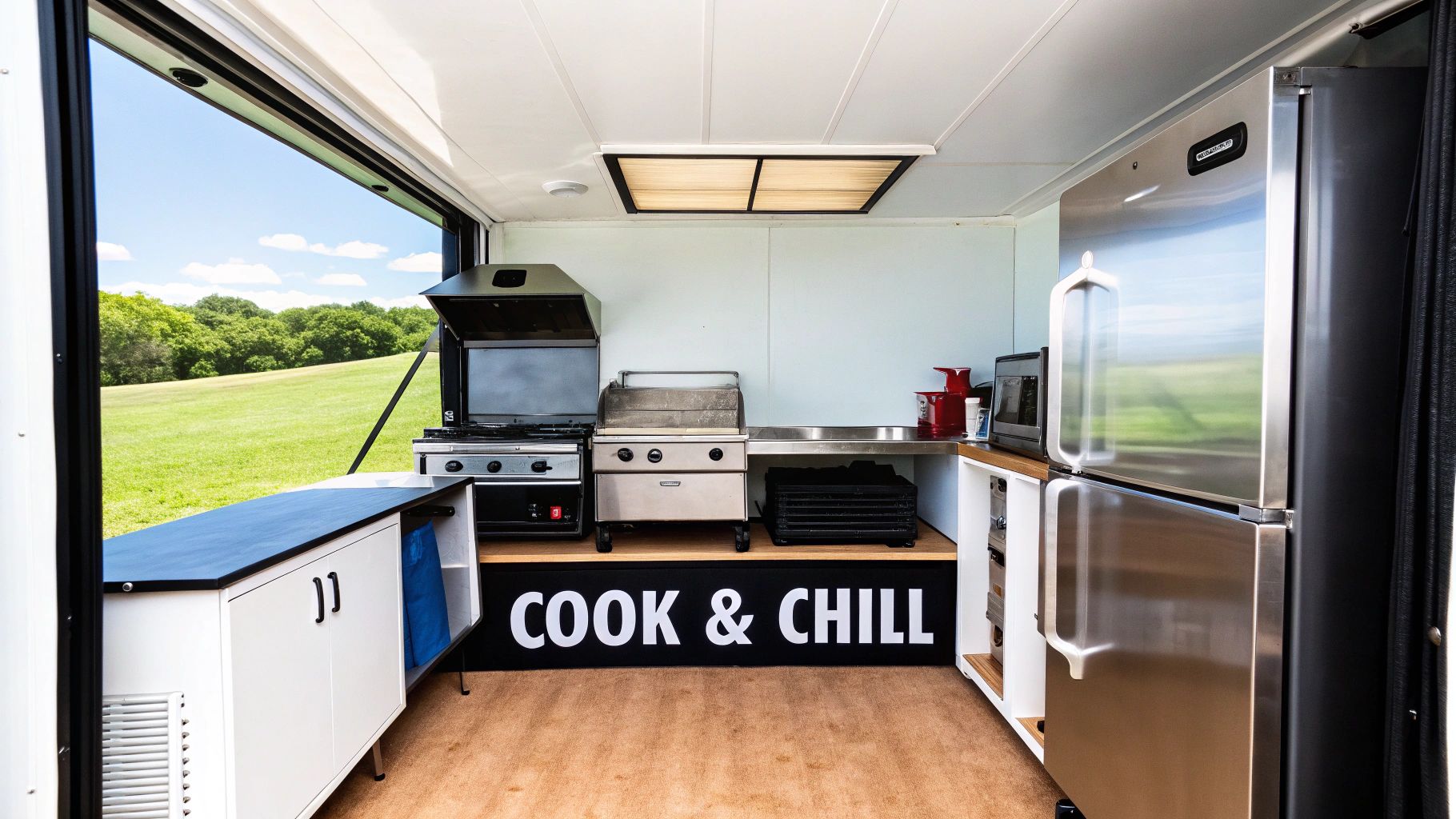
If you think of your food truck as the body, the cooking and refrigeration units are its heart. They pump life into your menu and keep the entire operation flowing smoothly. In a competitive food scene like Las Vegas, the gear you choose isn't just a box to check—it’s the foundation of your entire business. Your ability to crank out amazing food, serve customers fast, and keep ingredients safe all comes down to this core equipment.
Think of your cooking line as the engine driving your menu. Space is tight, so every single appliance has to earn its spot. The name of the game is finding compact, high-efficiency units that can handle the chaos of a lunch rush on the Strip without maxing out your generator or taking over your whole kitchen.
Equipping Your Cooking Line
Your menu is the only blueprint you need for your cooking equipment. A taco truck is going to look a lot different inside than a mobile pizzeria. The best way to start is to pinpoint the one piece of equipment you absolutely need for your signature dish, then build everything else around it.
- Commercial Griddles: A flat-top griddle is the ultimate workhorse for so many trucks. It’s perfect for searing burgers, flipping pancakes, or toasting sandwiches. Look for countertop models to save precious real estate.
- Deep Fryers: For those crispy fries, wings, or donuts everyone loves, a commercial deep fryer is a must-have. Propane-powered units are a popular choice for their quick heat-up times and portability.
- Charbroilers: If you want that amazing smoky flavor on your steaks, chicken, or veggies, a charbroiler is the only way to go. Consider a model with lava rocks or radiant heat to get that perfect, even cook.
- Convection Ovens: For trucks serving up baked goods, pizzas, or roasted dishes, a compact countertop convection oven is a game-changer. It provides fast, even heat circulation, which is key for getting consistent results every time.
Don't forget the little things. Versatile tools can make a huge difference in your workflow, so it's worth looking into options like choosing the right microwave oven for a mobile kitchen. Every piece of equipment you select directly impacts how fast you can serve and how good your food tastes.
We've seen a huge boom in food trucks, and with it, startup costs have climbed. These days, cooking and refrigeration gear can eat up 20–30% of the entire budget. For a new truck in a market like Vegas, that can easily mean an investment of $8,000–$20,000 just for the cooking appliances—the very equipment that powers your menu and brings in the cash.
Mastering Refrigeration in the Desert Heat
Now, let's talk about the other half of your kitchen's heart: refrigeration. Here in Las Vegas, keeping things cold isn't just a task; it's an ongoing battle against the desert. Your fridge and freezer are your first and last line of defense for food safety. If they fail, you’re not just looking at spoiled ingredients—you could be shut down and see your reputation tank.
Reliable commercial refrigerators and commercial freezers are non-negotiable. Don't even think about using a standard residential unit. They simply aren't built to handle the intense ambient heat and the constant vibration that comes with being on the road.
Your food truck equipment list has to prioritize NSF-certified units designed to take a beating. These commercial-grade models have beefier compressors and better insulation to hold safe temperatures, even when it’s scorching over 100°F outside.
Choosing the Right Refrigeration Units
When it comes to picking your units, let space and function be your guide. You need enough cold storage to get through a packed service without running out of product, but you absolutely cannot afford to waste a single inch of floor space.
Key Refrigeration Options:
| Equipment Type | Best For | Pro Tip |
|---|---|---|
| Undercounter Refrigerator | Storing items you grab all the time, like drinks, sauces, and prepped ingredients. | Tuck these units right under your prep stations to create a super-efficient workflow. |
| Sandwich Prep Table | Building sandwiches, salads, or tacos with refrigerated wells to keep toppings cold. | This is a brilliant two-in-one that combines workspace and cold storage, a massive space-saver. |
| Upright Reach-In Freezer | Holding bulk items like frozen proteins, fries, or baked goods. | Go for a slim, single-door model to make the most of your vertical space in a tight footprint. |
| Ice Machine | Serving cold drinks and supporting kitchen prep. | A compact undercounter ice machine is essential for any truck serving beverages; it saves space and ensures a constant supply. |
Investing in solid refrigeration from day one is one of the smartest money moves you can make. The cost of throwing out a full inventory or dealing with health code violations from a cheap, failing unit will always be more than what you save upfront. For a deeper dive, check out our guide on energy-efficient commercial refrigeration. It'll help make sure your kitchen's heart keeps beating strong, no matter how hot it gets out there.
Creating a Smooth Workflow with Support Systems
A high-performance food truck in Vegas is a lot like a well-oiled machine. Your cooking and refrigeration gear might be the powerful engine that gets all the attention, but it's the support systems that truly make or break your operation. We're talking about your food prep stations, holding equipment, and sanitation gear—the unsung heroes that turn a cramped, chaotic box into a streamlined, money-making powerhouse.
Without a smart workflow, even the most expensive griddle won't save you when the lunch rush hits. You need dedicated areas and the right tools so your team can move fast, build orders consistently, and keep that service window pumping.
Building Your Ergonomic Prep Station
Think of your prep station as the mission control for your entire menu. It's where all the magic happens, from chopping veggies to plating the final product. In the tight quarters of a food truck, an ergonomic layout isn't just a nice-to-have; it's absolutely essential for speed and safety. The whole point is to have everything you need within arm's reach, cutting out wasted steps.
The foundation of any solid prep area is a durable work surface. There's a reason everyone uses NSF-certified stainless steel tables—they're tough, non-porous, and a breeze to clean, which is exactly what the Southern Nevada Health District wants to see. When you're picking yours out, check out different stainless steel prep tables to find the perfect size for your layout. Many even come with undershelves, which is prime real estate for storage in a truck.
To round out your prep station, you'll need a few key pieces of equipment:
- Commercial Slicers: If you're slinging deli sandwiches or anything that needs perfectly uniform cuts, a commercial slicer gives you a level of precision and speed you just can't get by hand.
- Food Processors: These things are workhorses. They're a lifesaver for whipping up sauces, salsas, or plowing through a mountain of vegetables in seconds.
- Cutting Boards and Knives: Get a full set of color-coded cutting boards. It’s a simple way to prevent cross-contamination, which is a huge red flag for health inspectors.
An efficient prep station lives by the rule of "mise en place"—everything in its place. A well-organized workspace can slash ticket times by 30% or more, which means you're serving more customers and making more money every single hour.
Keeping Food Perfect with Holding and Service Gear
Okay, the food is cooked. Now what? The next big challenge is holding it at the perfect temperature until a customer orders it. This is where your holding and service equipment proves its worth, especially when you're prepping food ahead of a big rush. It’s not just about quality; keeping food at a safe temperature is a non-negotiable health code rule.
Food warmers, like countertop heat lamps or steam tables, are a must for holding things like fries, taco meat, or saucy dishes. They keep food safely above the 140°F danger zone without overcooking it, so everything stays fresh and delicious. On the flip side, you'll need beverage dispensers or an undercounter cooler to make sure drinks are ice-cold—a critical feature for anyone trying to survive a Las Vegas summer. An ice machine is another crucial component, ensuring you never run out of ice for drinks, which can be a significant profit center.
Meeting Health Codes with Vital Sanitation Systems
Finally, let's get to the most important support system of all: sanitation. There are no shortcuts here. Cutting corners on cleaning and hygiene is the fastest way to get your truck shut down on the spot. The Southern Nevada Health District has very specific, very strict rules for a reason—to keep the public safe.
Your food truck absolutely must have two separate sink setups:
- A Three-Compartment Sink: This is mandatory for the classic wash, rinse, and sanitize process for all your dishes, pots, and utensils. Each of the three bays needs to be big enough to completely submerge your largest pot.
- A Dedicated Handwashing Station: This must be a completely separate sink with its own hot and cold running water, soap, and paper towels. It’s strictly for your team to wash their hands.
The plumbing is what makes it all work. You'll need a freshwater tank to supply the water and a wastewater (or gray water) tank to hold the dirty water. Here's a key rule of thumb: your gray water tank must be at least 15% larger than your freshwater tank. This is a crucial design feature to prevent disgusting, hazardous overflows. Get these systems right, and you'll be running a clean, safe, and fully compliant kitchen on the bustling streets of Las Vegas.
Powering Your Truck Utilities and Safety Systems
Let’s talk about the unsung heroes of your food truck: the systems that keep the lights on, the air clear, and everyone safe. Beyond the flashy cooking line and the humming refrigerators, your truck is a self-contained hub of utilities. Here in Las Vegas, where inspectors don't miss a thing and competition is relentless, getting this behind-the-scenes infrastructure right isn't just a good idea—it's the only way you'll legally open for business.
Think of your truck as an island that needs its own power plant. You really have two choices here: a generator or hooking up to shore power. A generator gives you total freedom. You can set up at a downtown festival one day and a private catering gig the next. The trade-off? It needs fuel, regular maintenance, and can be noisy. Shore power, on the other hand, is a simple electrical hookup that’s quiet and steady, but it literally tethers you to a spot with the right outlet.
Choosing Your Power Source
For most food trucks hustling around Vegas, a powerful, quiet generator is the only way to go. The key is picking the right one, and that starts with a little math. You need to add up the wattage requirements for every single piece of equipment you might run at the same time—from your fridge and freezer to your lights and your POS system.
Pro Tip: Always buy a generator with a wattage rating at least 20% higher than your peak load calculation. This extra juice prevents you from tripping the breaker when a big unit like a refrigerator compressor kicks on, and it'll seriously extend the life of your generator.
Once you’ve got power handled, the next non-negotiable is your ventilation and fire suppression. This isn't just about keeping the truck from feeling like a sauna; it's a make-or-break requirement for passing both health and fire inspections in Clark County. If you're cooking with open flames or grease-producers like fryers and griddles, this system is your license to operate.
The workflow below shows just how critical these systems are, supporting everything from prep to service to cleanup.
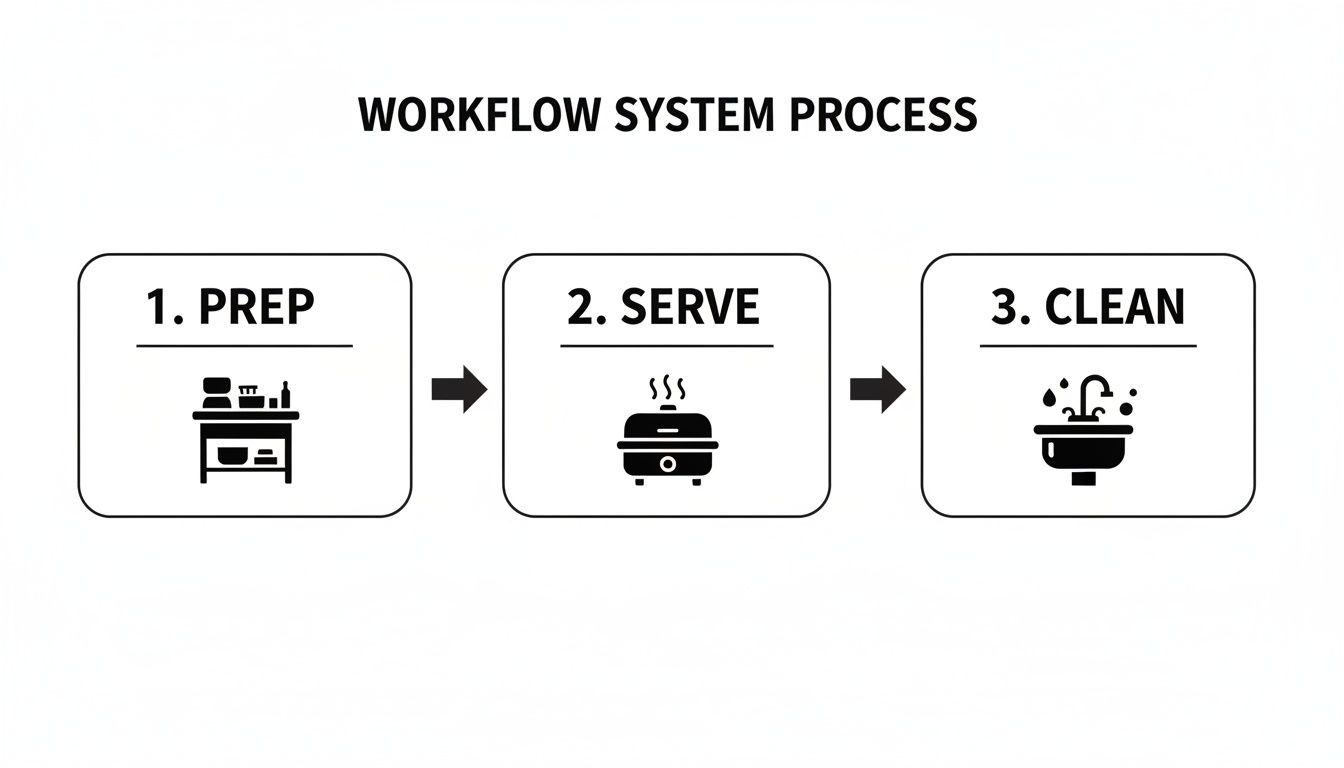
As you can see, a seamless operation completely depends on having reliable power for your prep stations, proper ventilation over the cookline, and all your utilities working for cleanup.
Mandated Safety and Ventilation Gear
The heart of your ventilation system is a commercial-grade hood that sits right over your cooking equipment. This hood, paired with a powerful exhaust fan, is designed to suck all that hot, greasy air out of the truck. It keeps your kitchen air breathable, the temperature manageable, and, most importantly, slashes your risk of a grease fire.
Built right into that hood is a complete fire suppression system. You’ll see nozzles pointed directly at your appliances and a manual pull station. If a fire ever flashes up, the system automatically douses the flames with a fire-retardant chemical, usually shutting off your gas or power at the same time.
- Commercial Hood: It absolutely must be sized to hang over the edges of your cooking equipment. No shortcuts.
- Exhaust Fan: Needs to be powerful enough for proper airflow, measured in cubic feet per minute (CFM).
- Fire Suppression System: Look for a UL 300-compliant system. This is the gold standard for commercial kitchens and what inspectors will be looking for.
These systems are a big-ticket item, but they are absolutely essential. Recent industry data paints a clear picture: flawless equipment is the backbone of a successful food truck. Stats from 2025 show average food truck earnings hit $346,000 annually, with the top 25% pulling in over $492,000. That kind of money is only possible if your truck is actually running. For propane-fueled gear, expect the core fire safety and hood package to run $3,000–$8,000. It’s a non-negotiable cost of doing business safely in Vegas. If you want to dive deeper into how equipment impacts the bottom line, you can read the full research on food truck earnings on cloudwaitress.com. At the end of the day, paying for top-notch safety gear is an investment in your business's future.
Here is the rewritten section, crafted to sound completely human-written and natural, following the provided style guide and requirements.
Budgeting and Sourcing Your Equipment in Nevada
Getting the right gear for your food truck is about more than just making a shopping list. It’s about having a rock-solid financial game plan, especially when you're trying to make a name for yourself in a market as wild as Las Vegas. Think of your budget as the blueprint for your entire operation; it dictates the quality of your kitchen and, ultimately, whether you’ll be around for the long haul. Every single dollar, from the fryer to the plumbing, needs a purpose.
You have to see the whole financial picture from day one. Picture yourself launching your dream truck on the bustling Las Vegas streets, where the neon never sleeps and hungry crowds are a constant. To give you some perspective, the U.S. food truck market exploded to a $4.36 billion valuation back in 2025, and it’s been growing at a rate of over 5% globally ever since. That boom tells you one thing: your kitchen equipment is the absolute backbone of your business. It's also why it can easily eat up anywhere from $10,000 to $45,000 of your startup cash. You can find more insights on food truck equipment trends on accio.com.
New vs. Used: A Critical Decision
One of the first big money decisions you'll face is whether to buy your equipment new or used. The appeal of used gear is obvious—that lower price tag can feel like a lifesaver when you're just starting out. But honestly, that path is full of traps that can end up costing you a lot more down the road.
Used equipment almost never comes with a warranty. That means if a key piece of gear dies on you, you're on your own. Imagine your commercial refrigerator or commercial freezer gives out in the middle of a scorching Las Vegas summer. That’s not just a hassle; it’s a total disaster that can mean thousands in spoiled food and a day of zero sales. A brand-new unit with a warranty gives you security and peace of mind.
Investing in new, compliant equipment isn't just about avoiding repairs; it's about guaranteeing you can pass your Southern Nevada Health District inspection on the first try. Used gear might not meet current NSF or ETL standards, leading to costly delays and required replacements.
New equipment is also way more energy-efficient. An old, used fridge might save you a grand upfront, but it could easily burn through that much extra in generator fuel over a year. When your whole business is on wheels, every drop of fuel and every watt of power matters.
Financing Your Mobile Kitchen
Even with the best plan, that initial investment can be a tough pill to swallow. The good news is, Nevada entrepreneurs have a few different financing routes to get their kitchens rolling without wiping out their savings. This lets you keep cash on hand for all the other stuff—inventory, permits, marketing, you name it.
Common Financing Pathways:
- Equipment Financing Loans: These are straightforward loans made specifically for buying business equipment. The gear itself usually serves as collateral, which can make them easier to get approved for.
- Lease-to-Own Programs: This is a great option if you want to keep initial costs low. You make smaller monthly payments and have the choice to buy the equipment when the lease is up.
- SBA Loans: The Small Business Administration has loan programs that are perfect for equipment purchases. They usually come with good terms and lower interest rates.
Using one of these options lets you get reliable, warranty-backed equipment from the get-go. It's a smart financial move that sets you up to compete in the buzzing Las Vegas food scene, where every restaurant—on wheels or not—relies on quality gear.
Sourcing Locally in Las Vegas
Once you’ve got your budget and financing figured out, the last piece of the puzzle is finding where to buy everything. Big national websites have huge selections, but there’s a real advantage to working with suppliers who get what it takes to run a business in the Vegas market.
A local or regional supplier knows the desert. They can point you to a commercial refrigerator or commercial freezer with a heavy-duty compressor that won’t buckle under extreme heat. They also know the ins and outs of the local health and fire department rules, making sure every item on your food truck equipment list is up to code.
Better yet, a supplier who knows the local scene—from the high-end spots on the Strip to the food trucks serving every craving imaginable—can give you priceless advice. They can help you pick the right size ice machine for your menu or recommend a griddle that can handle the insane festival rush. That local know-how, combined with smart financing, turns your equipment list from just another expense into a solid investment in your Las Vegas food truck dream.
Your Top Food Truck Equipment Questions, Answered
Jumping into the food truck world, especially in a city as electric as Las Vegas, is going to bring up a lot of questions. The bar for quality here is high, thanks to our incredible restaurant scene, and your gear is what will ultimately allow you to compete. We’re going to tackle some of the most common questions we hear from new food truck owners.
Think of this as your final gut check before you start swiping the credit card. We'll cover what you absolutely must have to get licensed in Clark County and dive into the age-old debate of buying new versus used equipment—a crucial decision in our demanding desert climate.
What’s the Bare Minimum Equipment I Need to Get Started?
Before you even think about that specialty fryer or smoker for your signature dish, you have to nail the fundamentals. To legally operate a food truck in Las Vegas, your rig must pass a health inspection, and that means having a specific, non-negotiable set of equipment focused on sanitation and safety.
This is your foundational lineup:
- Sanitation Sinks: There’s no getting around this one. You need a three-compartment sink (for the classic wash, rinse, sanitize routine) and a completely separate handwashing sink. Both must have hot and cold running water.
- Core Refrigeration: A solid commercial refrigerator and/or a commercial freezer is mandatory. Keeping your ingredients at safe temperatures isn't just a good idea; it's the law.
- Primary Cooking Appliance: You need at least one piece of cooking equipment that’s central to your menu, whether that's a flat-top griddle, a multi-burner range, or a deep fryer.
- Ventilation and Safety: Any equipment that produces grease-laden vapor (think grills, fryers, ranges) must sit under a certified commercial ventilation hood with a built-in fire suppression system.
You won't get your permit without these four core components. A powerful generator and some sturdy stainless steel prep tables are also pretty much essential to actually cook and serve food day in and day out.
Should I Buy New or Used Equipment?
It's tempting to shave off costs by buying used gear, but let me tell you, it’s a huge gamble—especially here in Vegas. That lower price tag looks great upfront, but the hidden risks can bleed you dry later on.
Buying used is like buying a car with 150,000 miles, no warranty, and a spotty service history. It might work like a charm, or it could die on you in the middle of a lunch rush at the busiest event of the year. For the real workhorses—your commercial refrigerators, commercial freezers, and main cooking line that will be battling 110-degree heat—investing in new equipment with a solid warranty is the only smart move. New gear gives you reliability, better energy efficiency, and peace of mind knowing it meets the latest health codes.
How Do I Figure Out What Size Refrigerator or Freezer I Need?
This is a classic Goldilocks problem. You need enough cold storage to get through two or three busy days of service, but you don't have an inch of space to spare in a truck. It’s all about finding that “just right” balance between your menu, prep schedule, and sales volume.
First, make a super-detailed list of every single ingredient you need to keep cold or frozen. Then, estimate how much of each you'll go through in a typical busy stretch. That gives you a rough cubic footage to aim for.
A lot of Vegas truck owners get clever with space by using undercounter or worktop refrigeration. A 27-inch sandwich prep table, for example, pulls double duty. You get refrigerated storage underneath and a cutting board prep surface on top, all in one compact footprint.
My advice? Always lean towards slightly more cold storage than you think you need. Running out of product is a sales killer, and in the Nevada heat, you can't afford to take chances with food safety.
What Are the Most Important Compliance Stickers to Look For?
When you’re shopping for your food truck equipment list, there are two acronyms you need to burn into your brain: NSF and ETL. The National Sanitation Foundation (NSF) and Intertek (ETL) are third-party organizations that certify equipment for commercial kitchen use.
Seeing that little NSF or ETL Sanitation mark means the piece of equipment is built to last, is easy to clean and sanitize, and meets the tough public health standards inspectors look for. Trying to sneak in a residential fridge or stove is a rookie mistake and a surefire way to fail your inspection. Always, always check that your commercial refrigerators, commercial freezers, sinks, and prep tables have one of these certifications. It’s your ticket to getting licensed and hitting the streets without any headaches.
Ready to build a food truck kitchen that can handle the Las Vegas heat and hustle? At Las Vegas Restaurant Equipment, we specialize in new, warranty-backed equipment designed for performance and compliance. From powerful Atosa refrigerators to high-efficiency fryers and space-saving prep tables, we have everything you need to get rolling. Explore our full catalog and flexible financing options today at https://lasvegasrestaurantequipment.com.