

A commercial ventless hood is a self-contained ventilation unit that cleans the air right inside your kitchen using a series of high-tech filters. This completely removes the need to install expensive and disruptive external ductwork. It's the perfect answer for spots where a traditional hood system is either physically impossible or way too expensive to install, opening up all sorts of unconventional spaces for restaurant operations in the vibrant city of Las Vegas, home to a diverse array of restaurants catering to every palate.
Unlock Your Kitchen's Potential With a Ventless Hood
Picture this: you want to open a cool, high-end coffee shop in a historic downtown Las Vegas building. Or maybe a killer taco stand right on a busy casino floor. In a city where every square foot is premium and building codes are no joke, traditional ducted ventilation can be a dream-killer. Structural limits and sky-high installation costs often make it a non-starter.
This is exactly where the commercial ventless hood comes in and changes the entire game.
Think of it less like a simple hood and more like a powerful, self-contained air purification plant designed for the heat and intensity of a pro kitchen. Instead of punching massive holes through walls and roofs, it sucks in all the grease, smoke, and cooking smells, runs them through a sophisticated multi-stage filter system, and then sends clean air right back into the room.
Grow Your Culinary Footprint in Las Vegas
For any Las Vegas kitchen already running with the essential restaurant equipment needed for success—like commercial refrigerators, commercial freezers, and ice machines—adding cooking equipment can feel like a massive roadblock. A ventless hood is the key that unlocks that potential, giving you operational flexibility you just can't get otherwise. This isn't just a niche product; it's a major trend. The global market for these systems was valued at a whopping USD 1.38 billion, which shows just how critical they've become. You can check out more stats on the commercial kitchen fume hoods market on snsinsider.com.
That kind of flexibility is a huge advantage in a cutthroat market like Las Vegas, where your location and ability to innovate can make or break you. A ventless system gives chefs and restaurant owners the power to:
- Set up shop in totally non-traditional spots: We're talking airport kiosks, stadium concession stands, or even basement-level kitchens where running ducts is impossible.
- Adapt on the fly: Need to reconfigure your kitchen layout? Want to add a new cooking station for a special menu? No problem. You can move things around without a massive ventilation overhaul.
- Slash initial setup costs: By skipping the crazy expense and mess of installing ductwork, you can free up that budget for other essential restaurant equipment.
A ventless hood does more than just clean the air. It gives you the freedom to build your dream business in places you never thought you could. It’s a strategic move that pays off in agility and opportunity.
At the end of the day, a commercial ventless hood lets you focus on what really matters: creating amazing food for your customers. By knocking down the architectural barriers that hold so many concepts back, this one piece of equipment can be the difference between a dream on a napkin and a thriving Las Vegas reality. This kind of smart thinking is a core part of designing a modern restaurant kitchen that's built for both efficiency and the future.
How a Ventless Hood Scrubs Kitchen Air Clean
So, how does a commercial ventless hood manage to clean all that greasy, smoky kitchen air without a single duct leading outside? It’s not some kind of kitchen magic—it's a seriously impressive, multi-stage filtration process packed right inside the unit.
Think of it as a high-tech security checkpoint for air. Before any air is allowed back into your kitchen, it has to pass through a series of checkpoints, each one designed to nab a different kind of troublemaker. This is how a busy Las Vegas kitchen can keep the air fresh and comfortable for both staff and diners, even without traditional venting.
The whole process kicks off the second that grease-filled vapor rises from your cooking line.
The Multi-Stage Filtration Gauntlet
First up, the air smacks into a stainless steel baffle or mesh filter. This is the bouncer at the front door, built to stop the biggest, heaviest grease particles right away. By catching these larger droplets first, it keeps the more sensitive filters down the line from getting gummed up and overwhelmed.
Next, the air moves on to a more advanced cleaning stage. Often, this involves an electrostatic precipitator, a cool piece of tech that uses an electrical charge to literally zap smaller smoke and grease particles right out of the airstream. Some systems use activated charcoal filters instead, which are incredibly porous and act like a super-sponge, soaking up and neutralizing those stubborn cooking smells.
The diagram below really shows how this technology can open up brand new possibilities for foodservice, turning previously unusable spaces into viable spots for a new cafe.
As you can see, the ventless hood is the key that can unlock a space you thought was off-limits and transform it into a money-making kitchen.
Making Sure the Recirculated Air Is Pure
For the final step, many high-end ventless hoods bring in the heavy artillery: a HEPA (High-Efficiency Particulate Air) filter. This is the final boss of filtration, designed to trap up to 99.97% of the tiniest particles that somehow snuck past the first two stages. We're talking microscopic grease aerosols and other airborne gunk. If you're curious about the science behind it all, it's worth reading up on different air cleaning technologies.
By the time the air has run this gauntlet, it’s been completely stripped of grease, smoke, and odors. It’s then sent safely back into the kitchen, creating a much cleaner and more pleasant workspace without ever needing a hole in the wall.
Every stage plays a vital role in handling the tough demands of a commercial kitchen. This powerful filtration is what makes a commercial ventless hood such a game-changing solution for countless electric cooking setups here in Vegas and beyond.
Getting the Go-Ahead in Clark County
Putting a new ventless hood in your Las Vegas kitchen isn’t as simple as picking one out and plugging it in. This is one of those times when you absolutely have to follow the local rules, and it’s a non-negotiable step for any restaurant, bar, or food truck. Before you even start browsing models, you need a solid plan that’s been cleared by a few key agencies.
This means you’ll need the green light from the Southern Nevada Health District (SNHD), the Clark County Building Department, and your local fire marshal. Each of these officials plays a crucial part in signing off on your equipment and where you plan to put it. Their job is to make sure your setup is safe for your staff and your customers. Skipping this step can lead to some seriously expensive fines and delays that could kill your project before it even starts.
The Fine Print: Local Certifications and Appliance Rules
One of the first things any inspector will check for are the right certifications. Your ventless hood absolutely must be UL listed to standard UL 710B and NSF certified. Think of these labels as more than just suggestions; they’re proof that the unit has been put through its paces and is safe for recirculating air.
There’s another major limitation you need to know about. Commercial ventless hoods are almost always meant to be used with electric cooking appliances. We’re talking about gear like electric convection ovens, fryers, and griddles. Gas-powered equipment is a different beast—it produces much higher heat and different emissions, which is why it’s typically a no-go under a ventless system according to fire and safety codes.
Navigating the approval process in Clark County is a critical checkpoint. Always ask inspectors which specific electric appliances are permitted under your chosen ventless hood model before you finalize your purchase. This clarity prevents costly mismatches between your hood and your cooking line.
The fact that these systems are getting more popular is part of a bigger trend. The entire cooking hood market, which includes ventless tech, was valued at a huge USD 13.03 billion and is expected to climb to USD 22.42 billion by 2032. North America is leading the charge with a 35.7% market share, fueled by demand in fast-paced cities like Las Vegas where smart, modern ventilation is a must for staying efficient and compliant. You can dive deeper into these numbers over at Data Bridge Market Research.
Staying Ahead of the Game
Getting a handle on these local rules is everything in the competitive Las Vegas restaurant world. Whether you're in a massive casino kitchen or a cozy neighborhood spot, safety and compliance have to be top priorities. A little planning up front ensures all your big-ticket items—like your ventless hood, commercial refrigerators, and ice machines—work together and meet every code requirement.
Do your homework and talk to the local authorities early on. It’s the best way to make sure your kitchen opens on time and without breaking the bank. To get a head start, take a look at our guide which includes a complete restaurant health inspection checklist to make sure you’re ready for anything.
Choosing Ventless vs. Traditional Ducted Systems
Picking the right ventilation for your Las Vegas kitchen is a huge decision. It’s one of those choices that will affect your budget, your kitchen’s layout, and how you operate day-to-day for years to come. In a town like ours, with every kind of eatery you can imagine, making smart equipment choices is non-negotiable. Whether a commercial ventless hood or a classic ducted system is right for you really comes down to your specific menu, the equipment you're running, and the building you're in.
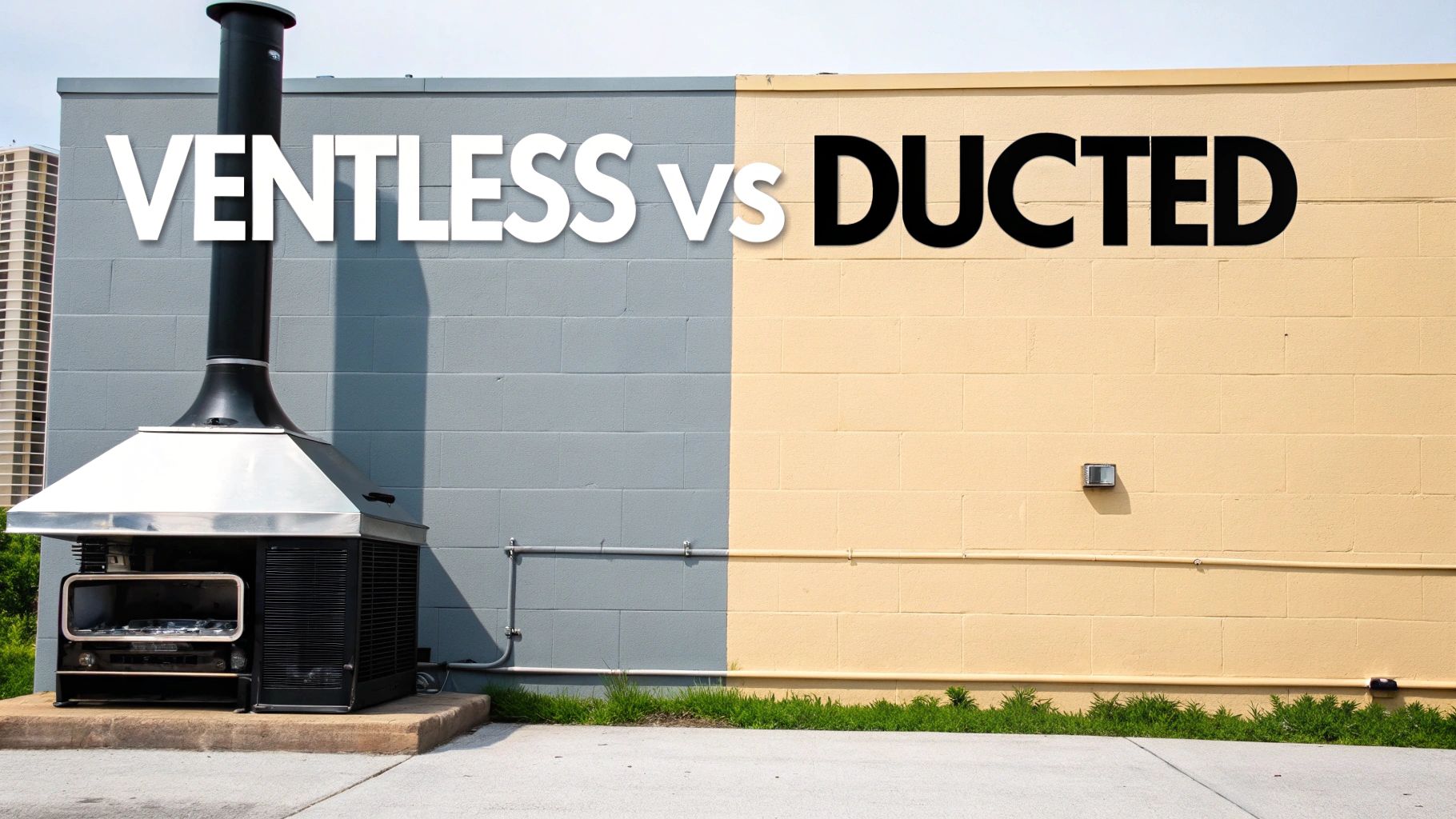
This decision ripples through your whole kitchen, impacting where you can place essential restaurant equipment like your commercial refrigerators, commercial freezers, and ice machines. Let's dig into the key differences so you can make the right call for your business.
To get a clearer picture, let's stack these two systems side-by-side.
Ventless Hoods vs. Traditional Ducted Hoods: A Comparison
| Feature | Commercial Ventless Hood | Traditional Ducted Hood |
|---|---|---|
| Installation Cost | Low – no major construction needed. | High – requires ductwork, roof penetration, and contractors. |
| Installation Time | Fast – often installed in a day. | Slow – can take weeks and is highly disruptive. |
| Location Flexibility | Excellent – can be placed almost anywhere. | Limited – requires access to an exterior wall or roof. |
| Ongoing Costs | Higher – regular, expensive filter replacements are a must. | Lower – baffle filters need cleaning, not replacement. |
| Energy Use | Lower – self-contained system. | Higher – powerful fans run continuously. |
| Best For | Electric appliances, pop-ups, historic buildings, kiosks. | High-volume gas cooking, charbroilers, fryers. |
| Code Compliance | Requires strict adherence to UL/ETL listings for specific appliances. | The long-established standard for fire and safety codes. |
Seeing it laid out like this really highlights the give-and-take. It's a classic case of paying now versus paying later.
The Big Difference: Upfront Cost vs. Long-Term Expenses
The most glaring contrast between these two systems is the price tag and headache of getting them installed. A traditional ducted hood isn’t just a piece of equipment; it's a full-blown construction project. You're talking about hiring contractors, maybe even engineers, to cut through walls and ceilings to run massive ductwork all the way outside. It’s expensive, it’s messy, and it takes time.
A commercial ventless hood, on the other hand, is basically a plug-and-play appliance. Because it’s a self-contained unit, the installation is a world apart—radically simpler and cheaper. You completely sidestep all that structural modification. For a new spot trying to get open in Vegas, that can mean saving thousands of dollars that can be put toward other crucial equipment.
This shift toward more flexible solutions isn't just a local trend. The commercial kitchen ventilation market was valued at USD 12.5 billion in 2023 and is projected to climb to USD 18.2 billion by 2030. With North America driving that growth, it’s obvious that operators in culinary hubs like Las Vegas are investing in smarter, more efficient systems. You can read more about the kitchen ventilation market growth at strategicmarketresearch.com.
Freedom to Set Up Shop Anywhere
Location is king in a market as packed as ours. A ventless hood gives you incredible freedom. It lets you open a kitchen in places where traditional ducting would be a non-starter—think historic downtown buildings, casino floors, or high-rise office towers. A ducted system literally tethers you to spots where you can punch a hole to the outside.
But here’s the trade-off: ongoing costs.
- Ventless Hoods: You’ll have higher operational costs because those high-tech filters don't last forever. They need to be replaced regularly to keep the air clean and the system safe, and they aren't cheap.
- Ducted Hoods: They definitely use more electricity to power those big exhaust fans. However, their metal baffle filters just need a good cleaning, not a complete replacement. This means your long-term costs for consumables are much lower.
The choice really boils down to this: do you want to spend big upfront on a ducted system to save on filters down the road? Or would you rather save a bundle on installation with a ventless hood and simply budget for filter replacements as an operating cost?
At the end of the day, both systems have their place in the Las Vegas food scene. A ventless hood is a lifesaver for all-electric cooking lines, pop-ups, or spots with impossible landlords. But for a high-volume steakhouse running gas charbroilers and a bank of fryers, the traditional ducted hood is still the undisputed champ. By weighing these pros and cons against your own vision, you can lock in the system that truly works for your business.
Getting Your Ventless Hood Set Up and Keeping It Running Right
Alright, so you've decided a commercial ventless hood makes sense for your Las Vegas spot. That's a huge step, but what comes next is just as important. Picking the right unit and locking down a maintenance plan is what separates a smart investment from a future headache. This isn't just another piece of equipment; it's a critical part of your kitchen's ecosystem.
First thing's first: you have to get the size and power right. The hood needs to be a bit bigger than the cooking equipment it sits over, extending past the edges. That overhang is non-negotiable—it creates the pocket of air needed to suck up all the heat, steam, and greasy vapor before it escapes into your kitchen.
You also have to match the hood’s CFM (Cubic Feet per Minute) rating to what your appliances are putting out. If your hood is underpowered for the job, it’ll never keep up, leaving you with cruddy air quality and a potential safety mess.
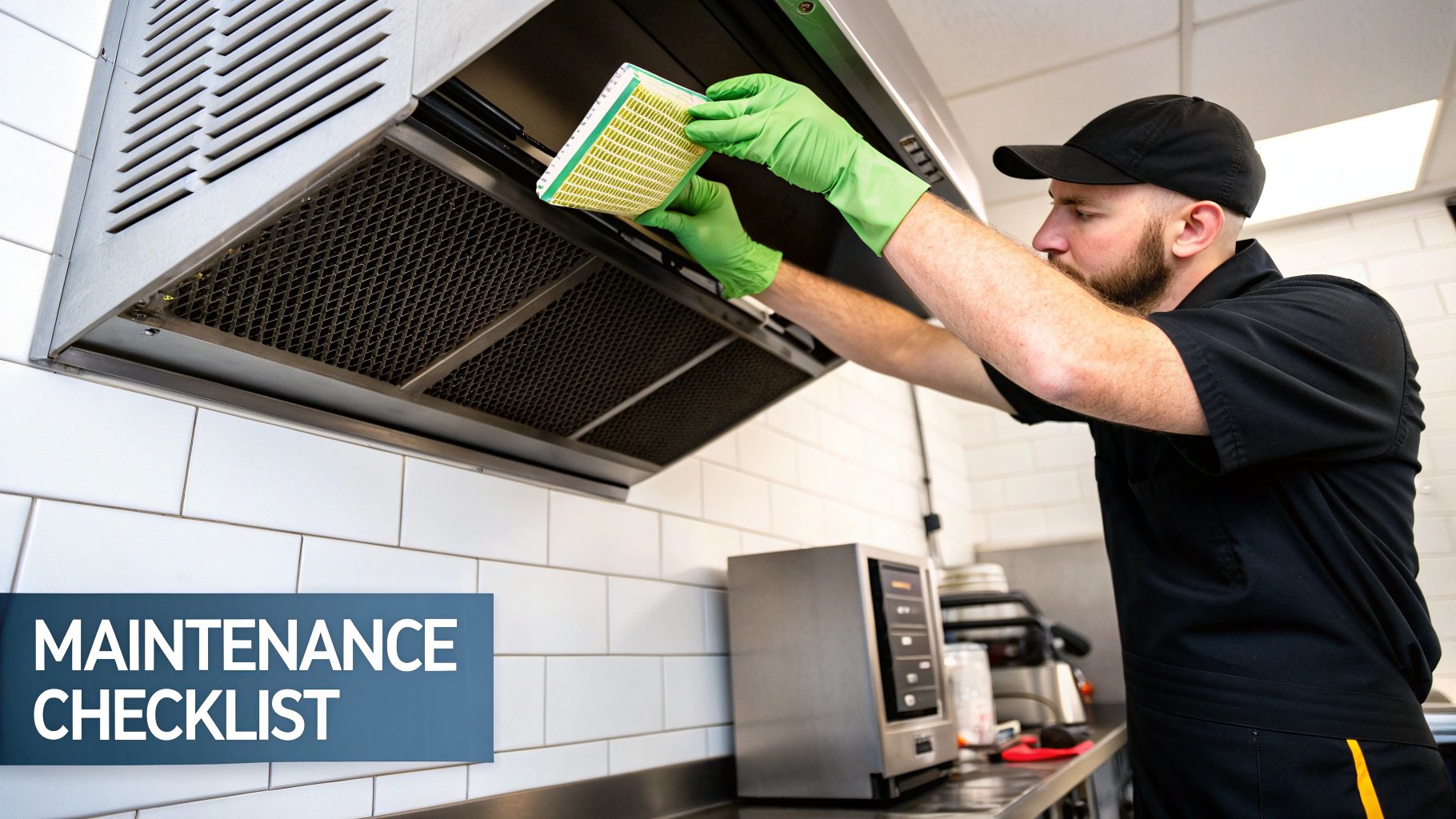
Your No-Excuses Maintenance Checklist
Let’s be real: a ventless hood is only as good as the care you give it. With ducted hoods, you just clean the filters. Here, you're dealing with a multi-stage system where filters have a limited lifespan and must be replaced. Skipping this isn't an option. It tanks your air quality, jacks up your fire risk, and will eventually burn out the unit.
Here’s a simple schedule to stay on top of it:
- Every Day: Wipe down all the stainless steel, inside and out, to stop grease from building up. Don't forget to empty and clean out the grease trap.
- Every Week: Glance at the system's indicator lights. They’re your early warning system, telling you when a filter is getting old or if something's wrong.
- Every Month: Pull out the pre-filters—your first line of defense—and give them a good inspection. Clean or replace them based on what the manufacturer says. A quick look will tell you a ton about how much grease your kitchen is producing.
The absolute most important part of owning a ventless hood is sticking to a strict filter replacement schedule. Think of it like changing the oil in your car. You wouldn't run your engine on old, sludgy oil, and you can't expect your hood to work with clogged-up filters.
Why You Can’t Slack on Filter Changes
Those high-tech filters, especially the charcoal and HEPA ones, are the heart and soul of the system. They’re doing the really hard work of pulling tiny particles and smells out of the air. But they don't last forever.
How often you change them depends entirely on your operation. A kitchen that’s frying food from open to close is going to chew through filters way faster than a small coffee shop that just uses a convection oven for pastries.
Interestingly, understanding how to choose an air purifier for your home can give you some good perspective here, since a ventless hood is basically a super-powered, specialized air purifier for your kitchen. The core ideas of trapping particles and killing odors are the same.
Nailing the selection and staying on top of maintenance means your ventless hood will be a workhorse for years. It keeps your crew safe and helps all your other essential restaurant equipment—from commercial refrigerators to commercial freezers and ice machines—run better in a clean kitchen. To get a better handle on equipment safety, check out our guide on what ETL certification means for your kitchen.
Answering Your Top Questions About Ventless Hoods
Navigating the world of kitchen ventilation can feel like a maze, especially in a city like Las Vegas where regulations are tight and competition is fierce. Whether you're running a historic spot downtown or a fast-paced kitchen on the casino floor, you need straight answers. Here are the most common questions we get from local restaurateurs about going ventless.
Can I Use a Ventless Hood with My Gas Charbroiler in Las Vegas?
The short answer is almost certainly no. Fire codes and health regulations here in Las Vegas and across Clark County are incredibly strict, especially when it comes to ventilating appliances that produce heavy grease or use natural gas, like charbroilers. A commercial ventless hood is specifically engineered and certified for use with certain electric cooking equipment—think ovens, griddles, and some deep fryers.
Before you even think about buying, your first call must be to the Southern Nevada Health District (SNHD) and your local fire marshal. They have the final say on what’s approved for a ventless system in your neck of the woods.
What Are the Ongoing Costs of a Ventless Hood?
It's true that you save a bundle on the initial installation by ditching the expensive ductwork. But with a ventless hood, your ongoing operational cost shifts to filter replacements. Unlike a traditional ducted hood where you just pull out the metal filters and run them through the dishwasher, a ventless system relies on specialized charcoal or HEPA filters that need to be replaced.
How often you replace them comes down to your menu and cooking volume. A high-volume Vegas kitchen frying food from open to close will burn through filters much quicker than a small café that’s just baking pastries.
The trick is to treat filter costs as a predictable operational expense, just like your utility bill or food orders. When you factor this into your budget from day one, your ventless hood remains a smart, cost-effective solution for your business.
How Do I Know if a Hood Is Compliant in Henderson or Summerlin?
Compliance isn't just about buying the right piece of equipment; it's about the entire setup and installation. For any location in the Las Vegas valley, whether it's Henderson, Summerlin, or right on the Strip, true compliance stands on three legs:
- Certification: The hood absolutely must be certified by a recognized agency like UL (specifically to standard UL 710B) and NSF.
- Appliance Pairing: It has to be explicitly approved for the specific electric cooking appliances you plan to put under it.
- Local Approval: Your complete plan—the hood, the appliances, and the layout—needs a green light from the SNHD and the city’s building and fire departments before you install anything.
Are Ventless Hoods Effective in a Hot Las Vegas Kitchen?
Yes, they are fantastic at capturing grease, smoke, and odors, which is critical for keeping your kitchen clean and safe. But it’s vital to understand what they don't do: they don't remove heat. A ducted hood sucks all that hot air out of the building. A commercial ventless hood filters the air and then recirculates it—still warm—right back into your kitchen.
This means your main HVAC system has to be beefy enough to handle the total heat load coming off your cook line, especially during our brutal desert summers. A powerful HVAC system, working alongside other workhorses like your commercial refrigerators and ice machines, is the bedrock of any successful Las Vegas restaurant.
Ready to explore ventless solutions or upgrade your kitchen with top-tier equipment? At Las Vegas Restaurant Equipment, we provide the warranty-backed, compliant gear you need with fast, free shipping to the entire Las Vegas area. Check out our full catalog and get your operation running today at https://lasvegasrestaurantequipment.com.