

A commercial refrigerator isn't just a bigger version of the one in your home kitchen. It's a heavy-duty cooling powerhouse, engineered from the ground up for the brutal demands of professional settings like restaurants, bars, and hotels. It’s built with powerful components and durable materials specifically to maintain safe food temperatures, even when the doors are swinging open every few seconds in a scorching hot kitchen.
Your Kitchen's Most Valuable Player
Think of it like this: if you're gearing up for a race, you wouldn't bring the family sedan to the starting line. You'd show up with a finely-tuned race car built for raw power, endurance, and performance under extreme pressure. That's the difference between a residential and a commercial refrigerator in a nutshell. Your home fridge is that reliable sedan, perfect for daily errands, but a commercial unit is the high-performance engine that drives a professional kitchen.
In the vibrant city of Las Vegas, where a diverse array of restaurants caters to every palate, this distinction is everything. From the massive buffets on the Strip to the cozy downtown cafes, the success of any food business truly hangs on the reliability of its essential equipment. Commercial refrigerators, along with their deep-freeze cousins like commercial freezers and workhorse ice machines, are the absolute backbone of kitchen efficiency and food safety needed for success.
Built for Business, Not Backyards
So, what are these machines really designed for? At their core, they are specialized appliances created for business use in the food service, retail, and hospitality industries. Unlike the fridges we have at home, they're constructed with much larger capacities, more robust components, and are optimized for durability to handle the relentless pace of a commercial kitchen. You can get a deeper look at the commercial refrigeration equipment market from industry analysts.
This intense focus on performance ensures they can take the heat—literally. They're built to manage constant opening and closing, high ambient kitchen temperatures, and the strict food safety regulations that are just another Tuesday for a restaurant in a city like Las Vegas.
A commercial refrigerator is more than just a cold box; it’s a critical investment in food safety, operational efficiency, and inventory protection. Choosing the wrong unit is a gamble no Las Vegas restaurateur can afford to take.
When you get right down to it, this piece of equipment is the silent MVP of your entire operation. It works tirelessly behind the scenes, keeping thousands of dollars worth of ingredients fresh, preventing costly spoilage, and making sure every single dish you serve meets the highest standards of quality and safety. Without a reliable refrigeration system, even the most talented chef's masterpiece would be at risk.
Before we dive deeper, let's break down the key differences in a simple, at-a-glance format.
Commercial vs. Residential Refrigerators At a Glance
This table gives you a quick snapshot of why you can't just stick a home fridge in a professional kitchen and call it a day. The demands are worlds apart.
| Feature | Commercial Refrigerator | Residential Refrigerator |
|---|---|---|
| Cooling Power | High-powered compressors for rapid temperature recovery | Standard compressors designed for infrequent openings |
| Construction | Stainless steel exterior and interior for durability and easy cleaning | Plastic interiors and varied exteriors (stainless, enamel) |
| Durability | Built to withstand constant use, heavy loads, and high heat | Designed for light-duty, stable home environments |
| Certifications | NSF/ETL certified for public health and safety standards | Typically UL listed for home electrical safety |
| Placement | Can operate in high ambient temperatures (up to 100°F+) | Needs placement in a controlled, cool environment |
| Cost | Higher initial investment and operating costs | Lower upfront cost and more energy-efficient for home use |
| Repairs | Requires specialized technicians for service | Can be serviced by general appliance repair professionals |
As you can see, from the engine that runs it to the steel that protects it, every part of a commercial refrigerator is built with one thing in mind: professional performance.
Finding the Right Fit for Your Las Vegas Kitchen
Picking the right commercial refrigeration for your place is a lot like casting a great show—every single player has a crucial role. The vibrant Las Vegas food scene is incredibly diverse, with restaurants that cater to every palate, from huge steakhouses on the Strip to cozy cocktail bars on Fremont Street. This demanding environment means you need a smart approach to cold storage. First, you have to understand what a commercial refrigerator is actually built to do. But knowing which type is right for your kitchen? That's the real key to success.
Imagine a packed steakhouse on Las Vegas Boulevard. Its entire operation depends on having massive amounts of prime beef, fresh produce, and great wine on hand. For them, a big walk-in cooler and freezer isn't some luxury; it's the beating heart of their business. It gives them the bulk storage they need to serve thousands of people every night without a single hiccup. These units, along with high-capacity ice machines, are the heavy lifters of essential restaurant equipment, keeping ingredients perfect on a massive scale.
This flowchart quickly shows you the two main worlds of refrigeration and where commercial units fit in.
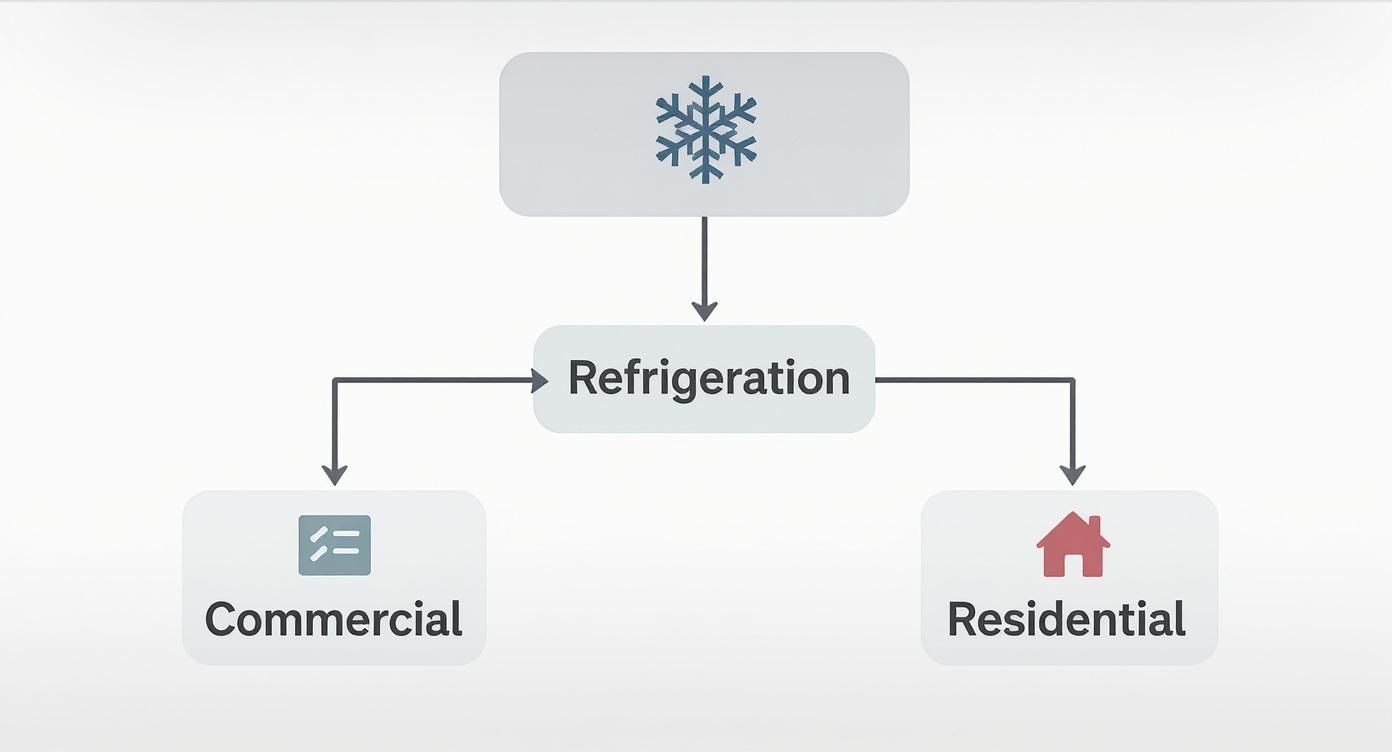
As you can see, the two paths are totally separate. Commercial is for business, residential is for home. They're fundamentally different systems designed for completely different jobs.
The Workhorses of the Kitchen Line
While the walk-ins hold the main inventory, the action on a busy kitchen line requires units that are much more accessible. This is where reach-in refrigerators and commercial freezers shine. These upright cabinets are the daily workhorses, keeping all the must-have ingredients right at a chef's fingertips. They’re built for rapid temperature recovery, which is a non-negotiable feature when the doors are flying open and shut during a dinner rush.
For kitchens where every inch counts, like a trendy downtown bistro or a popular food truck, undercounter and worktop units are game-changers. These compact fridges and freezers slide right under the countertops, making the most of a tight space. Some even pull double duty as prep stations, offering a chilled surface for building salads or sandwiches, which really helps streamline the workflow.
In a city that never sleeps, your refrigeration can’t afford to either. The right equipment mix ensures every part of your operation, from back-of-house prep to front-of-house service, runs smoothly and efficiently.
Customer-Facing and Specialty Units
Of course, refrigeration isn't just for the back of the house. Merchandisers, those glass-door refrigerators, are made to show off products directly to customers. You see them everywhere—in convenience stores packed with cold drinks or in cafes displaying their grab-and-go salads and sandwiches. They do two jobs at once: keep things cool and drive impulse buys.
Finally, you've got the specialty units that solve specific problems:
- Prep Tables: A must-have in any pizzeria or sandwich shop. These combine a refrigerated base for storage with a top rail to hold cold ingredients, keeping everything fresh, organized, and ready for assembly.
- Bar Refrigerators: Sleek back-bar coolers and bottle coolers are built to keep drinks perfectly chilled and within easy reach for bartenders, guaranteeing fast service in a high-energy bar or nightclub.
Every piece of equipment has its own job. You can browse a huge selection of commercial refrigerators in Las Vegas to see how all these different types can come together to build the perfect cold storage setup for your business. From the raw power of a walk-in to the on-the-line speed of an undercounter unit, matching the gear to the task is everything.
Decoding the Tech Specs That Truly Matter
Knowing the different types of commercial refrigerators is a solid first step, but picking the right one means you’ve got to look under the hood. The technical specs can look like a foreign language, but they’re the key to figuring out if a unit can actually survive the brutal reality of a Las Vegas kitchen. These numbers aren't just for show; they translate directly into performance, reliability, and, ultimately, your bottom line.
Think about it: in the desert heat, where kitchen temperatures can get wild, a refrigerator's cooling power is everything. A unit that performs just fine in a cooler city might completely choke during a summer rush here. That’s why digging into the specs isn't just for tech geeks—it's a crucial step for any serious restaurant operator in Vegas.
Translating Cooling Power and Performance
At its core, a commercial refrigerator’s only job is to get heat out. This is where you’ll run into a critical number: BTU, or British Thermal Units. The easiest way to think of BTUs is as raw cooling horsepower. A higher BTU rating means the refrigerator has a beefier system for yanking heat out of the cabinet, which is absolutely vital for quick temperature recovery after your line cook has been holding the door open.
This cooling magic is all thanks to the refrigeration cycle. In simple terms, a special liquid called a refrigerant does a constant loop through the system.
- Inside the refrigerated box, the refrigerant soaks up heat from your food and turns into a gas.
- The compressor, the heart of the system, squeezes this gas under high pressure, making it even hotter.
- This super-hot gas zips over to the condenser coils, where a fan blows kitchen air across them, releasing all that captured heat out into the room.
- As it sheds heat, the refrigerant cools down, turns back into a liquid, and gets ready to start the cycle all over again.
In a high-heat battleground like a Las Vegas kitchen, a tough refrigeration cycle backed by a high BTU rating is your best defense against food spoilage. It’s what ensures your unit can keep its cool when the kitchen is at its hottest and busiest.
The Importance of Defrost Cycles
Another spec you can't afford to ignore is the defrost type. Over time, ice builds up on the evaporator coils, and that ice acts like a thick winter coat, insulating the coils and making it harder for them to absorb heat. This forces the whole system to work overtime just to keep up. Commercial units have a few ways of dealing with this.
Automatic Defrost: This is what you’ll find in most modern units, and for good reason. The system uses a timer and a small heating element to periodically melt away any ice buildup, all without you lifting a finger. It’s a true set-it-and-forget-it solution that keeps the refrigerator running at peak efficiency.
Manual Defrost: You don’t see this as often in refrigerators, but some commercial freezers still use a manual system. This means you have to completely empty the unit, shut it down, and let the ice melt on its own. It's a hassle, no doubt, but some operators prefer it because it never introduces that little burst of heat from a defrost cycle, which can be better for super-sensitive products like ice cream or gelato.
For the vast majority of busy Las Vegas restaurants, the hands-off reliability of an automatic defrost system is the clear winner. It guarantees consistent, efficient performance day in and day out, which is one less thing you have to worry about during a dinner rush.
Mastering Energy Efficiency in a Hot Climate
In a city like Las Vegas, your air conditioning bill is already through the roof. The last thing you need is a commercial refrigerator quietly bleeding your budget dry. Choosing an energy-efficient unit isn't just a "green" move; it's a cold, hard financial strategy that directly pads your bottom line every single month.
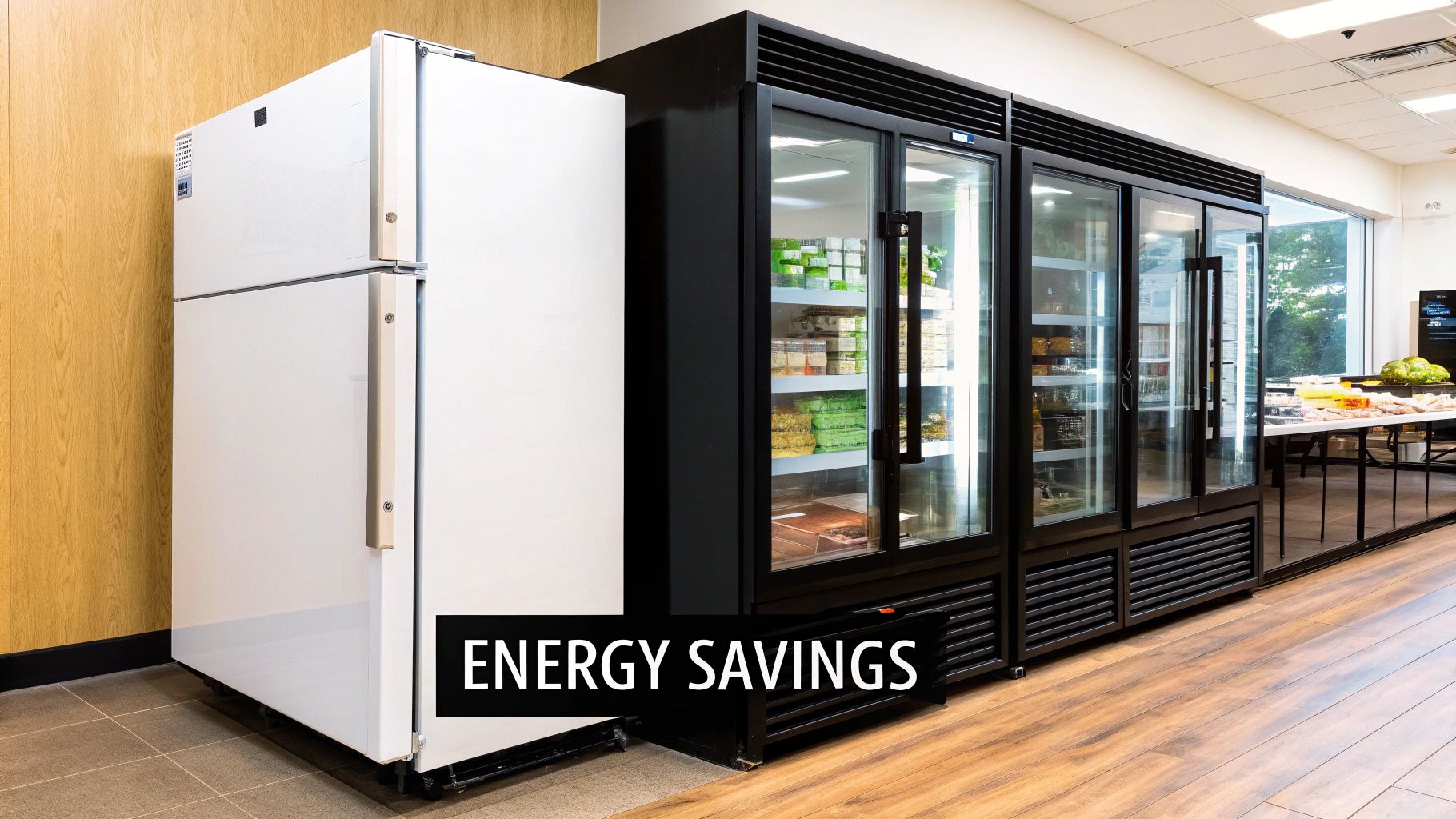
Think about it: that relentless desert heat forces your refrigeration to work overtime just to hold a safe temperature. An inefficient model will run its compressor nearly non-stop, and you'll see the damage on your next utility bill. This is exactly why a smart upfront investment pays for itself over and over again.
Look for the ENERGY STAR Certification
Your first line of defense against sky-high energy costs is the ENERGY STAR label. This is the government-backed seal of approval for energy efficiency, showing that a product meets strict guidelines from the U.S. Environmental Protection Agency. An ENERGY STAR-certified commercial refrigerator is engineered to be 15-30% more efficient than a standard model.
So, how do they pull that off? It comes down to a few key upgrades:
- Superior Insulation: High-quality foam is packed in to keep the cold air where it belongs—inside. This means the compressor doesn't have to kick on as often.
- Advanced Compressor Technology: Today's compressors are smaller, more powerful, and sip electricity instead of guzzling it.
- Tight Door Seals: A perfect, airtight seal from high-grade gaskets is crucial. It stops cold air from escaping and prevents that hot kitchen air from sneaking in.
In the brutal Las Vegas climate, an ENERGY STAR-certified refrigerator isn't a luxury—it's an absolute must. It’s your guarantee that the unit is built to perform without becoming an energy monster, even when it's 115°F outside.
Picking equipment with this certification means you’re buying a machine designed to lower your operating costs from day one. Seriously, exploring energy-efficient commercial refrigeration options is one of the smartest things a Las Vegas restaurant owner can do for their business.
Beyond the Label: Modern Eco-Friendly Features
But true efficiency isn't just about the power cord. The type of refrigerant—the lifeblood of the cooling system—plays a huge role in the unit's environmental impact. Old-school refrigerants like Freon have been phased out because they were terrible for the ozone layer.
Today's workhorses use eco-friendly refrigerants like R290 (propane), which has a much lower global warming potential. These natural refrigerants are not only better for the planet but often make the cooling cycle more efficient, which saves you even more money.
When you consider that commercial refrigeration systems account for a staggering 40% of energy consumption in American supermarkets, it puts things in perspective. Choosing a unit with modern, eco-friendly features is a responsible decision that helps both your business and the environment.
Sizing Your Unit and Planning Your Installation
Picking out the perfect commercial refrigerator is about more than just finding a model you like. You have to be sure it’s the right size for your kitchen and that getting it installed will go off without a hitch. Mess this part up, and you’re looking at some costly mistakes, from a fridge that can't handle a Friday night rush to one that literally won't fit through your front door. A little planning is your best defense against these kinds of expensive surprises.
First thing's first: capacity. A unit that’s too small will leave you scrambling for space during a dinner service, forcing you to make emergency runs to the supplier. On the flip side, a fridge that’s way too big is just a waste of energy, cooling empty space and running up your power bill—a huge deal for any restaurant trying to make it in Las Vegas.
Calculating Your Ideal Capacity
To get it right, you really have to think about your day-to-day operations. The vibrant city of Las Vegas is home to a diverse array of restaurants catering to every palate, from high-volume buffets to intimate bistros. A bustling Italian spot on the Strip that burns through fresh ingredients is going to need a lot more cold storage than a small neighborhood cafe with a tight menu. Before you even start shopping, make a quick checklist to figure out what you actually need.
- Menu and Inventory: What’s your ratio of fresh to frozen? A steakhouse is going to need serious cold storage for all that meat, while a pizzeria is more focused on specialized prep tables for toppings.
- Daily Customer Volume: How many people are you serving on a slow Tuesday versus a packed Saturday night? Your refrigeration has to be able to keep up when you're slammed.
- Ingredient Turnover: How often are your deliveries coming in? If you’re getting produce dropped off daily, you might get by with less long-term storage than a place that only gets shipments twice a week.
Sizing is a balancing act. You're aiming for a unit that runs at about 75-80% capacity during normal business hours. That leaves you just enough of a buffer for your peak times without wasting money cooling empty shelves.
Mastering Installation Logistics in Las Vegas
Once you’ve got the size figured out, it's time to think about the logistics of getting it into your building. This is where a lot of people trip up, and in Las Vegas, even small delays can cost you big. Grab your tape measure and walk the path the unit will take, from the delivery truck right to its final home in your kitchen.
You need to confirm that the refrigerator's dimensions—and don’t forget its crated shipping size—will clear every single doorway, hallway, and tight corner. Then, think about where it’s going to live. Commercial refrigerators kick out a lot of heat, and in our desert climate, they absolutely need room to breathe. Make sure there’s adequate ventilation space all around the unit (the spec sheet will tell you exactly how much) so the compressor doesn't overheat and die on you. In Las Vegas, that's non-negotiable. A little careful planning here will save you the massive headache of ending up with a perfect unit that just won't fit.
Keeping Your Equipment Running with Proactive Maintenance
Your commercial refrigerator is a serious investment. It's the silent workhorse powering your Las Vegas restaurant through every crazy tourist season and sold-out weekend on the Strip. Protecting it isn’t just about routine upkeep; it’s about safeguarding your inventory, your reputation, and ultimately, your revenue.
A proactive maintenance plan is your absolute best defense against a catastrophic breakdown. You don't want to be caught with a dead walk-in during a dinner rush.
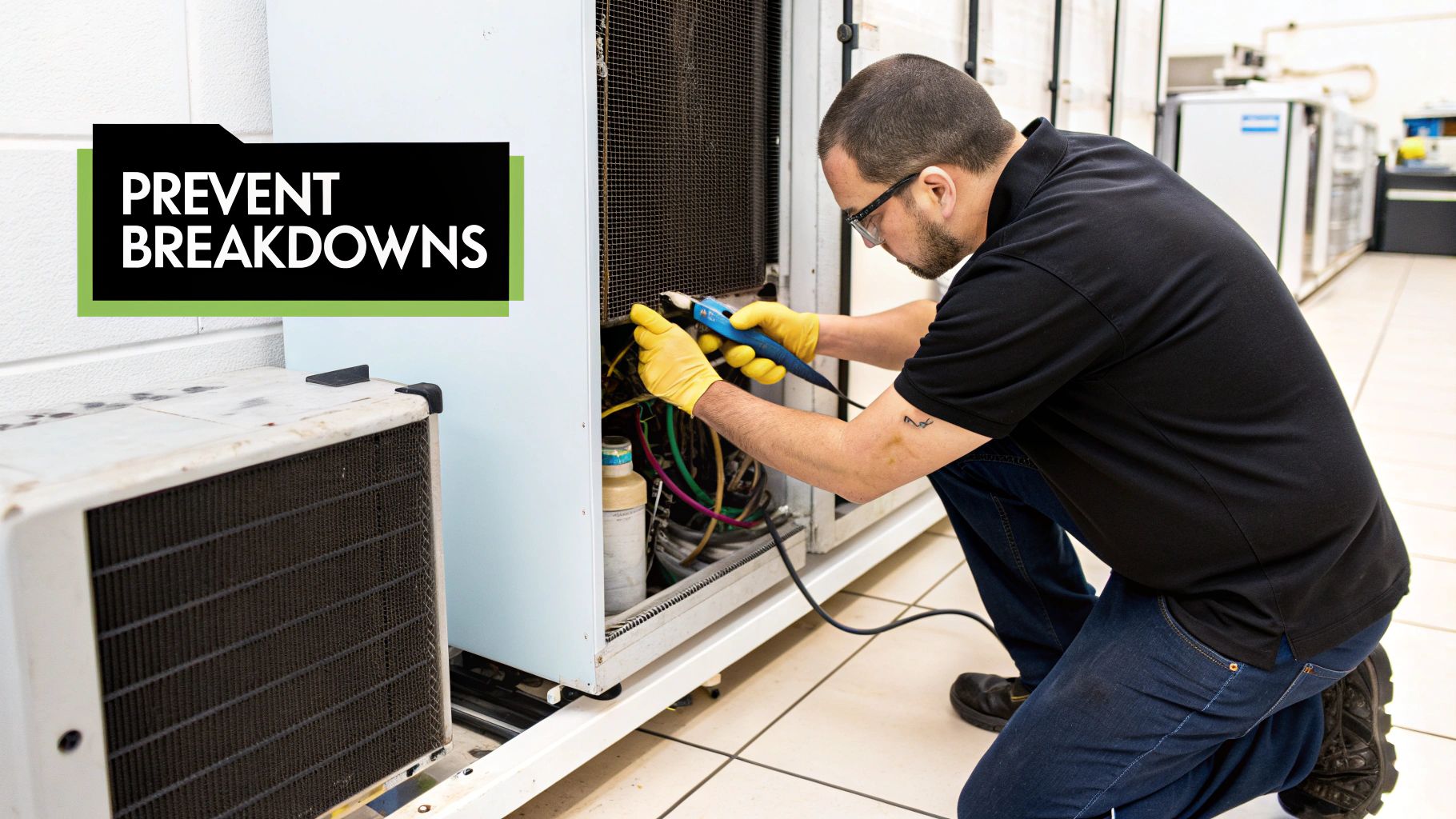
The good news? Many of the most essential tasks are simple enough for your kitchen staff to handle. By turning these small steps into daily routines, you’re building a powerful preventative care program right into your opening and closing procedures.
Your Simple Maintenance Checklist
Just a few minutes of attention each week can be the difference between a smooth service and a costly emergency call. Focus on these high-impact areas:
- Clean Condenser Coils: These coils are designed to release heat, but in a busy kitchen, they become magnets for grease and dust. Clogged coils force the compressor to work overtime, jacking up your energy bill and pushing the unit toward failure. A quick brushing every month or so is all it takes to keep them clear.
- Inspect Door Gaskets: A torn or loose gasket is like leaving the door wide open. It lets cold air pour out, forcing the unit to run constantly just to keep up. Wipe them down daily and check for a tight seal—if you can slide a dollar bill through easily, it's time for a replacement.
- Monitor Temperatures Consistently: Get in the habit of logging the internal temperatures. If you see the numbers slowly creeping up over a few days, that’s a huge red flag that something’s wrong. It gives you time to act before you lose a cooler full of expensive product.
In the high-stakes Las Vegas culinary scene, equipment failure is simply not an option. Think of regular maintenance as your cheapest insurance policy against lost inventory, angry customers, and those dreaded emergency repair bills.
Quick Troubleshooting Tips
Even with the best care, things can go wrong. Before you pick up the phone, run through these common culprits:
- Unit Isn't Cooling: Start simple. Is it plugged in securely? Is the thermostat set correctly? Take a look at the condenser coils—are they caked in dust and grime?
- Strange Noises: A constant, loud humming could mean the condenser fan is blocked or struggling. A repeated clicking sound might point to an issue with the compressor relay.
- Water Leaking: A clogged defrost drain is the number one cause. It's usually a simple fix and can prevent water from pooling inside your unit or creating a slip hazard on the floor.
While these tips can solve minor headaches, it’s crucial to know when to bring in the pros. For complex issues involving refrigerants or electrical components, professional commercial refrigeration repair in Las Vegas is the only way to get the job done right and safely.
Questions We Hear All the Time from Restaurant Owners
When you're running a restaurant in the Las Vegas valley, you've got enough on your plate without worrying about your equipment. We get a lot of the same questions from seasoned pros and new restaurateurs alike, so let's tackle some of the most common ones head-on.
Can I Just Use a Regular Fridge from a Big Box Store in My Restaurant?
I hear this one a lot, and the answer is a hard no. The Southern Nevada Health District is very clear: every piece of equipment in your kitchen has to be commercial-grade and carry an NSF or ETL certification. A residential fridge just isn't built for the constant opening and closing of a busy service, it can't recover temperature fast enough, and most importantly, it will get you an instant fail on your health inspection. It's just not worth the risk.
How Often Does My Commercial Refrigerator Need a Check-Up?
Think of it like getting the oil changed in your car, especially out here in the desert. Proactive maintenance is your best friend. We strongly recommend getting a professional to look over your unit at least twice a year. A good schedule is once before summer kicks into high gear and again before the holiday rush starts. On a daily basis, have your staff make it a habit to wipe down the coils and check that the door seals are tight. A little bit of prevention goes a long way in avoiding a catastrophic failure during a packed Saturday night on the Strip.
What’s the Best Refrigerator for a Smaller Bar?
For those tight spots in a cozy downtown bar or a lounge on Fremont Street, you've got to be smart with your space. Undercounter and back-bar coolers are the heroes here. They tuck right under your countertop, giving bartenders instant access to cold bottles, mixers, and garnishes without eating up an inch of your precious floor space. If you're looking to show off a great selection of craft beers, a glass-door merchandiser is a fantastic way to tempt customers.
How Do I Keep My Power Bill from Exploding in the Las Vegas Heat?
The summer utility bills here can be brutal, but you can fight back. Your first line of defense is investing in an ENERGY STAR certified refrigerator. These units are engineered from the ground up with better insulation and high-efficiency compressors specifically to handle high ambient temperatures without having to run 24/7. Another simple but crucial tip: give your unit room to breathe! A fridge crammed into a tight corner with no airflow has to work way harder, which sends your energy costs through the roof.
For a complete selection of new, warranty-backed commercial refrigerators, commercial freezers, and ice machines perfect for Las Vegas conditions, trust Las Vegas Restaurant Equipment. Explore our inventory and get fast, free shipping at https://lasvegasrestaurantequipment.com.