

In the high-stakes, fast-paced world of Las Vegas dining, a commercial kitchen waste disposal isn't just another appliance—it's the unsung hero keeping your operation from grinding to a halt. Think of it as your first line of defense against kitchen chaos. It immediately tackles food scraps, keeping your kitchen clean, hygienic, and running at the breakneck speed this city demands.
The Secret Weapon Of Successful Las Vegas Kitchens
In the vibrant city of Las Vegas, where you'll find a diverse array of restaurants that cater to every palate, success is about more than just amazing food. It's measured in speed, cleanliness, and pure, unadulterated efficiency. Behind every great dining experience is a kitchen that runs like a well-oiled machine, and a commercial-grade disposal is a critical gear in that system.

This isn’t just about getting rid of leftovers. It’s about creating a seamless workflow that starts the second a plate hits the dish pit. By immediately grinding and flushing food waste, you’re giving your staff a more sanitary space to work in, which drastically cuts down on pests and cross-contamination risks. That frees them up to focus on what they do best: cooking exceptional food.
An Essential Part of the Kitchen Ecosystem
A tough, reliable disposal is just one piece of the puzzle; it works in concert with other essential restaurant equipment needed for success. Picture the flow: ingredients come out of your commercial refrigerators and commercial freezers, get prepped, and cooked. Ice for drinks comes from well-maintained ice machines. Scraps and waste are made at every step. Without a disposal, that waste piles up fast, creating clutter, bad smells, and real hygiene problems.
But with a powerful disposal unit right in the dish pit, the entire process is uninterrupted.
Why A Commercial Disposal Is A Non-Negotiable Asset
For any Las Vegas restaurant owner, the benefits of investing in a proper commercial disposal are immediate and tangible. It’s not a "nice-to-have"—it's a core component of a profitable kitchen.
| Benefit | Direct Impact On Your Restaurant |
|---|---|
| Improved Hygiene | Eliminates overflowing, smelly trash bins that are a magnet for pests and health code violations. |
| Increased Efficiency | Your team spends less time hauling heavy, leaking trash bags and more time on revenue-generating tasks. |
| Enhanced Safety | Fewer food scraps on the floor means a major reduction in dangerous slip-and-fall hazards. |
| Regulatory Compliance | Helps you easily meet the notoriously strict health and sanitation standards required in Las Vegas. |
Simply put, a high-quality disposal streamlines your back-of-house, making it safer, cleaner, and more efficient from day one.
In a city built on impeccable presentation and service, a clean and efficient back-of-house is non-negotiable. A commercial-grade disposal is the first step in ensuring your kitchen reflects the high standards your customers expect.
It's no surprise that restaurants everywhere are catching on. The global market for kitchen waste disposers was valued at around USD 2.5 billion in 2023 and is on track to hit USD 4.2 billion by 2032, largely driven by the demands of urban hubs like ours. You can read the full research about this growing market to see just how vital these units have become.
Choosing The Right Disposal For Your Restaurant's Menu
Picking the right commercial kitchen waste disposal isn't just about grabbing a popular brand off the shelf. It’s about matching the machine’s guts and power to what you’re actually scraping off plates every night. Think of it like this: a cozy Fremont Street café that mostly serves soups and salads can get by with a reliable sedan of a motor. But if you’re running a high-volume steakhouse on the Strip, you need the raw power of a V8 to chew through dense scraps without a second thought.
Get this decision wrong, and it’ll cost you. An underpowered unit will jam up and burn out, leaving you with a mess during the dinner rush. On the flip side, a monster machine is just a waste of money, sucking up more electricity and water than your kitchen really needs. The goal is to find that sweet spot for your specific menu.
Decoding Horsepower For Your Kitchen
Horsepower (HP) is the number one spec you need to look at. It tells you everything about the disposal’s grinding force and how much waste it can handle. In the commercial world, they’re usually broken down into three tiers.
-
Light-Duty (1/3 to 3/4 HP): These are perfect for smaller spots like delis, coffee shops, or even church kitchens. They’re built for soft food waste—think vegetable peels, fruit scraps, and light plate scrapings.
-
Medium-Duty (1 to 2 HP): This is the go-to range for most full-service restaurants, schools, and smaller Las Vegas hotels. These disposals can handle a bigger variety and volume of food waste, making them a solid, versatile choice.
-
Heavy-Duty (3 to 10 HP): These are the absolute titans, built for the toughest jobs imaginable. We’re talking massive casino buffets, hospital kitchens, and convention centers that need to pulverize everything from poultry bones to fibrous vegetable stalks, non-stop.
To put it in perspective, a medium-duty unit is probably just right for a neighborhood joint in Henderson serving 250 meals a day. But a giant resort kitchen serving thousands needs a heavy-duty beast that won't even flinch.
Beyond The Motor: Grind Chamber Materials And Build Quality
While horsepower grabs all the headlines, the stuff the grind chamber is made of is just as important for making sure your investment lasts. This is where all the action happens, and corrosion is your worst enemy.
Always look for stainless steel components. Stainless steel holds up way better against rust and the corrosion that comes from acidic foods and harsh cleaners. A disposal with cast iron or galvanized steel parts might be cheaper upfront, but it's going to fail much quicker in a busy kitchen.
The grind chamber is the heart of your disposal. Prioritizing durable, corrosion-resistant materials like stainless steel is a direct investment in the unit's lifespan and reliability, saving you from premature replacement costs and operational headaches.
This is a big deal here in Las Vegas, where our water is notoriously hard. Mineral deposits from hard water will eat away at lesser metals, drastically shortening your equipment's life. A quality build ensures your disposal can take a beating day after day for years.
Matching The Machine To The Menu
Let's tie this all together with a couple of real-world Las Vegas examples.
Say you run a bustling Italian place known for fresh pasta and salads. Most of your waste is soft—leftover pasta, veggie trimmings, bread. A solid 1.5 HP medium-duty disposal would be a perfect match. It's got plenty of power for the job without being overkill.
Now, picture a popular BBQ joint slinging ribs, chicken, and brisket. The scraps here are way tougher, with small bones and dense bits of meat. This kitchen absolutely needs a heavy-duty model of at least 3 HP. Anything less would be a recipe for constant jams, service calls, and frustrating downtime. Getting this right from the start is the first step to a kitchen that just works.
How To Correctly Size Your Waste Disposal
Picking the right size for a kitchen waste disposal is more art than science, and it’s a decision that can make or break your kitchen’s flow. This is especially true in a place like Las Vegas, where restaurants of every stripe are serving up an incredible variety of food. Get this wrong, and you're just asking for constant clogs and a motor that's going to burn out way too soon. Go too big, and you're just throwing money and electricity down the drain.
Getting the size right from the start is about protecting your investment and stopping those operational headaches before they even begin. You need a unit that can power through a Saturday night dinner rush, whether you're running a massive buffet on the Strip or a cozy little bistro downtown. Let’s walk through how to figure out exactly what you need.
Start With Your Menu and Daily Volume
First thing's first: take a hard look at what you’re actually serving. The type of food waste your kitchen cranks out is just as important as how much of it there is. A steakhouse dealing with tough gristle and small bones is going to need a much beefier machine than a café that’s just getting rid of soft vegetable peels.
Next, you have to get a handle on your daily volume. The go-to metric for sizing commercial disposals is meals served per day. You need to be honest with yourself here—base your numbers on your busiest days. That’s the only way to make sure your equipment can handle the pressure when you’re slammed.
Sizing a disposal isn't just about avoiding clogs; it's about matching your operational reality. A properly sized unit becomes a reliable asset, while a poorly chosen one becomes a constant source of stress and unexpected costs.
A Practical Sizing Example: A Las Vegas Buffet
Let's put this into practice with a classic Las Vegas buffet. A high-volume spot like this is the ultimate stress test for any piece of kitchen equipment.
Imagine our buffet serves about 800 meals during its busiest shift—let's say that’s the weekday lunch rush.
- Determine Peak Meal Period: The busiest time is lunch, running from 11 AM to 2 PM (a 3-hour window).
- Calculate Waste Per Meal: Industry averages suggest a typical meal creates between 1/4 to 1/2 pound of food waste. For a buffet, with all its variety and potential for heavy waste, we'll aim high and use 0.5 pounds per meal.
- Total Waste Calculation: 800 meals x 0.5 lbs/meal = 400 pounds of waste.
- Calculate Hourly Rate: 400 lbs / 3 hours = roughly 133.3 pounds of waste per hour.
Based on that quick math, our buffet needs a serious, heavy-duty disposal that can chew through at least 134 pounds of mixed food scraps every hour without breaking a sweat. This calculation points us straight toward a heavy-duty model, likely something in the 3 to 5 HP range.
Quick Sizing Reference For Commercial Disposals
While running the numbers for your specific kitchen is always the best bet, this chart is a great starting point for matching your restaurant type with the right disposal horsepower.
Use this chart as a starting point to match your restaurant type and volume with the appropriate disposal horsepower and duty level for optimal performance.
| Restaurant Type | Average Meals Per Day | Suggested Horsepower (HP) | Recommended Duty Level |
|---|---|---|---|
| Small Café or Deli | Under 100 | 1/2 - 3/4 HP | Light-Duty |
| Casual Dining Restaurant | 100 - 500 | 1 - 2 HP | Medium-Duty |
| Large Restaurant or Hotel | 500 - 1500 | 3 - 5 HP | Heavy-Duty |
| Casino Buffet or Institution | 1500+ | 5+ HP | Extra Heavy-Duty |
Following this kind of systematic approach helps ensure your disposal is a workhorse, not a weak link in your kitchen line. And remember, the disposal is only one part of the equation. It needs to be paired with the right commercial sinks that are tough enough to support the unit and fit seamlessly into your dish pit's workflow.
Thinking about the bigger picture, managing waste efficiently is a huge challenge. In the United States alone, we discard nearly 60 million tons of food every year. That breaks down to about 325 pounds per person and represents almost 40% of our entire food supply—a staggering loss valued at $218 billion. A good commercial disposal is a key piece of tech for tackling this problem right where it starts: in the kitchen.
Integrating Disposals With Grease Management Systems
In the fast-paced Las Vegas restaurant world, your kitchen waste disposal and your grease management system aren't solo acts—they're a critical duo. If you install a high-horsepower disposal without a solid plan for handling the Fats, Oils, and Grease (FOG), you're basically paving a direct path to clogged pipes, hefty emergency plumbing bills, and some serious fines from Southern Nevada health inspectors. A truly efficient kitchen is built on an integrated system where these two pieces of equipment work in perfect harmony.
This is about more than just checking a box on a health code form; it’s about protecting the very arteries of your restaurant's plumbing. Every time you grind up food scraps, you’re releasing tiny particles of FOG into your wastewater. Without a grease trap doing its job, that grease cools down, solidifies, and builds up inside your pipes until you've got a complete blockage on your hands. For any busy Vegas spot, that kind of shutdown is an absolute nightmare.
The Critical Connection Between Your Disposal and Grease Trap
Think of your kitchen waste disposal as the on-ramp to a highway and your grease trap as the essential inspection station. Everything that goes down your sinks has to pass through that trap before it hits the city's sewer system. The disposal’s job is to break the food waste down into small enough pieces to travel, but it's the grease trap’s job to catch all the harmful FOG before it causes a major pile-up downstream.
When it's set up right, water flows freely while grease is captured effectively. This synergy is what prevents backups and keeps your operation compliant with local regulations, which are notoriously strict here in Clark County thanks to the sheer volume of restaurants.
This simple diagram breaks down the first key steps in choosing the right unit before you even think about connecting it to your plumbing.
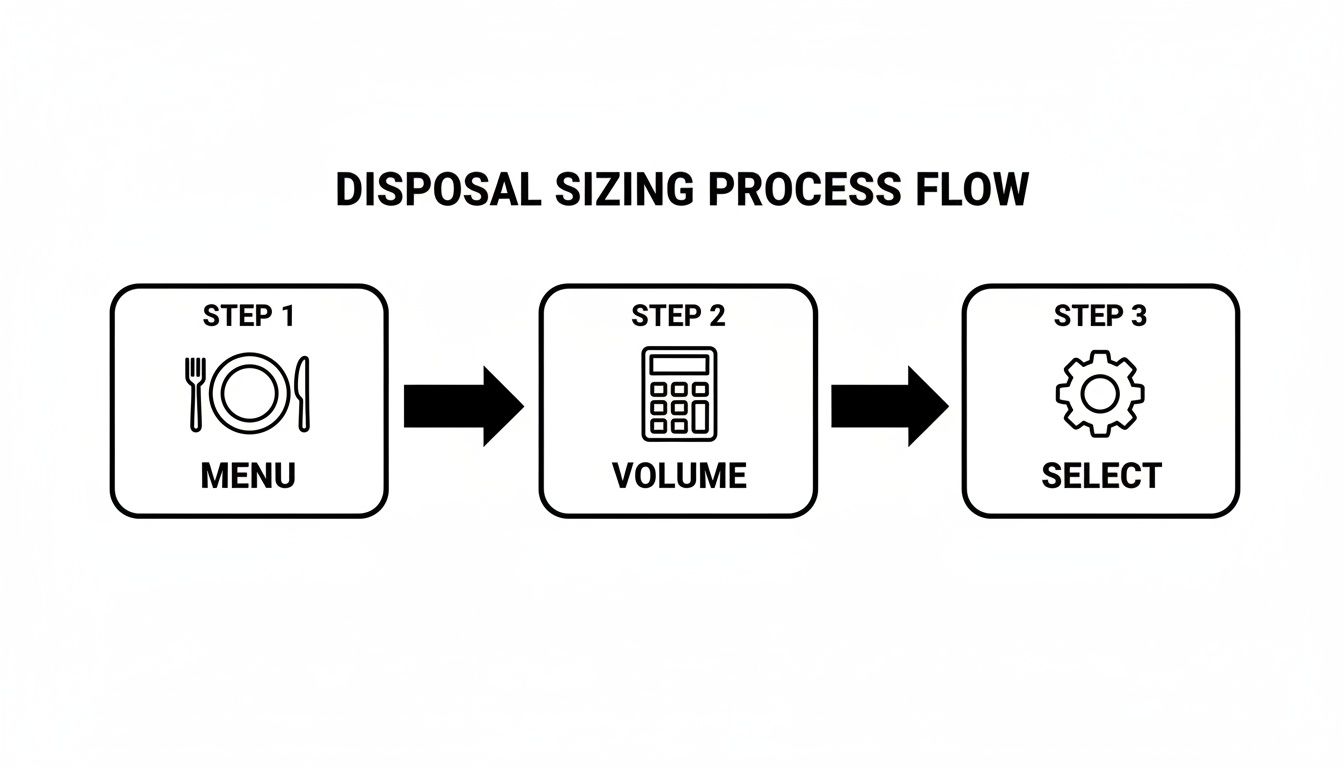
As you can see, properly sizing your disposal based on your menu and daily volume is the absolute foundation for creating a balanced system.
Best Practices For A Compliant Installation
Getting this system to work flawlessly takes some careful planning during the installation phase. It’s not as simple as just hooking up a couple of pipes. The placement and connection between the disposal, the sink, and your grease interceptor have to be precise to get the flow and capture just right.
Here are the non-negotiables for a correct setup:
- Proper Slope: The pipe that runs from your disposal to the grease trap needs a specific downward slope. The industry standard is at least 1/4 inch of drop per foot of pipe. This ensures gravity does the work of moving water and solids along without any help.
- Avoid Sharp Turns: Whenever you can, use sweeping, 45-degree elbow joints instead of sharp 90-degree turns. This simple choice helps prevent food particles from getting snagged and creating clogs before they even make it to the trap.
- Correct Sizing: The grease trap itself has to be big enough to handle the flow rate from every fixture connected to it—including the disposal and all the sinks at your warewashing station. An undersized trap will get overwhelmed in a hurry, letting FOG slip right by and into the city sewer lines. Our guide on restaurant dishwashing equipment dives deeper into how all these pieces fit together.
A correctly integrated disposal and grease trap system isn't an expense—it's an insurance policy against plumbing disasters. Getting the installation right from the start saves thousands in potential repairs and fines, protecting both your pipes and your bottom line.
The global market for kitchen waste disposals, valued at $1,108 million in 2025, is only expected to grow as kitchens everywhere grapple with rising food waste. In the US, consumers waste a staggering 35 million tons of food each year, and household waste jumped 280% from early 2021 to 2022, showing just how critical effective management systems have become. By following these best practices, Las Vegas restaurants can ensure their setup is efficient, compliant, and ready for the demands of a city that never stops dining.
Staying Compliant With Las Vegas Health Codes
Navigating the local health regulations in Las Vegas can feel like a high-stakes game, but for any restaurant operator here, it’s a game you have to win. The Southern Nevada Health District (SNHD) has very specific, non-negotiable rules for managing food and grease waste, putting your kitchen waste disposal squarely in the spotlight.
Staying compliant isn't just about dodging fines; it's about running a responsible, solid business in a city that expects nothing less than excellence from its restaurants.
Think of an SNHD inspector as a seasoned auditor for your kitchen’s entire waste system. They don’t just glance at a single piece of equipment. They're looking at the complete flow, from the second food scraps hit your sink to where the wastewater finally ends up. A powerful disposal is a fantastic start, but if it isn't properly tied into your grease management system, it can quickly turn into a major violation.
What Inspectors Look For
SNHD inspectors have a sharp eye for the usual compliance slip-ups. When they step into your kitchen, they’re immediately sizing up a few key areas related to your waste management. Knowing what they’re looking for is the first step to sailing through your inspections.
Here's what's on their checklist:
- Proper Equipment Installation: They'll confirm your disposal and grease trap are installed to local plumbing codes, checking for the right pipe slope and flow rates.
- Grease Trap Maintenance: Inspectors need to see that your grease trap isn't overflowing and that you’re cleaning it on a regular, documented schedule.
- Maintenance Logs: You absolutely must keep detailed records of when your grease interceptor was last pumped and serviced. This is often the first thing an inspector will ask to see.
- Staff Knowledge: Your team has to know what can and can't go down the drain. An inspector might even ask a few questions to see if they’ve been trained properly.
Failing to meet these standards can bring a lot more than just a slap on the wrist. Violations can trigger mandatory re-inspections, steep fines, and in the worst cases, a temporary shutdown of your restaurant—a devastating blow for any business.
Actionable Advice For Passing Inspections
Staying on the right side of the health department is all about being proactive, not scrambling at the last minute. Start by making compliance a core part of your kitchen's daily rhythm. Create a clear, visible cleaning schedule for your sinks, disposal, and the area around your grease trap.
Next, get a binder or a digital folder and meticulously log every single time the grease trap is serviced. Write down the date, who did the service, and what they did. This paperwork is your best proof that you’re doing your due diligence.
Finally, train your staff relentlessly. Every new hire working the dish pit needs to understand that fibrous vegetables, excessive grease, and coffee grounds have no business going into the kitchen waste disposals.
This level of readiness means that when an inspector shows up, you aren't just crossing your fingers and hoping to pass—you're ready to prove your commitment to a clean, safe, and compliant kitchen. It's a critical part of thriving in the electric Las Vegas restaurant scene, where the standards are as high as the skyline itself.
Proactive Maintenance And Troubleshooting Tips
Your commercial kitchen waste disposal is a real workhorse. Day in and day out, it grinds through pounds of food scraps, keeping your Las Vegas kitchen running clean and efficient. But just like any other critical piece of equipment—from your walk-in freezer to your ice machine—it needs consistent care to stay in fighting shape.
Ignoring it is a recipe for disaster. You're just asking for an unexpected jam, a pricey emergency service call, and frustrating downtime, probably right in the middle of a dinner rush.
The good news is, a proactive maintenance schedule doesn't have to be a huge ordeal. By building a few simple habits into your team’s daily closing routine, you can seriously extend the life of your unit and stop the most common problems before they even start. It's the same principle we talk about in our guide on commercial ice maker maintenance—a little upkeep goes a long way.
Your Daily And Weekly Maintenance Checklist
When it comes to keeping your disposal happy, consistency is everything. Making a simple checklist part of your staff's duties ensures nothing falls through the cracks. This small investment of time now will save you from major headaches and repair bills down the road.
Daily Tasks (End of Shift):
- Flush with Cold Water: After the last of the prep scraps are gone, let cold water run for at least 30-60 seconds. This is crucial for flushing any leftover bits and pieces completely through the plumbing and into the grease trap.
- Deodorize and Scour: Toss in a few lemon or orange peels to help kill any funky odors. For a little extra cleaning power, grind a handful of ice cubes—they act like tiny scrubbers, scouring greasy buildup off the grinding chamber walls.
- Quick Visual Check: Before clocking out, have your staff do a quick look-see (with the power OFF, of course!) to make sure a fork, a piece of plastic wrap, or any other non-food item hasn't accidentally fallen in.
Weekly Tasks:
- Give it a Deep Clean: Use a disposal-safe cleaner or a simple mix of baking soda and vinegar to break down any stubborn gunk and grease that has built up over the week.
- Inspect the Seals: Take a peek at the rubber splash guard and any other visible gaskets. You're looking for cracks or signs of wear and tear that could eventually turn into a nasty leak.
What Should Never Go Down Your Disposal
Good training is your number one defense against clogs and jams. Your commercial disposal is a beast, but it’s not invincible. Make sure every single person on your team, from the head chef to the newest dishwasher, knows this list of "never-evers."
The most expensive repair is often the one that could have been avoided with simple training. What your staff keeps out of the disposal is just as important as what goes in.
- Stringy, Fibrous Veggies: Things like celery, corn husks, and artichokes have long, tough fibers that can wrap around the blades like string, jamming the motor solid.
- Grease and Oil: This is a big one. Pouring large amounts of liquid fat down the drain is asking for trouble. It will solidify in your pipes, creating a clog that even the strongest disposal can't fix.
- Coffee Grounds: They seem small and harmless, but coffee grounds clump together in pipes and create a dense, sludge-like blockage that’s a nightmare to clear.
- Hard Items (Bones, Shells, Pits): While some heavy-duty units can handle tiny chicken bones, anything bigger is off-limits. Never put in beef bones, oyster shells, or hard pits from avocados or peaches.
- Foods That Swell: Pasta and rice are like little sponges. They’ll soak up water and expand long after they’ve been ground up, potentially clogging the drain line further down.
By drilling these simple maintenance and training tips into your kitchen’s routine, you can turn your disposal from a potential liability into a reliable asset that will serve your Las Vegas restaurant for years.
Frequently Asked Questions
Even with the best plan, dropping a big chunk of change on essential equipment like a new kitchen disposal is going to bring up some questions. Here in Vegas, every dollar counts, so you need straight answers. We’ve pulled together the most common questions we hear from local restaurant owners to give you the info you need.
Think of this as the final checklist before you pull the trigger, making sure you're set up for success from day one.
Do Commercial Disposals Jack Up The Water Bill?
This is a huge concern for anyone running a business in the desert, but you might be surprised. Modern commercial disposals are actually built with efficiency in mind. Yes, they need a constant flow of cold water to work right—this is key for solidifying any grease so it can be chopped up and flushed away—but the hit to your water bill is usually pretty small, especially when you weigh it against the benefits.
It’s a small price to pay to avoid a massive plumbing nightmare, which would cost you a fortune in repairs and kill your service for a night. The real secret is training your staff to only run the water when they're actually feeding waste into the unit.
Can I Just Use A Residential Disposal In My Small Cafe?
Look, I get wanting to save a few bucks, but putting a residential disposal in any commercial kitchen is a recipe for disaster. Home models just aren't built for the kind of punishment a restaurant dishes out, not even a small one. The motors are weaker and the parts can't handle the constant, heavy-duty grinding.
The minute you install a residential-grade disposal in a commercial kitchen, you've likely voided the warranty. Worse, you’re practically guaranteeing it will break down, clog up, or burn out, costing you way more in the long run than just buying the right tool for the job in the first place.
What’s The Best Way To Train Staff On The Disposal?
Good training is your number one weapon against misuse and expensive service calls. The best approach is to keep it super simple and hammer it home.
- Make a "Do Not Grind" Poster: Get a big, laminated sign with pictures and post it right over the disposal sink. Show things like bones, artichokes, celery, coffee grounds, and of course, silverware. Visuals are everything in a busy kitchen.
- Show, Don't Just Tell: When you're onboarding new people, physically walk them through the process. Turn the cold water on first, then the disposal. Feed waste in a little at a time. Then, let the water run for about 30 seconds after the grinding sound stops to flush everything out.
- Make It Part of the Daily Huddle: Mention it in your pre-shift meetings every now and then. When your crew understands that the disposal is a crucial piece of gear that keeps the whole kitchen running smoothly, they’ll start treating it that way.
Ready to get your Las Vegas kitchen a disposal that can actually handle the grind? Las Vegas Restaurant Equipment has a hand-picked selection of tough, high-performance commercial disposals built for the hustle of our city. Check out what we have and find the perfect match for your operation.