

Opening a restaurant in Las Vegas isn't just about cooking great food. You're jumping into a vibrant city with a diverse array of restaurants that cater to every palate, making it one of the most competitive, high-energy food scenes on the planet. Success here demands a rock-solid plan, the right financing, and a deep understanding of local regulations. And in a town that never sleeps, having the essential restaurant equipment to keep up is non-negotiable.
Your Blueprint for the Las Vegas Food Scene
Thinking about starting a restaurant in Vegas can feel like a high-stakes gamble, but with the right blueprint, it's a calculated move. This city’s appetite is massive and diverse, from the high rollers on the Strip to the families out in Summerlin. That creates a huge opportunity for anyone with a clear vision and the grit to see it through.
There's a persistent myth that restaurants are doomed to fail, but the numbers tell a different story. In reality, only about 17% of restaurants close in their first year. That survival rate is actually better than the average for other service businesses. This guide is built to give you that strategic edge, focusing on what it really takes to launch successfully here.
Core Pillars of a Vegas Restaurant Launch
To get your idea off the ground and turn it into a real, thriving business, you have to nail a few key areas right from the start. Each piece is critical for building an operation that can handle the pressure and stand out in a city famous for its hospitality.
- A Killer Concept and Business Plan: Your concept is everything—it's your identity. It needs to be sharp enough to grab tourists and compelling enough to build a local following. All of this must be backed by a business plan with financial projections that make sense.
- Essential Commercial Kitchen Equipment: The desert heat and insane volume are no joke. Your equipment has to be bulletproof. We’re talking about workhorse commercial refrigerators, heavy-duty commercial freezers, and high-capacity ice machines that won't quit when you're slammed.
- Mastery of Local Regulations: Getting a handle on Clark County’s specific licensing and health permits is non-negotiable. Mess this up, and you're looking at costly delays that can sink you before you even open.
I've seen it happen time and again: new owners underestimate how much they need for quality equipment. Skimping on your commercial refrigerators and freezers to save a few bucks upfront will come back to bite you with emergency repairs and thousands in spoiled inventory.
While this guide dives deep into the specifics of the Las Vegas market, you still need a strong grasp of general business fundamentals. For a wider view, this guide on how to start a small business offers some great foundational insights.
Nailing a Concept That Actually Works in Vegas
Let's be blunt: in Las Vegas, "what's for dinner?" is a question with a million-dollar answer. You're not just competing with the restaurant next door; you're up against celebrity chef meccas on the Strip and beloved local joints from Spring Valley to Henderson. To make it here, you need more than a good menu. You need a killer concept—an unforgettable identity that grabs a specific slice of this insane market and doesn't let go.
Think of your concept as the soul of your restaurant. It’s what guides your decor, your brand's personality, how your staff interacts with guests, and most importantly, who you're trying to get in the door. Are you chasing high-rollers who want a once-in-a-lifetime fine dining spectacle? Or are you aiming to be the go-to spot for the thousands of hospitality workers pouring out of casinos at 3 a.m., hungry for a decent meal?
Carve Out Your Niche in the Vegas Valley
Before you even dream about menus or kitchen designs, you have to answer the single most important question: Who are you cooking for? Trying to be everything to everyone is a fast track to failure in this town. You have to get specific.
Think about who's really out there in the Las Vegas valley:
- The Tourist Onslaught: We're talking high-volume, people who are here for a good time, not a long time. They're looking for that "Only in Vegas" experience and are often less price-sensitive. This usually means a prime location near the Strip or Fremont is a must.
- The Suburban Locals: These are the families in places like Summerlin or Henderson. They want consistency, good value, and a place they can feel comfortable bringing their kids to week after week.
- The Foodie Crowd: These are the adventurous eaters who follow the local food blogs. They're on the hunt for the next big thing, the most innovative chef-driven concepts, and you'll often find them exploring spots in the Arts District.
- The Industry Crew: This is a massive, and frankly, underserved market. Tens of thousands of service workers need quality food and drink options that fit their wild schedules and their budgets.
Once you lock in on your target customer, every single decision you make—from the font on your menu to the music you play—should be filtered through them. That focus is what makes you stand out in a city overflowing with choices.
Matching the Menu and Vibe to Your Vision
Your menu is where your concept gets real. It has to be exciting, it has to make you money, and above all, it has to be something your kitchen can execute perfectly, every single time. In a town like Las Vegas, consistency is everything. A tourist who loves their meal might tell a few friends, but one bad experience can spiral into a handful of nasty online reviews before you can even blink.
The atmosphere is what seals the deal. It's the vibe people get the second they walk through your door. A late-night spot for the industry crowd might have a grittier, industrial feel with an amazing bar program. A family-focused restaurant in Henderson needs to be bright, welcoming, and comfortable.
Look, your concept isn't just what's on the plate; it's the whole story you're telling. A strong, clear identity is what turns a first-time guest into a regular who drags all their friends in. That's how you build a real, sustainable business here.
The Workhorses of Your Kitchen: Essential Equipment
Turning that killer concept into reality means having the right tools for the job. Your equipment isn't just an operational line item; it's the foundation of your entire business. It's what allows you to deliver on your promises, plate after plate, especially in the brutal Las Vegas environment. The summer heat alone puts an unbelievable amount of stress on kitchen gear, not to mention the high-volume rushes.
For any Las Vegas restaurant, three pieces of equipment are completely non-negotiable:
- Commercial Refrigerators: This is the heart of your operation, protecting thousands of dollars in food inventory. You need a reliable, efficient unit that won't fail you during a 110-degree day. It’s a must for passing health inspections and avoiding the nightmare of massive food spoilage.
- Commercial Freezers: Crucial for storing ingredients in bulk, your freezer has to hold its temperature no matter how hot the kitchen gets. This is about preserving quality and your bottom line.
- Ice Machines: In the desert, ice isn't a bonus—it's a utility. A powerful, high-capacity commercial ice machine is absolutely vital. The last thing you want is to run out of ice for drinks during a slammed Saturday night dinner service.
Getting Through the Las Vegas Licensing and Permit Maze
So you've got a killer concept and you're ready to open a restaurant in Las Vegas. Fantastic. But before you can even think about your grand opening, you've got to tackle the mountain of paperwork that is the city's licensing and permit process.
Let's be clear: this isn't just about ticking boxes. Getting your licenses and permits right in Clark County is the foundation of your entire business. Mess this up, and you're looking at expensive delays or, even worse, getting shut down before you even start. This is the non-negotiable first step to making sure your restaurant is safe, compliant, and built to last.
The whole process starts with your big idea—your concept, your menu, your identity. That initial planning directly feeds into every single application you'll fill out.
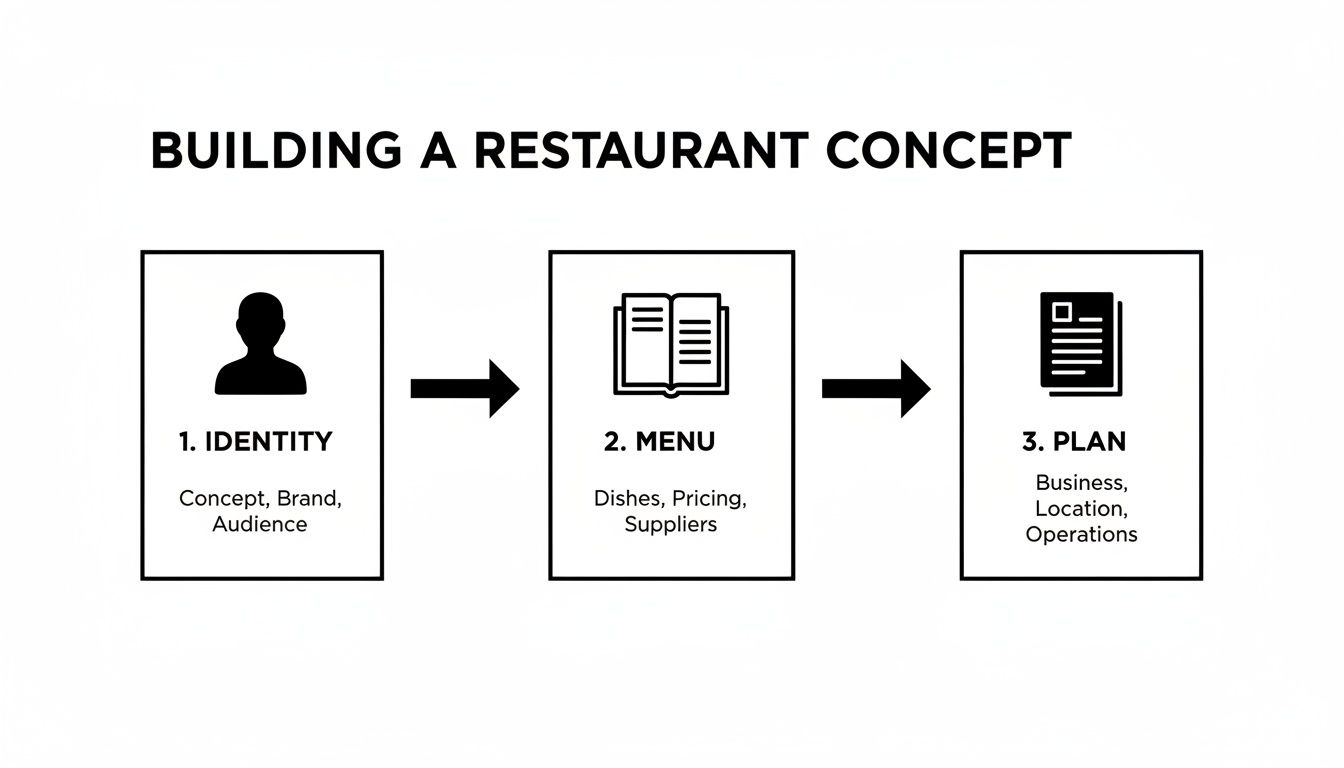
As you can see, a solid plan is your launching pad for navigating all the official red tape.
Your Essential Licensing Checklist
First things first, you need the basics. Think of these as your ticket to the game. You'll need to secure a State of Nevada Business License and then a Clark County Business License. Without these, you're not legally allowed to operate.
Alongside those, you have to get a Seller's Permit from the Nevada Department of Taxation. This is what gives you the authority to collect sales tax on all that delicious food and drink you'll be selling. Get these three squared away before you even think about the more specific food-service permits.
Conquering the Health Permit Process
Alright, now for the big one: the Health Permit. This is issued by the Southern Nevada Health District (SNHD), and they are meticulous. The process starts way before you're ready to open—it begins with your kitchen plans. You have to submit detailed blueprints for their review and approval.
The SNHD is going to pick apart every detail of your proposed kitchen. They’re looking for:
- Proper Equipment: Every piece of gear, especially your commercial refrigerators and commercial freezers, must be NSF/ETL certified. This isn't just a suggestion; it's a hard requirement. This certification proves the equipment is built for a commercial setting and is easy to properly clean and sanitize.
- Smart Layout: Your floor plan has to show a logical workflow that prevents cross-contamination. Think about the journey of your ingredients, from the delivery door to the final plate.
- Sanitation Stations: You need the right number of sinks in the right places. This includes dedicated hand-washing sinks, dishwashing stations, and mop sinks. We've got a detailed guide that breaks down exactly what you need for a compliant hand washing station.
I've seen it happen time and time again. A new owner tries to save a few bucks by buying used or non-certified equipment. The SNHD takes one look at their plans and rejects them flat out. That one mistake can push your opening back by months and blow up your budget when you're forced to buy all new appliances.
Securing Specialized Permits and Approvals
Once you have the health department on board, you're not quite done. Other agencies need to give you their blessing, too. A Fire Department permit is a must. They'll come in to inspect your fire suppression systems, make sure your emergency exits are clear, and check all your safety signage.
Planning to serve alcohol? You'll need a liquor license, which is often the most difficult and time-consuming permit to get. It usually involves intense background checks and public hearings, so start this process as early as possible.
Finally, don't overlook zoning and building codes. You have to absolutely confirm that your location is zoned for a restaurant. If you're doing any kind of renovation—even knocking down a non-structural wall—you'll need building permits and follow-up inspections to ensure everything is up to code. Each one of these permits is a critical piece of the puzzle when you're figuring out how to start a restaurant business in a city as competitive as Vegas.
Finding Your Location and Essential Equipment
In a city built on spectacle, your restaurant's location is everything. It's the first impression, the hook that pulls people in. A prime spot in Las Vegas isn't just about putting a pin on a map; it's about choosing your audience and setting the entire vibe for your operation. This decision is one of the most critical you'll make, directly impacting foot traffic, visibility, and, of course, your bottom line.
Whether you're picturing a high-energy space inside a casino, a hip storefront in the Arts District, or a neighborhood gem in Henderson, the spot has to match your concept. This is a strategic move, not a gut feeling. It demands a serious look at local demographics, parking nightmares (or lack thereof), and how close you are to your ideal customer.
Choosing Your Las Vegas Battleground
The Las Vegas valley is a patchwork of communities, each with its own rhythm. A spot on the Strip guarantees a constant flood of tourists, but you'll pay for it with sky-high rents and cutthroat competition. Head out to a neighborhood like Summerlin or Enterprise, and you'll find lower costs and a real chance to build a loyal following of locals who come back week after week.
Let the data guide you. You need to become an expert on your potential block. What are the traffic patterns at 8 p.m. on a Tuesday? What about noon on a Saturday? What other businesses are around? Most importantly, does the person walking down that street match the customer profile you spent all that time building in your business plan? Get this wrong, and you could have the best food in town served to an empty dining room.
The connection between location and survival isn't just talk. A UC Berkeley analysis found that 17% of independent restaurants go under in their first year. A huge chunk of that comes down to picking the wrong spot and not connecting with the local market.
Equipping Your Kitchen for the Desert Heat
Once you’ve locked down your location, it's time to build the engine room: the kitchen. Here in Vegas, your equipment isn't just a collection of appliances; it's your lifeline. The punishing desert climate and the relentless pace of a busy service put an incredible strain on every single piece of gear. Reliability isn't a feature—it's a necessity.
The Southern Nevada Health District (SNHD) doesn't mess around. To pass their inspections, every piece of equipment must be NSF/ETL-compliant. This certification is your guarantee that the gear is built for commercial abuse, is safe to operate, and can be properly cleaned and sanitized. If you want a deeper dive, our guide on designing a restaurant kitchen breaks down how to build a space that’s both compliant and efficient.
A rookie mistake we see all the time is underestimating how the Las Vegas heat brutalizes refrigeration. A standard commercial fridge that works fine in another city will be fighting for its life here. Investing in heavy-duty, well-insulated units isn't an upgrade; it's the bare minimum for survival.
Your kitchen layout and equipment are two sides of the same coin. For a cafe, great professional traditional espresso coffee machines are non-negotiable. The same logic applies to every part of your cook line, from the range to the walk-in freezer.
To keep you on track, here's a look at the essential equipment categories every new Las Vegas restaurant needs to consider.
Table: Essential Kitchen Equipment for a Las Vegas Restaurant
| Equipment Category | Essential Items | Las Vegas Specific Tip |
|---|---|---|
| Cooking | Commercial Range, Griddle, Charbroiler, Fryers, Ovens | Choose units with powerful ventilation and high BTU output. The kitchen will get hot, so you need equipment that performs under pressure. |
| Refrigeration | Reach-In Coolers, Walk-In Cooler, Undercounter Refrigerators, Prep Tables | Invest in heavy-duty compressors and extra insulation. Standard units will struggle and fail in the summer heat, spoiling thousands in inventory. |
| Freezing | Reach-In Freezers, Walk-In Freezer | Look for freezers with robust seals and quick temperature recovery. Constant door opening in a hot kitchen demands it. |
| Warewashing | 3-Compartment Sink, Hand Sinks, High-Temp Dishwasher | A high-temp dishwasher is crucial for proper sanitization to meet SNHD standards. Hard water treatment is also a smart investment. |
| Ice Production | Commercial Ice Machine, Ice Bin | Get a machine rated for high ambient temperatures. Your ice demand will skyrocket from May to September. Don't get caught short. |
| Food Preparation | Slicers, Mixers, Food Processors, Work Tables (Stainless Steel) | Stainless steel is your best friend. It’s durable, easy to sanitize, and required by health codes for food contact surfaces. |
| Beverage Station | Soda System, Coffee Brewers, Blenders, Bar Coolers | Ensure your beverage coolers can keep drinks ice-cold even when you're slammed. A lukewarm soda is a quick way to disappoint a customer. |
This checklist is your starting point for building a kitchen that can take the heat—literally and figuratively.
The Unsung Heroes: Commercial Refrigeration and Ice Machines
Among all the shiny stainless steel, a few pieces of equipment are absolutely critical to surviving in the Las Vegas market. These are the workhorses that guard your inventory, ensure food safety, and keep customers happy when the sidewalk is hot enough to cook on.
- Commercial Refrigerators: Think of your refrigerator as the security guard for your inventory. One failure overnight can cost you thousands in spoiled food. You need units with powerful compressors, thick insulation, and energy-efficient designs to keep your product safe and your power bills manageable.
- Commercial Freezers: Just as important, your freezer needs to hold a consistent deep-freeze temperature, even when your kitchen feels like a sauna. This is non-negotiable for storing bulk proteins, preserving quality, and keeping your food costs in line.
- Ice Machines: In a city where an ice-cold drink is a basic human need, a weak ice machine is a recipe for disaster. You need a commercial ice machine with a massive production capacity to keep up with the summer rush. Running out of ice in July is simply not an option.
Funding Your Dream Without Breaking the Bank
Let’s talk money. Turning that Las Vegas restaurant concept into a brick-and-mortar reality takes more than just a killer menu; it requires serious capital. I've seen too many great ideas fizzle out because they were underfunded from day one. It's one of the quickest ways for a promising spot to fail before the neon sign even gets a chance to shine.
We're going to break down the real-world costs of launching in this town, build a budget that actually works, and explore the smartest ways to get funded.
Financial missteps are the silent killers in this industry. Think about it—restaurants often operate on razor-thin pre-tax profit margins, hovering around 5%. Every single dollar counts, especially in a dog-eat-dog market like Vegas. When you hear that roughly 26% of new restaurants either close or change owners within the first year, it's not just a scary statistic. It's a warning: a solid financial plan isn't a "nice-to-have," it's your survival gear.
Laying Out Your Startup Costs
Before you even think about asking for a loan, you need to know exactly what it's going to cost to open your doors. Your budget is your roadmap, and if you miss a turn, you'll end up lost. A realistic budget for a small or midsize restaurant here in Vegas usually lands somewhere between $250,000 and $750,000. Of course, that number can swing wildly depending on your concept, the location, and how much of a gut job the space needs.
Your costs will basically split into two piles:
- The Big Upfront Stuff (Capital Expenditures): This is all the one-time spending to get the place built. We're talking construction, the security deposit on your lease, buying all that shiny kitchen equipment, and paying for the initial mountain of permits and licenses.
- The Day-to-Day Cash (Operational Expenses): This is your working capital. It's the cash you need in the bank to keep the lights on for the first few months before you're actually making a profit. This covers your first big food order, your team's first few paychecks, grand opening marketing, and utility deposits.
A classic rookie mistake is budgeting just enough to get the doors open and not a penny more. You absolutely need a cash cushion. Plan for at least three to six months of operating expenses in reserve. An unexpected AC repair in July or a slower-than-hoped-for opening month can bleed you dry in a hurry.
How to Get the Funding in Las Vegas
Once your budget is nailed down, it's time to find the cash. Not many people can self-fund an entire restaurant launch, so you'll need to look at your options. Luckily, there are a few solid avenues for aspiring Vegas restaurateurs.
- Traditional Bank Loans: This is usually the first stop. Banks can offer good interest rates, but they're tough. Expect to show them a bulletproof business plan, have stellar personal credit, and be ready to put up some serious collateral.
- SBA Loans: These are backed by the Small Business Administration, which makes them a bit easier to get than a standard bank loan. Because the government is guaranteeing a portion of the loan, banks are more willing to take a chance on a new restaurant venture.
- Equipment Financing: Honestly, this is a game-changer for managing startup costs. Instead of dropping a massive chunk of your cash on equipment, you finance it. This lets you get the top-tier commercial refrigerators, powerful commercial freezers, and high-volume ice machines you need without draining your bank account.
This strategy is so effective because it keeps your liquid cash free for the stuff that pays the bills every day. You can find out more about how restaurant equipment financing helps you get the right gear while protecting your cash flow. By financing the hardware, you're ensuring your kitchen is ready for the Vegas dinner rush without putting your entire financial future on the line in those critical first few months.
Building Your Team for a Flawless Grand Opening
Your brand-new kitchen and killer location are a great start, but they're just an empty stage. It's the people—your staff—who bring the whole show to life. In the hyper-competitive Vegas hospitality world, getting and keeping a star team is one of the toughest parts of figuring out how to start a restaurant business. Your crew is the face of your brand, the engine in your kitchen, and the difference between a one-time visitor and a loyal regular.
Building this dream team starts way before the first interview. You need to write job posts that do more than list duties; they need to sell your vision and culture to attract real talent. In the interview, dig deeper than skills. Look for that spark—a genuine passion for hospitality.
Training Your Brand Ambassadors
Once you’ve made your hires, training is where the magic happens. This is your chance to turn new employees into true brand ambassadors. It’s got to be about more than just memorizing the menu or learning the POS system. A solid training plan immerses your staff in your restaurant's story, its core values, and your unique standard of service.
- Front-of-House (FOH): Train your servers and hosts to be storytellers, not just order-takers. They need to be able to share the inspiration behind a dish or make a personal recommendation that completely elevates a guest's night out.
- Back-of-House (BOH): Your kitchen crew has to operate like a well-oiled machine. Training here is all about consistency, food safety, and clear communication when the pressure is on. Every single plate has to meet your exacting standards.
The real secret sauce is when your team feels a sense of ownership. A well-trained, empowered staff doesn't just sling plates; they craft memorable experiences that will define your restaurant's reputation from the moment you open your doors.
Creating a Grand Opening Buzz
With your team trained up and ready to go, it's time to get people excited for the launch. Pulling off a successful grand opening in Vegas means cutting through the noise with a smart marketing strategy that gets people talking.
Start by reaching out to local food influencers and bloggers. An invite to a private pre-opening event can generate authentic reviews and social media hype that reaches thousands of potential customers. Another pro move is to host a "soft opening"—a few nights of invite-only service for friends, family, and industry folks. It's the perfect way to iron out any operational wrinkles and build anticipation for the main event. This trial run gives your team a low-stress environment to nail down their roles, ensuring your grand opening is a smooth, successful night that sets the tone for everything to come.
Burning Questions About Opening a Vegas Restaurant
Jumping into a market as wild as Las Vegas is bound to bring up some questions. It's a different beast out here. From the brutal desert climate to the maze of local regulations, getting straight answers is the first step. Let's tackle some of the most common things aspiring restaurateurs ask when they're trying to make a name for themselves in the Vegas food scene.
Think of this as some quick, real-world advice for your most pressing concerns about getting a restaurant off the ground in this one-of-a-kind city.
What’s the Single Most Important Piece of Equipment?
Hands down, reliable refrigeration is the undisputed king in Las Vegas. People really underestimate the strain our desert heat puts on cooling systems. When your commercial refrigerator or freezer dies during a July heatwave, it’s not just an inconvenience—it's thousands of dollars of spoiled inventory flushed down the drain.
This is why you absolutely cannot cut corners on high-quality, energy-efficient commercial refrigerators and commercial freezers. You need units built to handle brutally high ambient temperatures. On that same note, a powerful commercial ice machine is mission-critical. The demand for cold drinks is relentless, especially when the asphalt is melting outside.
How Much Cash Do I Really Need to Start?
The final number can swing wildly based on your concept and where you set up shop, but a realistic budget for a small to midsize spot in Las Vegas is going to land somewhere between $250,000 and $750,000. That's a huge range, I know, but it covers everything—your lease deposits, renovations, all the licensing fees, and your first big food and beverage order.
Your kitchen equipment is a massive chunk of that number. A smart move to protect your cash flow is to look into equipment financing. This gets you the essential gear you need—like those powerful Atosa refrigerators and high-capacity ice machines—without draining the bank account you'll need for payroll and marketing in those make-or-break first few months.
The biggest mistake I see is underestimating the permit timeline with the Southern Nevada Health District (SNHD). Choosing non-compliant equipment or submitting incomplete plans can cause delays that cost you months and tens of thousands of dollars. Always work with suppliers who know the local codes inside and out.
What's the Biggest Mistake New Owners Make?
One of the most common and expensive traps new owners fall into is not taking the local permitting process seriously enough. It's so much more than just filling out a few forms. You’re dealing with incredibly detailed plan reviews and a rulebook thicker than a phone book.
A classic rookie error is failing to choose NSF/ETL compliant equipment from day one. The SNHD will flat-out reject your plans if they see uncertified gear, forcing you into a costly, last-minute scramble for replacements. Same goes for not understanding the specific local codes for things like grease traps or ventilation. The smartest thing you can do is partner up with contractors and equipment suppliers who know the Las Vegas game and can keep you from getting shut down before you even open.
Ready to equip your Las Vegas kitchen for success? At Las Vegas Restaurant Equipment, we provide the heavy-duty, compliant commercial refrigerators, commercial freezers, and ice machines you need to thrive in the desert heat. Get fast, free shipping and expert advice to build your dream restaurant. Explore our selection today at https://lasvegasrestaurantequipment.com.