

So, what exactly is a commercial blast chiller? Think of it as a specialized piece of refrigeration that’s built for one thing: cooling hot food down, and doing it fast. It's designed to rocket food through the temperature danger zone way quicker than any standard fridge or freezer ever could. The whole point is to stop bacterial growth almost instantly, which keeps your food's quality, texture, and flavor locked in while making it as safe as possible to serve.
Winning the Food Safety Game in Las Vegas
In a vibrant city like Las Vegas, you'll find a diverse array of restaurants that cater to every palate, from massive buffets on the Strip to quiet fine-dining spots in Summerlin. Success here isn't just about incredible food and stunning presentation. Your kitchen lives and dies by speed, consistency, and above all, absolute safety. A single food safety mistake can be catastrophic, which means having the essential restaurant equipment needed for success is non-negotiable.
Every great Las Vegas kitchen is built on solid cold storage. You've got your workhorse commercial refrigerators for fresh ingredients, your big commercial freezers for long-term storage, and high-volume ice machines keeping the drinks cold. That's the backbone. But there’s a fourth player that’s just as critical, bridging the gap between the stove and the cooler: the commercial blast chiller.
The Unseen Hero of the Modern Kitchen
Picture a perfect prime rib roast just pulled from the oven at a busy steakhouse. That journey from piping hot to safely chilled is where food is at its most vulnerable. That temperature range between 140°F and 40°F is the "danger zone"—it's where bacteria can double in as little as 20 minutes.
You can't just shove a hot roast into a standard refrigerator. The heat will warm up the whole unit, putting everything else inside at risk and forcing the compressor to work itself to death.
This is exactly where a commercial blast chiller comes in and saves the day. It’s a purpose-built machine that uses powerful blasts of freezing air to bring food temperatures crashing down through the danger zone, usually in 90 minutes or less.
By cooling food this rapidly, a blast chiller essentially freezes bacterial growth in its tracks. This not only guarantees food safety and helps kitchens fly past health code requirements, but it also locks in the texture and moisture that make a dish truly great.
This isn't just some fancy gadget; it's a strategic weapon for any serious culinary operation. And the market reflects that. Valued around USD 1.5 billion in 2023, the global blast chiller market is expected to hit nearly USD 2.8 billion by 2032. The hotel and restaurant sector is a huge part of that, projected to hold a 38.7% industry share by 2025, which shows you just how essential this equipment has become. You can read the full analysis of the commercial blast chiller market trends for more details.
For any restaurant in Las Vegas, a blast chiller isn't just a piece of the puzzle—it's the final, crucial piece for food safety.
Blast Chiller vs. Traditional Cooling Methods
It's easy to think a freezer is just a freezer, but when it comes to cooling hot food, the difference is night and day. Here’s a quick look at why a blast chiller is in a league of its own for a professional kitchen, especially in a demanding place like Las Vegas.
| Feature | Commercial Blast Chiller | Standard Refrigerator/Freezer |
|---|---|---|
| Cooling Speed | Rapidly cools from 194°F to 37°F in ~90 minutes | Very slow; can take over 4 hours |
| Food Safety | Minimizes time in the danger zone, halting bacterial growth | Allows prolonged time in the danger zone, increasing risk |
| Food Quality | Preserves texture, moisture, and flavor with small ice crystals | Creates large ice crystals that damage food structure, causing sogginess |
| Kitchen Workflow | Enables safe "cook-chill" processes, improving efficiency | Disrupts workflow; hot food can't be stored immediately |
| Impact on Other Foods | Self-contained; doesn't affect temperatures of other stored items | Hot items raise the internal temperature, endangering other foods |
| Energy Efficiency | Highly efficient for its specific task; runs for short cycles | Compressor runs constantly to combat heat load, wasting energy |
Simply put, a standard freezer is for keeping cold food cold. A blast chiller is for making hot food cold—safely and quickly. This distinction is critical for any operation that values quality and safety.
How Rapid Cooling Protects Food Quality
To really get why a commercial blast chiller is such a game-changer, you have to understand a little bit about the science of freezing. Think about what happens when you stick a tray of water in a regular freezer. It freezes slowly, right? As the temperature gradually drops, large, jagged ice crystals form.
Now, imagine that tray of water is actually a delicate piece of sea bass or a rich crème brûlée. Those big, sharp ice crystals will literally shred the food’s cell walls. When it thaws, all the moisture escapes, and you're left with a mushy, watery mess. It’s a texture killer.
A blast chiller works on a totally different principle. It doesn't just lower the temperature; it launches an all-out attack on heat. Powerful, high-velocity fans blast frigid air across the food, ripping the warmth away at an incredible speed.
This super-fast cooling process means those big, destructive ice crystals never get a chance to form. Instead, you get tiny micro-crystals that leave the food’s cellular structure almost completely intact. That’s the secret to keeping the flaky texture of your salmon, the creamy mouthfeel of your gelato, and the crisp bite of your blanced vegetables.
Chilling Cycles Tailored for Your Menu
A good blast chiller isn’t a one-trick pony. It comes with different cycles designed for specific foods and densities. It's like having different gears on a truck—you need a low gear for hauling a heavy load up a steep hill and a high gear for cruising on the freeway.
This simple diagram shows the safe, streamlined workflow a blast chiller creates, connecting the dots between the heat of the line and the final serve.
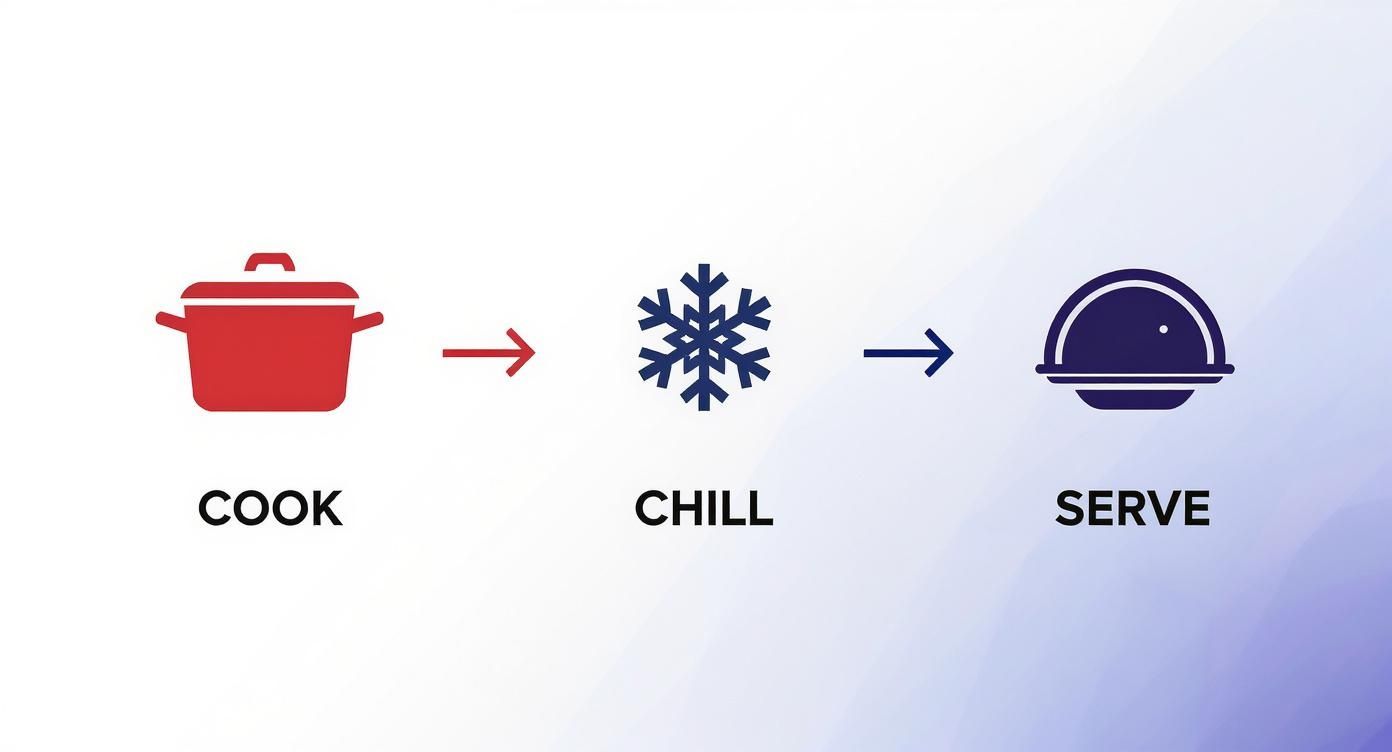
As you can see, food goes directly from the cooking stage to a safely chilled state, locking in quality until the moment it hits the plate.
Two of the main cycles you’ll use every day are soft chilling and hard chilling.
- Soft Chilling: This is your gentle cycle, perfect for delicate items that can't take a full-on freeze blast. Think custards, leafy greens, rice, and thin fish fillets. The air temperature stays just above freezing, cooling the food down quickly without damaging its fragile texture.
- Hard Chilling: This is the workhorse setting for dense, heavy foods. We're talking thick cuts of prime rib, big pots of chili, deep-dish lasagnas, and rich sauces. The unit pumps out much colder air to penetrate right to the core, ensuring even the thickest items are cooled down safely and fast.
Beyond Chilling to Shock Freezing
Most modern blast chillers also feature a shock freezing cycle, which takes things to a whole new level. This function can plummet food temperatures from a piping hot 194°F all the way down to 0°F in around four hours—sometimes less.
This isn’t your standard freezer's slow crawl. It’s a lightning-fast process that completely avoids the quality degradation you see with conventional freezing. For any busy Las Vegas kitchen, this is huge. It means your prep team can cook off large batches of signature sauces, portioned steaks, or soup bases and freeze them with virtually zero loss in quality, flavor, or texture.
When your team masters these cycles, the entire kitchen workflow changes. You can cook proteins, sauces, and starches during quiet periods, preserve them perfectly, and then re-thermalize them during the rush. They'll taste just as fresh as if they were made to order. It's not just about food safety; it’s about consistency and quality.
Once an item is blast-chilled, it gets moved to a commercial refrigerator for service within a few days. If it's been shock-frozen, it goes into a commercial freezer for long-term storage. This creates an unbreakable cold chain from prep to plate—the absolute foundation of any safe, smart, and successful kitchen here in Vegas.
Choosing the Right Blast Chiller for Your Kitchen
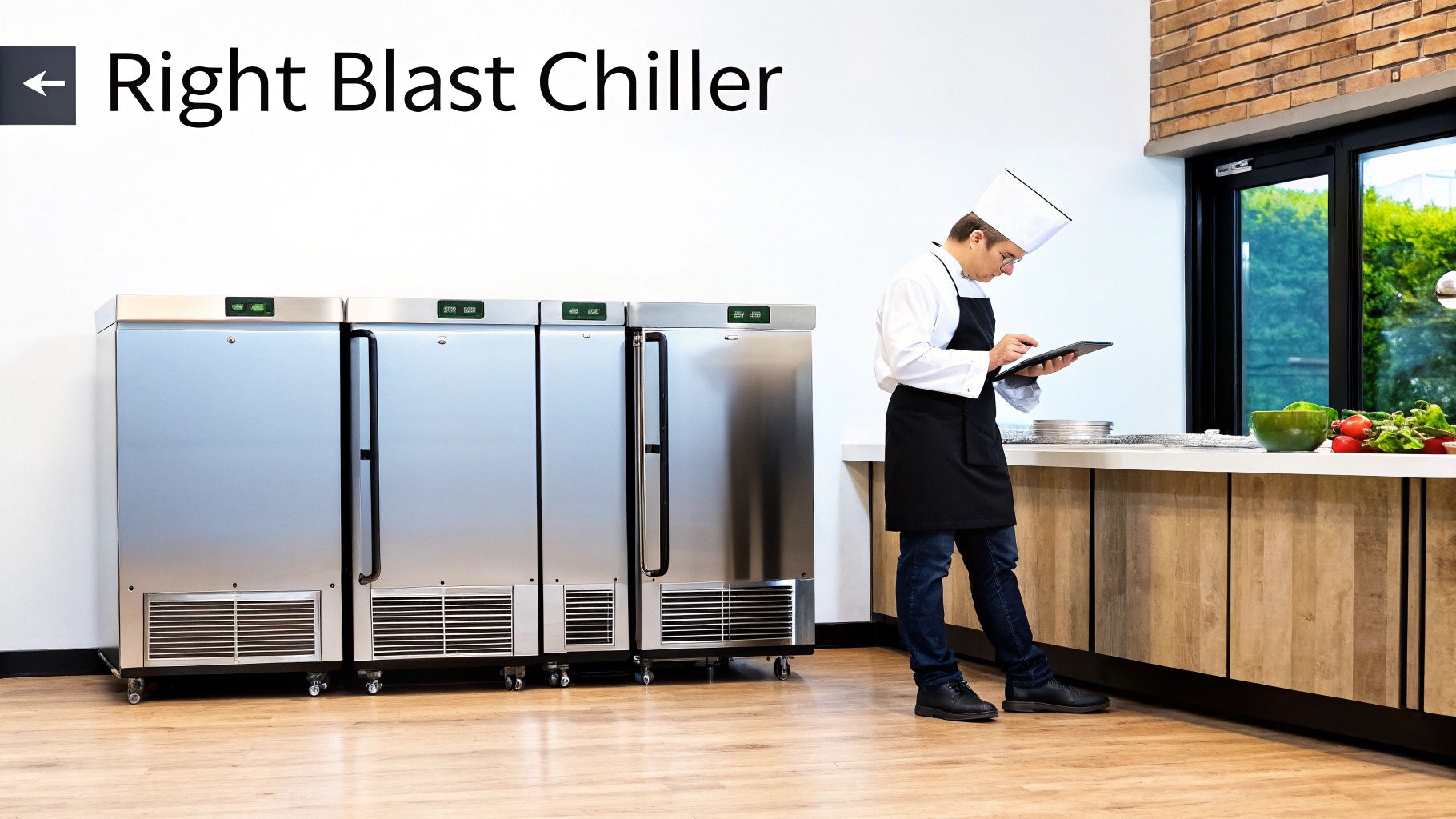
Picking out the right commercial blast chiller is one of those decisions that can truly change your kitchen’s entire flow. You have to look past the spec sheets and think about what you really need to keep up with the pace of your Las Vegas restaurant, bar, or hotel. This isn't just about buying a machine that gets food cold. It's an investment in efficiency, safety, and the quality of every dish you serve.
The first step is a gut check on your kitchen's real-world output and physical layout. A massive Strip buffet that pushes out hundreds of pounds of food every service is playing a totally different game than a cozy downtown bistro. Getting honest about this from the jump will point you toward the perfect size and type of unit for your actual operation.
Matching Chiller Size to Your Kitchen's Reality
Blast chillers are definitely not a one-size-fits-all deal. They’re built in different shapes and sizes to handle specific footprints and production volumes, and knowing the difference is the first step to making a smart buy.
-
Countertop Models: These little workhorses are fantastic for smaller kitchens, food trucks, or even just a specific station that needs its own rapid cooling power. Think chilling individual portions, delicate desserts, or small batches of signature sauces.
-
Reach-In Units: This is the most common style you’ll see in restaurants. They look a lot like a standard commercial fridge but pack a serious punch. They offer a great middle ground of capacity versus footprint, and you’ll typically see their size measured by how many full-size hotel pans they hold—like a 5-tray, 10-tray, or 15-tray model.
-
Roll-In Models: For the big players—casinos, mega-hotels, and large-scale catering outfits—roll-in blast chillers are non-negotiable. These units are massive, letting your team roll an entire pan rack straight from a combi oven right into the chiller. It’s the ultimate way to streamline a cook-chill process on a grand scale.
The great thing about modern blast chillers is their smart design. Manufacturers have figured out how to pack incredible power into a smaller footprint, making even high-capacity units a viable option for kitchens without a ton of extra square footage. For a deeper dive, explore this detailed analysis of the blast chiller market.
For kitchens that need serious cold storage, think about how a blast chiller fits into the bigger picture. A roll-in unit, for example, is best paired with a storage system that can handle the same volume. To see how these systems work together, check out our guide on commercial walk-in refrigerators.
Essential Features for Precision and Durability
Beyond just size, a few key features separate a good blast chiller from a great one. These are the details that give you absolute control over the cooling process and make sure your investment can handle the grind of a Las Vegas kitchen for years to come.
You absolutely need a unit with easy-to-use digital controls and, most importantly, a reliable food probe. A food probe is non-negotiable. It’s the only thing that measures the core temperature of the food, not just the air flying around inside the cabinet. This is how you guarantee—every single time—that your food has passed safely through the temperature danger zone.
Must-Have Specifications for Las Vegas Kitchens
To make sure your new equipment is ready for prime time and meets all local health codes, keep these specs at the top of your list.
-
Chilling Cycle Versatility: Your chiller needs to do more than just blast cold air. Make sure it has both soft chill and hard chill cycles. Soft chilling is gentle, perfect for delicate items like fish or custards, while hard chilling is for dense foods like big roasts and thick stews. A shock freeze function is a huge bonus for long-term preservation.
-
Durable Construction: A Las Vegas kitchen is a battlefield. You need equipment that can take a beating. Insist on a stainless steel interior and exterior (something tough like 304-grade) for maximum durability, easy cleaning, and rust resistance.
-
NSF Certification: This is an absolute must-have, no exceptions. The NSF seal means the equipment has been rigorously tested to meet public health and safety standards. An NSF-certified commercial blast chiller ensures you’re fully compliant with Southern Nevada Health District regulations right out of the box.
Focusing on these features will give you the confidence to pick a blast chiller that not only solves today's problems but is ready to help your kitchen grow and succeed tomorrow.
Boosting Your Kitchen's Profitability and Workflow
It's easy to look at a commercial blast chiller and see just another line item on an invoice. But that’s a huge mistake. A blast chiller is really a profitability engine, a powerful tool that can completely reshape how your kitchen operates—for the better. This isn't just about cooling food down. It's about optimizing labor, slashing waste, and ultimately, fattening up your bottom line.
The real magic happens when you embrace the cook-chill method. This strategy frees your team from the relentless cook-to-order grind, the very thing that leads to burnout and wildly inconsistent ticket times during a chaotic Las Vegas dinner rush.
Mastering the Cook-Chill Method
Picture your kitchen during the quiet off-peak hours. Instead of just cleaning or light prep, your team can be incredibly productive. With a blast chiller, they can knock out huge batches of your most popular dishes—signature sauces, complex soups, even perfectly cooked proteins.
Once cooked, these items go straight into the blast chiller. The temperature plummets through the danger zone in under 90 minutes, locking in that perfect flavor, texture, and moisture. From there, they’re moved into standard commercial refrigerators for short-term storage, ready and waiting for service.
When a ticket comes in, your line cooks just have to re-thermalize and plate the components. This single change can slash ticket times, take a massive amount of stress off your staff, and guarantee every plate leaving the kitchen is consistently excellent.
A Direct Impact on Your Bottom Line
Beyond the workflow, the financial wins are real and immediate. One of the biggest is the drastic cut in food waste, a major headache for any restaurant.
Rapid cooling with a commercial blast chiller minimizes food shrinkage. When hot food cools down slowly on a counter or in a walk-in, it’s constantly losing moisture to evaporation. By chilling food lightning-fast, you trap that moisture, which means better yield and less product getting tossed in the bin.
This isn't just about saving a few bucks on produce. It’s a systemic change that improves your entire cost of goods sold. Less waste means more profit from the same amount of raw ingredients, directly impacting your restaurant’s financial health.
This newfound efficiency also means you can expand your menu without overwhelming your kitchen. You can start offering more complex, higher-margin dishes without adding more staff, simply because most of the heavy lifting is done in advance.
Understanding the Investment and Return
A blast chiller isn't just a purchase; it's a strategic investment with a clear return. Let's break down where the savings come from.
Estimated ROI Breakdown for a Mid-Size Restaurant
| Area of Savings | Traditional Method Cost | Blast Chiller Method Savings (Est. %) | Annual Financial Impact |
|---|---|---|---|
| Food Waste (Shrinkage/Spoilage) | $15,000/yr | 20-25% | $3,000 - $3,750 |
| Labor (Prep/Overtime) | $50,000/yr | 10-15% | $5,000 - $7,500 |
| Increased Sales (Faster Turnover) | - | 5-10% | $10,000+ |
| Energy (Less Walk-In Strain) | $8,000/yr | 5% | $400 |
These numbers are estimates and can vary based on your operation's size and menu.
As you can see, the savings add up quickly. The investment starts paying for itself through:
- Reduced Food Spoilage: Less waste from both shrinkage and bacterial growth.
- More Efficient Labor: Staff get more done in less time during quieter hours.
- Faster Service: Lower ticket times mean happier customers and higher table turnover.
- Menu Expansion: Offer a wider variety of dishes without needing more hands on deck.
The strategic importance of this equipment is undeniable. The North American blast chillers market was valued at USD 0.56 billion in 2024 and is on track to nearly double to USD 1.14 billion by 2033. This boom is being driven by savvy operators who recognize that smarter equipment leads to a more profitable business.
Ultimately, a commercial blast chiller stops being just a piece of equipment and becomes a core part of your business strategy—one that drives profit, consistency, and growth.
Installation and Maintenance in the Desert Climate
https://www.youtube.com/embed/jfiDaHG_ozU
Let's be honest, running any piece of commercial refrigeration in Las Vegas is a challenge. The intense, dry heat of our desert climate means your equipment is already working overtime from the moment you plug it in. For a high-performance machine like a commercial blast chiller, proper installation and diligent maintenance aren't just good ideas—they're absolutely essential for survival.
Think of it this way: you wouldn't just drop a high-end sports car engine into a dusty garage and expect it to perform. Getting the installation right from day one is the first and most critical step in protecting your investment. A blast chiller isn't a toaster you just plug in; it's a powerful piece of machinery that has to battle your kitchen's environment. The wrong placement can lead to constant overwork, frustratingly poor performance, and a much shorter lifespan.
Setting Up for Success in the Heat
The single most important factor for installation is ventilation. Your blast chiller works by pulling heat out of the food and pushing it out into the kitchen. If your kitchen is already pushing 100 degrees and the unit is jammed into a corner with no airflow, that heat has absolutely nowhere to go. It just builds up, forcing the machine to fight a losing battle.
Here’s how to give your unit a fighting chance:
- Give It Room to Breathe: Always follow the manufacturer's specs for clearance on all sides, especially around the back and top where the condenser lives. A minimum of 4-6 inches is standard, but in a hot Las Vegas kitchen, more is always better.
- Keep It Away From Heat Sources: This is a big one. Never, ever install your blast chiller right next to your ovens, fryers, or griddle. The constant radiant heat will force the compressor to run nonstop, burning it out in no time.
- Check Your Power: These are serious machines that draw a lot of power. Make sure you have the correct dedicated circuit and voltage. The last thing you want are electrical problems frying the sensitive internal components.
When you get the setup right, the machine can finally "breathe." This allows it to run efficiently without having to fight both the heat coming off the food and the ambient heat of your kitchen.
"A well-ventilated blast chiller is an efficient blast chiller. In a demanding environment like Las Vegas, giving your equipment proper breathing room is the most effective way to prevent breakdowns and keep your energy bills in check."
A Simple Maintenance Checklist for Desert Kitchens
In our dusty climate, routine maintenance isn't optional. Dust and grease are the mortal enemies of refrigeration, clogging up vital parts and causing them to overheat. A simple, consistent cleaning schedule is your best defense against an emergency repair call on a busy Friday night.
Daily Tasks (End of Shift):
- Wipe down the inside surfaces and door gaskets with a food-safe cleaner. Clean gaskets mean a tight seal, which keeps the cold air in and the hot kitchen air out.
- Clean that food probe! You need it to be spotless for accurate temperature readings.
Weekly Tasks:
- Clean the Condenser Coils: This is the most important thing you can do. Gently vacuum or brush away any dust caked onto the coils. Clogged coils are the #1 cause of refrigeration failure, period.
- Check and clear the drain line to make sure water isn't backing up.
Monthly/Quarterly Tasks:
- Take a look at the door hinges and latches. Do they still close tightly?
- Listen for any weird noises. Rattles or strange hums from the compressor or fans can be an early warning sign of a bigger problem.
Taking regular care of your blast chiller doesn't just make it last longer—it's also a huge part of an overall strategy for energy-efficient commercial refrigeration. For more great tips, you can learn more about how to keep your entire cold line running smoothly in our detailed guide.
Ultimately, it’s always a smart move to have a reliable local service tech come out for a professional check-up a couple of times a year. They can spot issues you might miss, ensuring your kitchen’s workflow is never brought to a screeching halt.
Your Partner for Las Vegas Restaurant Equipment
Think of a commercial blast chiller as more than just another stainless steel box in your kitchen. It's a statement. It’s a commitment to incredible food quality, rock-solid safety, and a smarter, more efficient operation. This machine isn't a solo act; it’s the critical link in your entire cold chain, working hand-in-hand with your commercial refrigerators, commercial freezers, and ice machines to protect every single dish that leaves your kitchen. For any serious Las Vegas restaurant, it's not a luxury—it's essential restaurant equipment needed for success.
We've walked through how this technology can completely reshape your kitchen's workflow, protect your hard-earned reputation, and make a real difference to your bottom line. Now, it's time to find the perfect unit for your kitchen. Getting this choice right is crucial, and our team is here to make sure your investment pays off.
Your Local Experts in Kitchen Efficiency
Navigating the world of restaurant equipment can feel overwhelming, but you don't have to go it alone. Our team lives and breathes the vibrant Las Vegas food scene. We get the relentless pressure and sky-high standards of a city with a diverse array of restaurants, from the massive scale of a casino buffet to the pinpoint precision of a fine-dining spot on the Strip. We know what it takes to win here.
We believe the right equipment is the foundation of a great restaurant. Our goal is to be more than just a supplier; we aim to be your local partner, providing the tools and support you need to thrive in a competitive market.
That partnership begins with a simple conversation. We invite you to reach out to our experts for a personalized, no-obligation consultation. We’ll take the time to really understand your kitchen's layout, the unique demands of your menu, and where you want to take your business.
We stock a hand-picked selection of vital equipment, including high-performance ice machines and tough-as-nails refrigeration, all chosen to handle the brutal desert climate. Let us help you build a kitchen that’s set up for success with expert advice, professional installation, and ongoing support you can actually count on.
Got Questions? We've Got Answers
If you're running a kitchen in Las Vegas, you're used to relying on your heavy hitters: commercial refrigerators, commercial freezers, and ice machines that can keep up with the desert heat. Bringing a blast chiller into the mix can feel like a new frontier, so it's only natural to have a few questions. We hear a lot of the same ones from chefs and owners all over town, so let's get right to them.
I Already Have a Walk-In Freezer. Do I Really Need a Blast Chiller?
Yes, and here’s why. Think of your walk-in freezer as a long-term holding cell. Its job is to keep already-frozen food stable. That’s it. It simply doesn't have the muscle or the focused airflow to cool hot food down quickly.
When you put a hot stockpot in a walk-in, you’re asking for trouble. It’ll take hours to chill, and in the meantime, it's raising the temperature of the whole freezer. This forces your compressor to work overtime and puts your entire frozen inventory at risk.
A commercial blast chiller, on the other hand, is a specialist. It’s engineered for one purpose: to plunge food through the temperature danger zone in 90 minutes or less. Your freezer can't do that safely or efficiently.
How Is a Blast Chiller Going to Affect My Power Bill?
This is a big question for anyone running a business in Las Vegas, and the answer is usually a pleasant surprise. Modern blast chillers are incredibly efficient.
By handling the intense, energy-heavy job of rapid cooling in a dedicated, insulated box, they actually take the pressure off your other refrigeration units. Your walk-in no longer has to struggle for hours against a pot of hot soup. The blast chiller does the heavy lifting in one short, concentrated burst. This smart division of labor often leads to better energy management and lower bills overall.
Will This Actually Help Me Pass My Health Inspections?
Without a doubt. A blast chiller is one of your best allies when the Southern Nevada Health District shows up. It gives you a consistent, repeatable, and documented process for meeting cooling time requirements.
Many units can even log the data from each cooling cycle. Imagine being able to show an inspector a printout that proves, with exact times and temperatures, that every batch of food was cooled correctly. It takes all the guesswork out of the equation and shows you’re serious about food safety.
For any Las Vegas kitchen—from a high-end steakhouse on the Strip to a busy buffet—that kind of documented proof is gold. It protects your customers, your reputation, and your business.
What Kind of Maintenance Are We Talking About?
Keeping a blast chiller in top shape is pretty straightforward, but it's crucial for a long life, especially with all the dust we have here.
- Daily: A quick wipe-down of the inside, the door gasket, and the food probe is all you need.
- Weekly: Check the condenser coils. Dust is the mortal enemy of any refrigeration system. Keeping these coils clean is the single most important thing you can do for your machine.
- Annually: Have a pro come out for a check-up. They’ll make sure everything is running perfectly, helping you avoid a breakdown in the middle of a Saturday night service.
Ready to see how a blast chiller can make your kitchen safer and more efficient? The team at Las Vegas Restaurant Equipment is here to help you figure out the perfect fit for your operation. Come explore our full catalog and let's talk.